Saturday, August 31, 2019

Trump Could Get His Wildest Primary Challenge Yet With ‘Mr. Appalachian Trail’ Mark Sanford

DES MOINES, Iowa — Mark Sanford thinks it’s pretty rich that President Donald Trump is attacking him for having an extramarital affair. But he’s savvy enough to know it comes with the territory when you’re publicly mulling a primary bid against this president.

“There's a certain level of irony — given his record — in raising those issues, but he's entitled to do whatever he's going to do,” Sanford said.

But Sanford noted that there’s one big difference between his own well-documented infidelity and those of the president.

“I learned from that very public failure. And that stands in strong contrast to what the president said, which is he regrets nothing,” Sanford said. “We’ve all got to own our stuff and I’ve tried to own mine.”

Still, Sanford is self-aware enough to understand that the guy best known for going AWOL from his job for a week in 2009 to have an extramarital affair in Argentina while telling his staff he was hiking the Appalachian Trail might not be people’s first choice to primary Trump.

“We’ve all got to own our stuff and I’ve tried to own mine.”

Trump seems to know it too. He tweeted a jab at Sanford Tuesday, calling him, “Mr. Appalachian Trail.”

But hey, that’s even what Sanford told his friends who he said keep bugging him to run. (He would not reveal who, because he said he doesn’t want to get them in trouble). Initially, he thought, let one of the other prominent Republican critics of Trump run against him.

“I was like, ‘Thanks, but no thanks. And let's get, you know, [former Arizona Sen. Jeff] Flake, [former Ohio Gov. John] Kasich, you know, the Governor of Maryland [Larry Hogan], whoever, somebody else, to grab that charge and run with it.’ But nobody showed up,” he said.

READ: Joe Walsh acted like Trump for years. Now he's trying to take him down.

So Sanford is on the verge of taking on that burden. He spent a few days this week touring Iowa, talking to political operatives about whether he should take the plunge, following up on trips to other early primary states, like New Hampshire and South Carolina. He’ll probably decide by the end of Labor Day weekend whether he’ll do it, he said, speaking at a Panera before heading to the airport.

Sanford doesn’t have much to lose. Not at this point, anyway. He rode out the scandal and finished his gubernatorial term in 2011. He became engaged to the woman with whom he had an affair, but the relationship was soon broken off.

In 2013, he returned to Congress, where he had served in the 1990s. But he was beaten by a pro-Trump challenger in a 2018 primary, after his criticism of the president landed him in a public feud with Trump. (That challenger lost to a Democrat later that year). Now, most of his old pals in the Trump-aligned House Freedom Caucus aren’t really part of his life anymore.

“What that tells you is political friends oftentimes are good friends for a chapter of your life," he said. "Politics, particularly on a national level, is transactional, and when you no longer part of the equation of help or hindrance, you don't exist.”

And that’s just as well, Sanford said. Congressional Republicans have shown a disappointing level of complacency in the face of Trump’s takeover of the party — not to mention they didn’t stick up for him when Trump came for his head.

READ: A climate debate could still happen — if 2020 Democrats revolt against their own party

“Everybody is very quiet in D.C., as you well know. They're not going to speak up against him,” he said. “Take as witness of that what happened to the Freedom Caucus, the way it completely morphed from being about certain ideas that were supposedly to advance and in the pursuit of freedom to lapdogs for the president.”

But don’t expect Sanford to make a principled presidential run as an independent, or vote for a Democrat over the man who derailed his political career and the party that abandoned him. He would still never support a Democrat, he insists.

Burned bridges aside, Sanford could instantly become the Trump detractor most likely to possibly, maybe, get even a modicum of support — but that’s not saying much. Trump’s grip on the party is that strong. Ninety-five percent of Republicans in Sanford’s home state of South Carolina said they would cast a ballot for Trump, according to a poll released this month. Only 5 percent said they think Sanford would make a good president.

The few announced Trump primary challengers don’t seem destined to fare much better. Conservative shock jock Joe Walsh, who held office as a congressman from Illinois for one term, is already drawing jeers for his Trump-like past behavior, including stating recently that former President Barack Obama is a Muslim.

READ: Bernie Sanders isn't going to take down Elizabeth Warren: 'It's not what I do.'

Former Massachusetts Gov. Bill Weld, who has not held elected office in more than two decades, has proven just as objectionable, but to the right wing. He’s out of step with mainstream Republicans, most notably on the issue of favoring legal access to abortion.

Sanford, for all his baggage, is a pretty mainstream fiscal conservative, someone who could justify asking for a protest vote from an everyday Republican who is frustrated with Trump’s lack of focus on policy and substance.

But Sanford said he’s fine being one among a lonely crowd. He knows none of them are actually going to beat Trump, but just maybe, the message that there are Republicans frustrated with the president will get through to him.

“If he's out there alone, the President can easily dismiss it. If you‘ve got two or three people, it's like, ‘Wait a minute,’” he said.

Sanford’s self-awareness of his own past might also be why he, unlike other Trump opponents, is not focusing on the moral case against the president — even if he believes there is one to be made.

“Other people can make the personality-based charge, but that wouldn't be my thing,” Sanford said. “My thing would be, where are we on spending exactly? Where are we on trade, which used to be a significant tenet of the Republican Party? Where are we on our embrace of institutions and changing things slowly? That's what conservatives do.”

If nothing else, Sanford wants to elevate the issues of the debt and government spending so that it is talked about somewhere in a campaign, because he thinks neither Trump nor Democrats will address it. And when he hears that Trump is promising Republicans he’ll cut entitlement spending in his second term, Sanford rolls his eyes.

“Give me a break. It’s not credible. It's not believable, because this is the same guy that said in 2016, ‘If you elect me, I'll completely eliminate the debt,’” Sanford said. “Instead, we've seen record numbers in terms of debt and deficit and spending that there's been no curtailment, no pull back from his end.”

Cover: Former U.S. Rep. Mark Sanford speaks with attendees at U.S. Rep. Jeff Duncan's annual fundraiser on Monday, Aug. 26, 2019, in Anderson, S.C. Sanford is mulling a 2020 GOP challenge to President Donald Trump. (AP Photo/Meg Kinnard)


from VICE https://ift.tt/2MN3iHK
via cheap web hosting

Inside the Resistance Fighting India's Occupation of Kashmir

SRINAGAR, KASHMIR — Every night by 6 p.m., Indian security forces lock down the streets of Kashmir’s capital city. For almost a month, people here have been without internet or cell phone service, and have been banned from gathering in public.

Indian Prime Minister Narendra Modi’s ruling party suspended the autonomy of the states of Jammu and Kashmir on Aug. 5, and has sent an additional 35,000 troops to quell the resistance in this picturesque Himalayan valley.

But one neighborhood in Srinagar is resisting the occupation. Young men from his neighborhood have dug up trenches, take turns guarding barricades blocking their streets, and throw stones at security forces when they try to force their way in at all hours of the night.

“We stay up all night, our boys stand up to them. There are at least 300-400 people here.” Mohammed, a protester in Soura, an enclave of Kashmir’s capital, told VICE News.

“They use a lot of shotgun pellets, tear gas, and power shells, but by the grace of god they haven’t succeeded.” he said. “As long as there are men living here, we won’t let them in.”

Kashmir used to be India’s only Muslim-majority state. Now, it will become two federally administered territories, giving the central government direct control over an area that’s been the focal point of three wars with Pakistan, its nuclear-armed neighbor, and a 30-year-long separatist insurgency.

More than 150 people have been injured in clashes with the police since the lockdown began.

Hassan, who is also from Soura, was on the frontlines of one of the first protests when police shot him with a pellet shotgun.

“The doctor says that it was a full cartridge, and the pellets penetrated inside my body.” Hassan told VICE News. “Some people lost their eyes.They also captured five or six boys and we have no news about them to this day.”

While many have been arrested during protests, others have been taken from their homes in the night. Security forces have detained thousands, and reports suggest some have been tortured, though officials have denied these claims.

“The police raids several places at night. Sabotaging takes place,” Hayat Ahmed Bhat, a community organizer in Soura told VICE News. “They take small children, God knows where they take them, and they don’t release them. We can’t even comprehend what's going on in Jammu and Kashmir right now.”

Bhat spent nearly two years in jail in “preventive detention” and was released before the lockdown began. He immediately started organizing from the local mosque. The government spies on his rallies with drones as they’ve been unable to shut them down.

Bhat continues to organize despite his concerns for his family. He worries he will be arrested again if his neighborhood is overrun by the army.

“God willing we will completely resist this campaign.” Bhat said. “We have decided that until Article 370 is brought back, and Jammu and Kashmir get its rights…. And all the local captives are released, no Kashmiri, will sit here peacefully.”


from VICE https://ift.tt/34htfoc
via cheap web hosting

How Two Sisters Pulled Off a Daring Escape From Saudi Arabia

ISTANBUL — Dua and Dalal AlShowaiki spent five years planning their escape from Saudi Arabia. In early June, they finally had their chance during a family vacation in Istanbul.

When their father walked into the hotel bathroom, asking his second wife to watch the young women, Dua told her younger sister to get her shoes on. They grabbed their phones, left their hijabs behind, and ran for it.

“Despite our dire situation — we have no money, we have nothing, we're just out on the street — but I was laughing, saying to myself, ‘Look at what I've done,’” Dua, 22, said. “Later on, we understood the gravity of the situation, the disaster we’re in.”

They were escaping a life they describe as brutal. The sisters say they were beaten on a regular basis and prohibited from going anywhere without a male guardian and full veil. And they say they were about to be forced to marry men they’d never met, one of whom was more than twice their age.

But days after their escape, they found themselves in another crisis: trying to survive on the streets without passports or money, and writing desperate pleas for help on social media.

“Later on, we understood the gravity of the situation, the disaster we’re in”

They were working against the clock: If they didn’t find a country to resettle them, their father could find them and take them back to Saudi Arabia. There, they believed, they would face punishment, and possibly death, for their defection.

“I felt both afraid and nervous. All I could think of is that my dad is just gonna suddenly appear in front of us,” Dalal, 20, said.

Dua and Dalal AlShowaiki
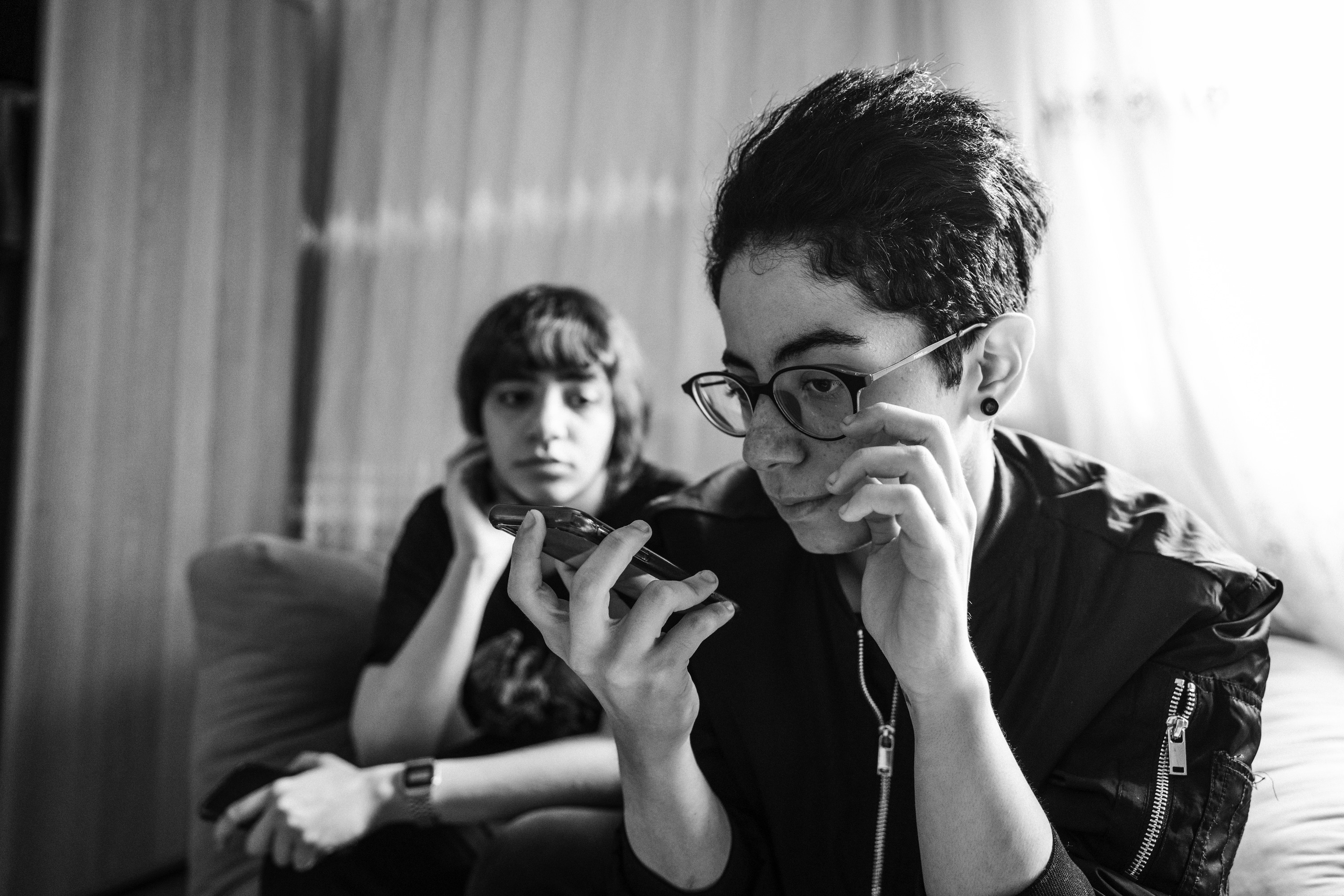
Saudi sisters Dua and Dalal AlShowaiki on a call with human rights organizations, pleading for their case to move along. (Daniel Vergara for VICE News)

The AlShowaiki sisters’ father, meanwhile, denies all allegations of abuse and forced marriage, and says he doesn’t know why his daughters fled. But the sisters say they couldn’t do simple things when they were younger, like watch TV or play outside, and they had to be fully covered. When they talk about their childhood, they physically cringe at the memories.

“I was maybe 9 or 11 years old. They had me wear a hijab, a niqab, and even an abaya. There’s something called an abaya that covers you from the head down,” Dalal said. “I never lived my normal childhood, being able to go out and play.”

“I wake up every couple of hours to check the windows and check on my cell phone”

Now, more than two months since their escape, the sisters are still in hiding in Istanbul, spending nearly 24 hours a day in a secret location. Their story, meanwhile, has spread across the world, highlighting the oppressive life that Saudi women and girls can face. Guardianship laws have historically required women to receive permission from a male guardian to travel, marry, work, or in many cases, just leave the house.

According to Dua and Dalal, Turkish authorities have said their father and Saudi government officials are offering to pay people to find their location. The Saudi Consulate in Istanbul did not respond to VICE News’ requests for comment for this story. And their father denies these allegations, but Dua and Dalal are terrified. Throughout the night, Dua looks out her window checking for suspicious cars.

“I wake up every couple of hours to check the windows and check on my cell phone,” Dua said. “I’m always afraid. I’d tell Dalal, ‘Look at this car that just passed: Of course, our dad must be in it. There’s a big black SUV. Of course it must be someone from the [Saudi] embassy,’” referring to the same embassy where journalist Jamal Khashoggi was murdered last year.

“I would be asleep and I dream every night that my father came and entered the room and found us,” Dua said.

Dua and Dalal AlShowaiki
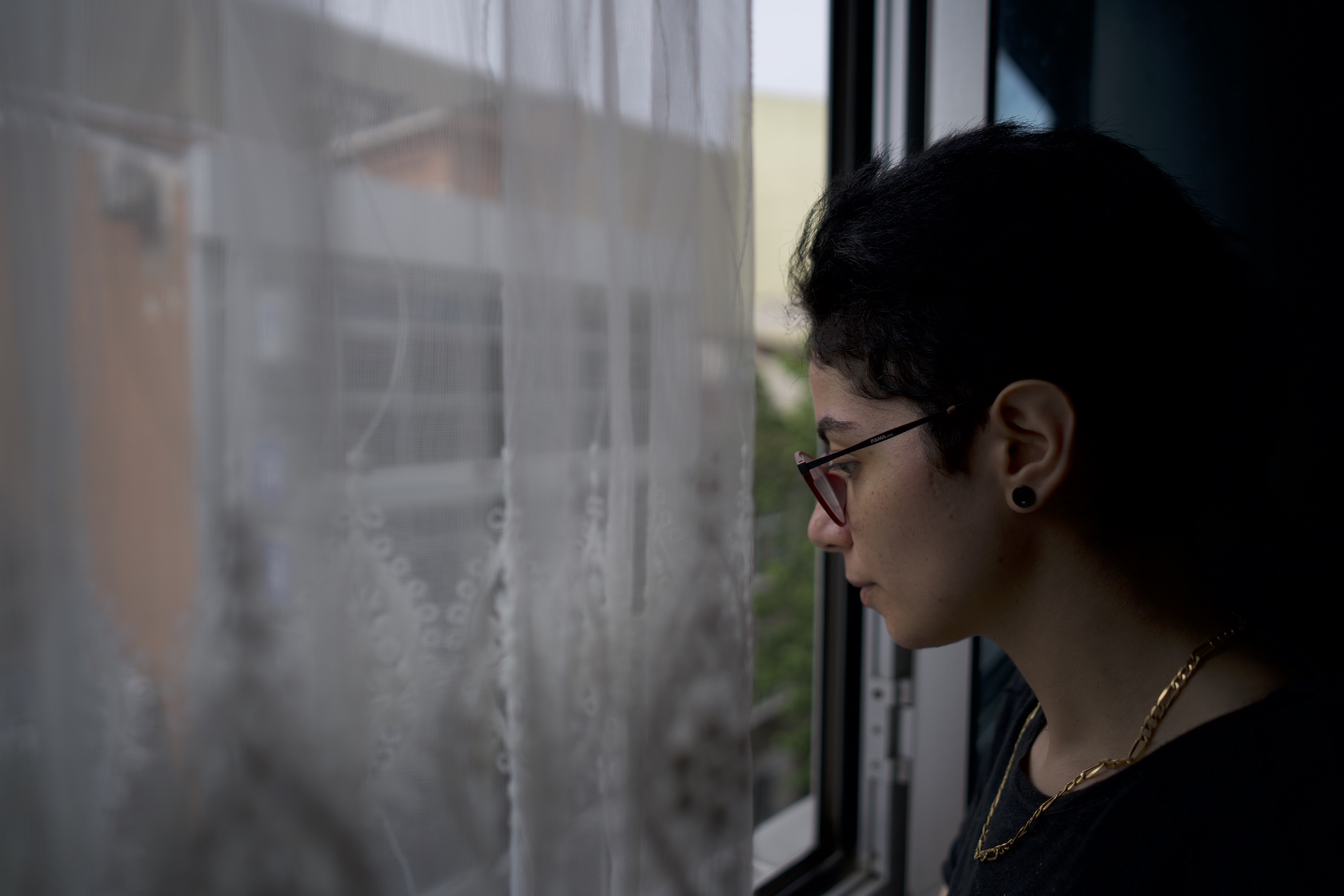
Dua AlShowaiki, who escaped from Saudi Arabia with her sister, looks out of the window, checking for suspicious cars. (Daniel Vergara for VICE News)

On Aug. 2, the Kingdom announced changes to the guardianship system that would allow anyone over 21, male or female, to apply for a passport and travel without the permission of a guardian. The announced changes also allow women to officially register births, deaths, and divorces. But how these new rules will be interpreted remains ambiguous until they’re put into practice later this fall. And some restrictions remain — namely that women will still need permission from their guardian to get married, one of the main causes for women running away in the first place.

While Saudi Crown Prince Mohammed bin Salman has purported to modernize parts of the Kingdom, by allowing women to drive and lifting the travel ban for women in addition to amending the guardianship system, he’s also escalated his campaign to track down and target dissidents abroad, something Dua and Dalal fear.

“What we have seen over the last 12 to 18 months is a crackdown on dissidents,” Dua and Dalal’s pro bono lawyer, Toby Cadman, told VICE News. “A crackdown on female activists. There are a number of high-profile female activists who have been thrown in jail. Many of them have been beaten, tortured. So to suggest that we are looking at a different era in the Kingdom of Saudi Arabia, if it wasn't so serious, it would be laughable.”

We’re talking about two young women who could be killed at any moment”

According to Human Rights Watch, women often flee due to domestic violence, political repression, and forced marriage, and that number is growing. Nearly 800 Saudis applied for asylum in 2018, up from just 195 in 2012, though UNHCR does not track how many of those individuals are women.

Dua and Dalal say none of their friends have escaped, but many women in Saudi dream of freedom.

“No girl in Saudi Arabia accepts this life that men are controlling them. A girl makes no decisions about her life, even a trivial one; a man controls that,” Dalal said. “I would never accept that for myself. I know that I have rights. For me, this is hell.”

Family members and friends have sent them messages on WhatsApp, Snapchat, and Twitter, telling them to go back to their home. When their father's second wife sent them a message, asking them to meet her in Egypt, where she lives, Dua and Dalal rolled their eyes.

“It’s bullshit,” Dalal said. “I’m not stupid,” her sister added.

Dua and Dalal AlShowaiki
Saudi sisters Dua and Dalal AlShowaiki have been hiding in Istanbul, while they await news of their resettlement to a new country. (Daniel Vergara for VICE News)

The sisters are in a race for resettlement against their father’s efforts to get them back, which they say includes the Saudi government.

“For me, I know that Saudi Arabia will try to send us back, 100%. That is for sure,” Dalal said.

They’re now registered with UNHCR and are under United Nations protection, but that does not include personal security or an official safe house. The Turkish Ministry of Interior granted them each an International Protection Applicant ID, so they’re not at risk of being deported. Cadman is trying to get them asylum in a third country, but they have yet to be resettled.

We’re talking about two young women who could be killed at any moment,” Cadman said. “And if they are… that will be on the conscience of the U.N., the Turkish authorities, and these countries for failing to respond to these pleas for help.”

“I’m so tired. I just want to be safe”

Dua and Dalal say every additional day they’re in Turkey is a day their life is at risk. They say if the Saudi Embassy or their family finds them, they won’t return to Saudi Arabia.

“I will kill myself. Before they kill me, I will kill myself,” Dua said. They’ve gone as far as planning how they would end their lives, believing the alternative is worse.

But, there are moments of levity. They dream of skateboarding outside of their bedroom, playing instruments without being punished, continuing their studies, and going to Eminem concerts. They obsess over their hairstyles and tease each other. When they talk about their dreams for the future, more than anything, they just want peace of mind.

“I’m so tired. I just want to be safe,” Dalal whispered.

Until then — despite the risks — they continue to remain vocal.

“If I die, or something happens to me, I will have left something,” Dalal said. “A presence, an image. I exist.”


from VICE https://ift.tt/2ZKG6M9
via cheap web hosting

Friday, August 30, 2019

'Doom' Programmer John Carmack Says Games Industry Doesn't Need Laws Against Crunch

Doom programmer and game industry legend John Carmack recently went on Joe Rogan’s podcast, a show downloaded by millions each month and a favored space for men to launder bad ideas. The pair talked about judo training, the future of virtual reality, the magnificence of space rockets (which Carmack has designed), and labor in the video game industry. Rogan asked about the long hours developers work to ship a game, often under brutal time constraints, which are known in the industry as "crunch."

Carmack acknowledged that people in the industry work very long hours, and that the long hours he's put into creating Doom and other games have made him rich. But ultimately, he doesn't believe game developers should be prevented from working long hours by law. Growing labor organization efforts in the games industry cite crunch as one of the main reasons developers need to unionize.

“There’s some serious debate about it. Some people despise that about the industry, that no one should work that hard,” Carmack said. “And there are people that think there literally should be laws that prevent people from working that hard. I always have to argue against that. There is a power to obsession and being able to obsess over something—your life’s work. Instead of work-life balance, it’s your life’s work.”

Earlier in the conversation, Carmack described how he works. He puts in 13-hour days and experiences a productivity drop off if he pushes it further. He feels guilty about working less than 60 hours a week. He also became a millionaire in his early 20s because he was a co-founder of id Software, not exactly the lived experience of most video game workers.

“Making games is really really hard,” Carmack said.

He pointed out that programmers fresh out of college who join up with Facebook or Google have nice perks. They work hard, sure, but they get to eat candy at work. They have benefits and job security. But work in the games industry is often punishing, and even he admitted “it doesn’t pay as well, there’s less job security, and they work you a lot harder.”

Big games like Red Dead Redemption 2 don’t ship without workers suffering through long, often mandatory, periods of extended hours called “crunch.” Carmack didn’t see much problem with that.

“It allows products to exist that wouldn’t otherwise exist by people working at that level in a way that couldn’t be sustained in other industries,” he said. “Many of the greatest things that were made in gaming were only possibly by people throwing themselves at that level at it.”

At certain points, Carmack acknowledged his privilege, and how much different his life has been.

“I always have to be aware that my view into the industry is colored by my experiences,” he said. “I never actually worked inside of the big EA or Activision studios. It’s possible that [their workers] have some valid criticism, but I still come down on … I think it’s great when they throw themselves at it, beyond the point that other people think is reasonable.”

And yet, there’s a growing movement in the games industry. Workers are organizing, talking about unions, and pushing back against abusive practices. Game Workers Unite is a grassroots organization that’s just starting to change the industry. The growing truth is that people don’t have to crunch to make games, and bosses shouldn’t require it of them.

“They [workers] have free will, they’ve chosen to do that, and if that’s what they think will get them closer to their goals, I’m not going to try to make that impossible for them,” Carmack said.


from VICE https://ift.tt/2MKdtgn
via cheap web hosting

This Late-Night Glove Salesman Masturbating Story Is Very Weird but Also True

This article originally appeared on VICE Canada.

It was 3 a.m. in Halifax, Nova Scotia, in the dead of winter—typical glove-wearing weather.

Andrew Blackbird had just finished a bartending shift and his wife, who was supposed to drive him home but had presumably fallen asleep, wasn’t answering his calls. Then his phone died. With all the cabs taken up, he started the 25-kilometer [15-mile] walk home.

It wasn’t long until a black SUV rolled up alongside him and a man who looked like Max Headroom asked if he wanted a ride. Desperate and freezing, Blackbird accepted. After Blackbird turned down the man’s request to “party,” the night took a disturbing turn.

According to Blackbird, the man told him, “Drive my jeep and wear my gloves."

Blackbird had no idea how often this strange request has been made to stranded Halifax men after a long night. He just thought it was one of those “weird random freak things.” In fact, it wasn’t until Blackbird saw an incredibly popular Reddit post (which eventually got turned into a podcast and a CBC story) describing an eerily similar experience that he learned the truth: there was an urban legend of a man who scouted the streets of Halifax looking for desperate men to try on his gloves.

1567142589458-leathergloves-smelling
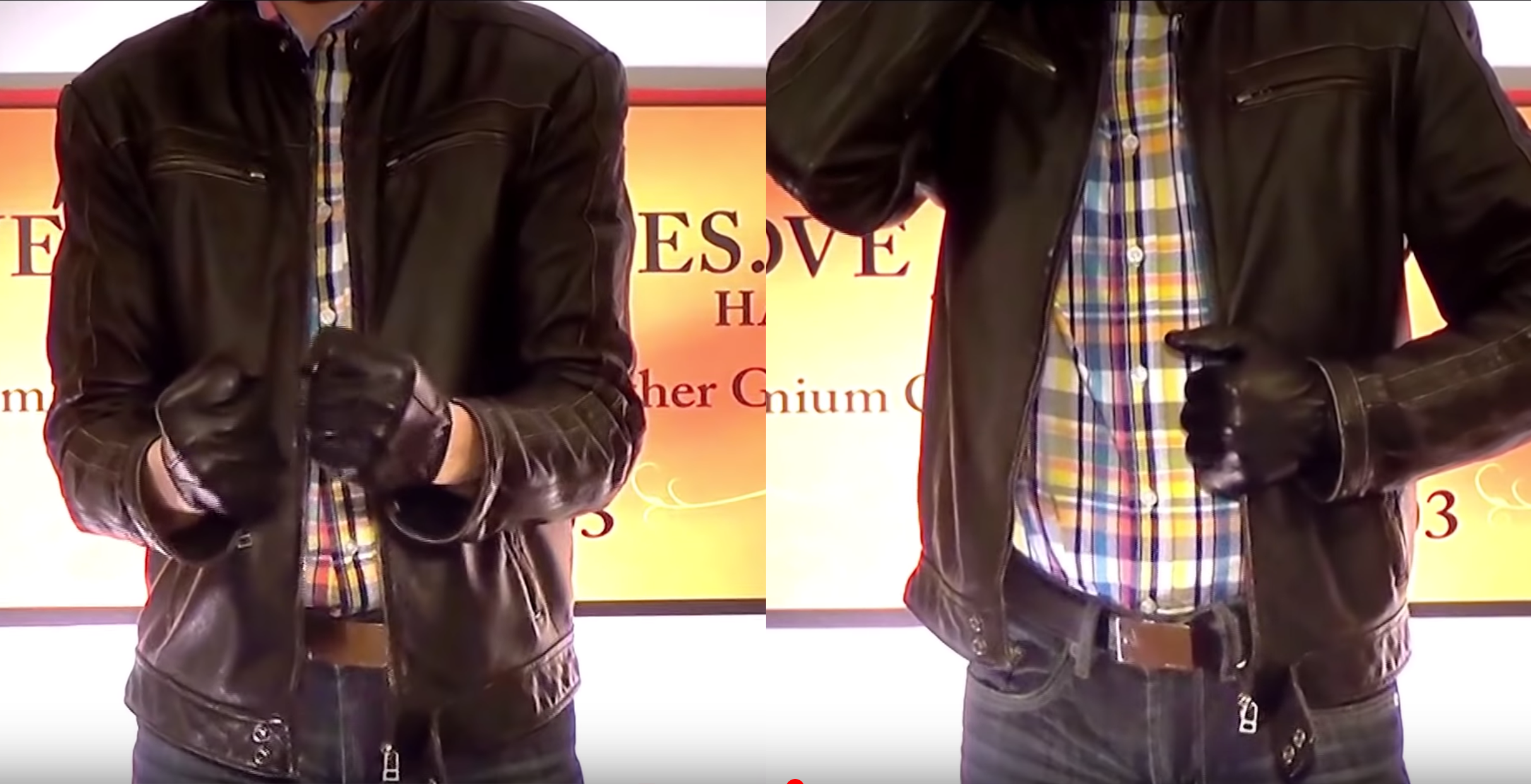
Two images from a YouTube channel connected to the Glove Guy. The video is entitled "Leather Glove Fetish" and shows a man making fists while wearing leather gloves and then sniffing them.

“He gives me a pair of leather gloves which are extremely tight to fit on my hands… He then prompts me to pull the glove right on and thread my fingers together to stretch it on properly, and shows me how to stretch the glove by pulling on it and making a fist,” says the 2017 post, the all-time most popular on the Halifax subreddit. “I turn back to the guy and he has a ‘better fitting’ pair of gloves for me to try on. This time it becomes extremely obvious that he has a fetish for young men wearing leather gloves and this is how he gets off.”

According to several comments (the post has 683 of them), Glove Guy cruises the streets in a black SUV after the bars close, picking up young, often drunk, men, and offering them rides home. Along the way, he gives them a business card and has them try on pairs of excruciatingly tight gloves, assuring them it's for his glove-sales business, “Love the Gloves.”

While many of his alleged actions are in dispute, one thing is clear: Glove Guy is real.

Blackbird acquiesced to Glove Guy’s requests and got behind the wheel. The two of them drove up and down the same patch of road while Blackbird tried on a selection of tight-fitting gloves—gloves he admitted were “really well-made.” Like the Reddit poster, Glove Guy had Blackbird make a “fist a few times to work them in.”

"The whole time I was doing that he's, like, looking at me and, like, fucking rubbing his leg and shit. He's like, 'How do they feel? How do they feel?' and breathing really hard," Blackbird told VICE.

"In my head I was like, 'Jesus Christ,' but I just told him, 'They feel good.'"

There have been enough glove-foisting incidents for the authorities to get involved: Halifax police have received reports and information regarding “a man offering rides to male pedestrians and asking them to try on gloves,” Cst. John MacLeod said in an email to VICE.

One case even resulted in a police charge. Shawn DeWolfe told VICE he was picked up by Glove Guy in 2016. He says that while he was made to try on several pairs of gloves, Glove Guy started to masturbate in the driver's seat. DeWolfe says he fled the vehicle as quickly as possible.

Most people “just think it’s funny,” DeWolfe previously told the CBC. "[But] for other men who had more serious encounters, I just believe that they're too embarrassed or too afraid to maybe even come out and talk because they're afraid that what other people might think of them."

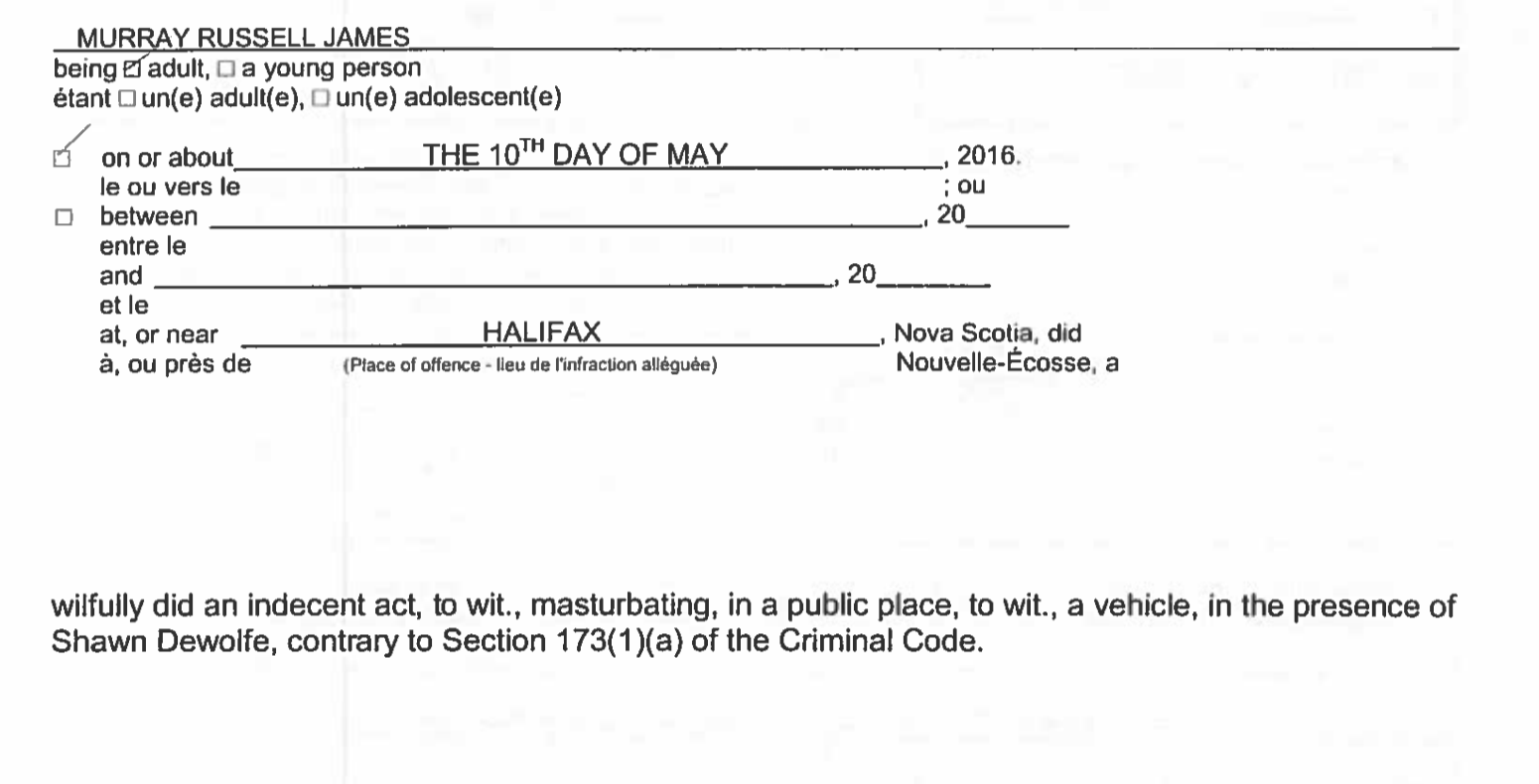
DeWolfe reported the incident, and in May 2016, officers charged Murray Russell James, 50 years old at the time, with one count of committing an indecent act. James pleaded guilty and in January 2017 received a 30-day conditional sentence. According to court documents, he was ordered not to leave his home from 6 p.m. to 6 a.m. He was also given a $100 fine and told to have no contact with DeWolfe. James told the CBC he denied masturbating next to DeWolfe and only pleaded guilty to avoid a harsher punishment.

1567171647136-courdocs
A portion of the court documents regarding James masturbating.

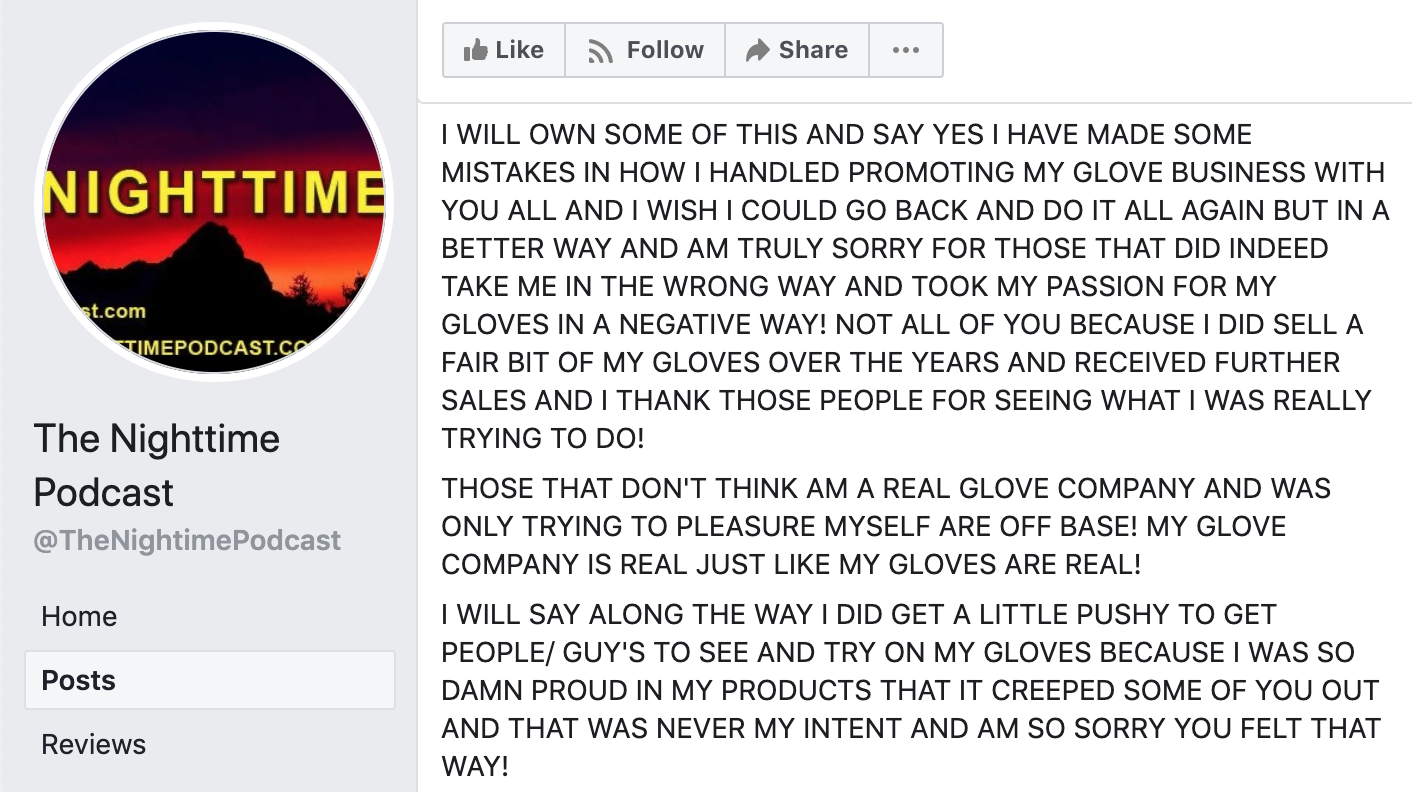
In a Facebook post dated August 1, he wrote that his "biggest mistake" was trying to promote his "glove business between the hours of 2 a.m. and 4 a.m." and "providing those with my business card first then showing them my awesome ultrathins [gloves] next." James denied any "inappropriate behavior" to the CBC, but did admit that sometimes he would offer drives at night.

The post continues: "I will say along the way I did get a little pushy to get people/ guy's [sic] to see and try on my gloves because I was so damn proud [of] my products that it creeped some of you out and that was never my intent and am so sorry you felt that way!"

Recently, in a separate incident, James was charged with impaired driving and suspended from driving for 90 days. According to Halifax police, he was arrested on July 29 at 2:30 a.m. on Carmichael St., a street off the city's main bar drag, and was alone at the time. In an email to VICE, James denied this was him, but Halifax police confirmed it was the same Murray James who pleaded guilty in 2016.

James told VICE in another email that the rumors spread by Reddit and the CBC were "fake news,” and he was "not interested in getting involved in most of these lies.” He added, "I would ask you to leave me alone or I will be sueing [sic] you for fake news!"

In another email, James said, “Mark my words you don’t want to fuck with me! I will come after you in every way possible.” He ended the correspondence by emailing the VICE reporter's headshot back to him.

1567142880812-lovethegloves-website
The homepage of the Love the Gloves website. The website is only accessible through the internet archive.

But that's only part of the story. To get the whole picture, which somehow involves allegations of cybersquatting, we first have to take to—yeah, you guessed it—a podcast. Jordan Bonaparte, the host of the true crimes Nighttime Podcast, decided to investigate the legend of Glove Guy after seeing the many Reddit posts. He interviewed four men with Glove Guy tales for two podcast episodes that aired in May 2019.

As one man explained on the show, “The first thing he does after I buckled my seatbelt is open the glove compartment, at which point, God knows how many pairs of gloves spilled onto my lap... and he almost frantically starts requesting that I start trying them on.”

Soon after the interview is aired, James registered "The Nighttime Podcast" as his own business with the Nova Scotia Registry of Joint Stock Companies (NS RJSC). He also purchased a website URL and created a Facebook page with a near-identical name to Bonaparte’s website and podcast (James added "The"). In his email exchange with VICE, James said he would "make it worse on Jordan [Bonaparte]” if the story was published.

In an all-caps Facebook post on The Nighttime Podcast Facebook page, James expressed his displeasure with Bonaparte and stated that there are “two sides" to every story. He admitted to picking up the men and having them try on the gloves but was adamant it was a marketing ploy.

1567142928313-Screen-Shot-2019-08-29-at-54612-PM
Screenshot from the Aug. 4 post.

A large part of James’ glove-related activities are tied to Love the Gloves. VICE could not authenticate if the company is still operational, but it does have a YouTube channel and previously had a website (it’s still accessible by the Wayback Machine).

One YouTube video, "Leather Driving Gloves," shows a man trying on several pairs of very tight leather gloves standing in front of the company banner. It goes on for seven minutes and not a word is spoken. VICE sent images of the man in the video to Blackbird, who confirmed it was the same guy who picked him up.

Another video, called “Leather Glove Fetish,” shows the torso of a man putting on gloves, making fists, and sniffing the leather. Bonaparte declined to comment to VICE for this story. But in an interview with the CBC, Bonaparte said he still retains ownership of his podcast since it is a trademarked product, and the business operates under his personal name. However, he is frustrated that the NS RJSC allowed the business name to be registered without doing research or requiring proof of the applicant’s ownership.

Bonaparte told the CBC he thinks the registrations were done to "squat on [his] work" as a form of retaliation for his podcast.

1567142952770-Screen-Shot-2019-08-29-at-23639-PM
A page from the Love the Gloves website. The website is only accessible through the internet archive.

DeWolfe told VICE he was contacted by James on social media and also threatened, even after the court order. According to DeWolfe, police told him to block James on social media and let them know if he attempted to contact him again.

MacLeod stated that each report is taken seriously and criminal activity should always be reported to local authorities. “We appreciate that this behavior may be disconcerting, and encourage anyone who has been approached in this manner to contact police so we can investigate the matter,” MacLeod said.

As to where the tale of the Glove Guy ends, well, it’s an ongoing saga. It’s unknown if the man is still out there picking up men and asking them to try on his “very well-made” gloves, but the idea of Glove Guy is no longer just a legend that drunk Maritimers tell in a south Halifax bar.

Blackbird sums up his Glove Guy encounter as a strange, uncomfortable experience. “Really, besides the unsettling feeling, he didn't do anything. I didn't really feel threatened," Blackbird said.

“I like to joke about the situation but I imagine if it happened to an 18-year-old college student it would be quite traumatic."

Sign up for our newsletter to get the best of VICE delivered to your inbox daily.

Follow Mack and MJ on Twitter.


from VICE https://ift.tt/2PpLK6z
via cheap web hosting

Google Contractors Are Unionizing With a Steel Workers Union

Contract workers at Google’s office in Philadelphia have just announced their intention to unionize.

66 percent of the eligible contractors at a company called HCL America Inc., signed cards seeking union representation, according to the United Steel Workers union. With the help of the Pittsburgh Association of Technical Professions (PATP), they’re asking the National Labor Relations Board (NLRB) for a vote on union representation. The PATP is a project sponsored by the union aimed at "helping Pittsburgh and Southwestern Pennsylvania workers in high-tech fields organize and bargain collectively.”

“Workers at HCL deserve far more than they have received in terms of compensation, transparency and consideration, and it has gone on like this for much too long,” HCL worker Renata Nelson said in a press release. “While on-site management tries to do what they can, where they can, their hands are often tied by arbitrary corporate policy.”

The vote for union representation is an important step, necessary to empower a union to exclusively represent employees and negotiate on their behalf for a collective bargaining agreement. The move also represents an important step in the small but growing movement to unionize Silicon Valley’s workforce. The press release explains that HCL's 90 employees "work side-by-side with those of the giant corporation for far less compensation and few, if any, of the perks."

This is the norm for members of Google's "shadow work force," an army of temps and contractors that outnumber Google's full-time workforce. Earlier this year, organizers of the Google employee walkouts released a statement supporting striking Uber and Lyft drivers, who are not technically employees of those companies and thus receive few benefits. In it, they critiqued of Google’s own classifications for “temps, vendors, or contractors" allowed the company to "abdicate its responsibility to the majority of its workforce."

In some instances, contractors do the same work as employees but are paid less and get fewer benefits. In other scenarios, the contractors are doing “ghost work” because they’re erased entirely as their labor is presented as the product of “artificial intelligence.”

From here, the workers and the union have to wait for the NLRB to determine if the cards and signatures collected qualify and then schedule a representation election. In that election, individual workers will vote for or against being represented by the union.

Google and the United Steelworkers Union did not immediately respond to a request for comment.


from VICE https://ift.tt/2ZEDDH6
via cheap web hosting

Facebook’s Open Source Community Is Reckoning With Toxicity and Harassment

Last week’s React Rally was set to be a highlight of the year for developers who use ReactJS, an open-source front-end framework developed by Facebook that powers much of the web (including Vice.com). But while the conference was going on, a broader conversation about the React community’s toxic and abusive behavior toward women, minorities, and other underrepresented groups in tech was playing out.

Like other open-source communities, ReactJS is now reckoning with how it treats traditionally underrepresented groups in tech. The flashpoint, in this case, were two separate conversations that converged into what’s now being called #Reactgate. One conversation was spurred by a series of tweets by high-profile members of the community, and the other by a talk about how the community must support women, people of color, and gender nonbinary people.

Last week, Heydon Pickering, a designer with a relatively large online following, sent a tweet comparing React to Vue, another framework, insinuating that React developers were into weightlifting, guns, and Donald Trump.

Quickly, Dan Abramov, a developer at Facebook, responded by defending the framework’s user base. Ken Wheeler, a developer who often gives speeches on the React conference circuit tweeted: “Imagine the kind of thought process that paints strength training as a bad thing and then projects a bunch of other unrelated shit onto it, while tying all of this to the use of a specific JavaScript view library,” he wrote, with a crying-laughing emoji for emphasis.

From there, a wider debate happened. Wheeler was already a relatively well-known figure among a certain cohort of coders. Wheeler caused controversy last year when he flashed the “OK” hand symbol, which had become associated online with white supremacy, at the 2018 React Rally as part of his presentation, while staging a large-scale performance of the “circle game.” The conversation about the ReactJS community, and Wheeler’s talk, resurfaced again this week.

Wheeler, for his part, has vehemently denied any accusations that he willingly and knowingly invoked a white power symbol. “So here I am, America enthusiast, jacked up type dude with a shaved head, and I can see how you could get the wrong idea here. But I assure you. At the time, I thought we were just having fun with a game that we played our entire lives, not doing some kind of dogwhistle,” he tweeted as part of a longer thread.

“I had never heard of this being an alt right thing,” he said via Twitter DM, “And I’m sorry if it was.”

But even before Pickering’s tweet, some in the front-end development community had already experienced online harassment and abuse. Earlier on the week of August 19, at the systems design-focused Clarity Conf, designer and art director Tatiana Mac gave a talk about the ways in which systems of oppression can replicate in systems design paradigms. After images of her presentation were made public, some Twitter users, including self-proclaimed “React bros,” began questioning the presentation’s relevance to tech: “Most definitely wasn't a tech conference. I don't see anything about React of [sic] WASM (WebAssembly) on the screen. Looks to be some kind of SJW conference,” one tweet read.

It didn’t take long for the two React-centric debates to converge. Critiques and defenses of Mac’s speech were bandied back and forth on Twitter and Reddit, and she started receiving a torrent of vitriol. Not long after that, both Wheeler and Facebook’s Abramov deactivated their Twitter accounts. Wheeler, in his messages with Motherboard, claims that he deactivated his account “both to deplatform [right wing trolls], and to take a breather.” When he returned to Twitter shortly thereafter, he issued an apology, both for his behavior and for any hatred on behalf of his followers that he might have directed towards Mac. Abramov, too, rejoined Twitter: “Hateful rhetoric has no place in the React community,” he tweeted.

"I receive (and continue to receive) hundreds of messages from people who want me to stop talking about this ‘social justice warrior shit’ and to remove the human side of tech"

But the rhetoric has taken a toll and has opened up a much-needed conversation in the community. Mac said she is stepping away from tech after fulfilling upcoming speaking obligations through 2020: “Your actions/inactions have spoken. Enjoy an industry without me,” she tweeted.

Mac, in DMs with Motherboard, said that the React developers she's worked with directly have been "absolutely lovely to work with," but that the broader community has often erased the contributions of women and people of color: "we're constantly thinking of the face of React developers, which is white dudes," she said.

Mac outlined why she believes the React ecosystem has a tendency to attract an abrasive, bro-heavy culture, one that eventually forced her exit from the community: “I receive (and continue to receive) hundreds of messages from people who want me to stop talking about this ‘social justice warrior shit’ and to remove the human side of tech,” she wrote. “The 'move fast and break things' mentality [of Facebook] has trickled down to React, where they built this framework that gained popularity very quickly and they never went back to build some key foundational elements (like a specific code of conduct) to systemically address things like abuse.”

Mac explained that system design communities, like those who work on the Sass framework, have been able to create less abusive communities by, in part, putting non-white, non-male leaders at their center. “Jina [Anne, Sass core team designer], for example, manages the Design Systems slack,” Mac wrote. “She does an extraordinary job monitoring and enforcing the code of conduct fastidiously.”

Mac said the community should focus on the impact of toxic behavior (including Wheeler’s hand gesture last year), not necessarily the intent. “The impact is that that hand gesture causes irreparable harm to communities of colour especially, who must use that as an identification for white supremacists,” she wrote. “Using it, regardless of intent (knowingly or unknowingly using it as a white supremacist symbol) causes immense fright within me—THAT is the impact (intentional or unintentional).” She is taking a step back from tech, she said, because “the abuse is unsustainable right now.”

Mac said the React core team that develops the language should “take crafting a code of conduct seriously, and enforce it diligently. The work is in the enforcement.”

Before Friday, React’s Code of Conduct redirected to an old version of the Facebook Code of Conduct, which was vague—“Be considerate,” “Be respectful”—and was relatively hard to find on the main React site. On Thursday night, Facebook engineers updated the Facebook Code of Conduct to reflect the Contributor Covenant, a set of guidelines for open source contributions created by technologist Coraline Ada Ehmke, aimed at protecting and promoting an inclusive environment).

When reached for comment, Abramov directed Motherboard to Alexandru Voica, a Communications Manager for the Engineering team at Facebook. Voica outlined three-pronged strategy React will be putting in place to address issues within the community: a new code of conduct, shaped by the Contributor Covenant, a reporting structure for abuses within the community, whether they occur online or at meetups, and “specific activities aimed at promoting diversity and inclusion within the React communities.”

But Mac said the damage has been done: “It feels to hurtful to give—and to love upon—to an industry that is showing me so much hate,” Mac said.


from VICE https://ift.tt/2ZDihpC
via cheap web hosting