Tuesday, September 3, 2019

Prince's Autobiography 'The Beautiful Ones' Has a Heartbreaking Story Behind It

When Prince died in April 2016, he seemed to have a lot of creative energy left in him. He was recording new music and was still mentoring younger artists. He was excited about a new way of performing he’d developed, playing shows with just a piano and a microphone, and he was preparing to write a memoir called The Beautiful Ones, looking back on the remarkable life he'd lived. Losing him was sad not just because of his extraordinary body of work, but because his story was still unfolding. This week's issue of The New Yorker offers a closer look into that period of Prince's life with a beautiful and sad story by Dan Piepenbring, the co-writer of that autobiography, which is set to come out in October.

Piepenbring starts with a bit of backstory on how he got involved with Prince's plan to write a memoir in the first place. It was, like all things Prince, idiosyncratic. A literary agency apparently sent Prince a list of potential writers, and the only two he was interested in working with were the ones who’d never written books before, though they were intimately familiar with his music. So he had Piepenbring and another writer send him personal statements about what his work meant to them.

Prince flew Piepenbring out to Paisley Park a day after receiving his statement. They felt a connection in that initial meeting and talked about Prince's aims for his book. “I want something that’s passed around from friend to friend, like—do you know [the Richard Linklater film] Waking Life?” Prince said. “You don’t show that to all your friends, just the ones who can hang.” They talked about racism and the importance of owning the rights to your artistic work.The next day, Prince invited him to a private screening at a local cinema. They watched Kung Fu Panda 3.

The three months between the time they met and Prince’s death seemed both heavy and wonderfully strange. Piepenbring says he was never formally offered the gig writing the book, but they soon started the work. "Many Prince associates have a similar story: they were never officially hired," he wrote. "Prince simply told them to show up again, and they did."

Throughout the story, Piepenbring paints Prince as funny, loving, and sly. It was the two of them against the publisher, Piepenbring writes, united to make a weird and cool book. But then Prince passed unexpectedly. Piepenbring says it was hard to wrap his head around the loss, at least at first. "It was hard to reconcile the sunny, puckish, solicitous man I met with the one described in news stories and police reports, who could be unyielding, furtive, and willfully opaque," he wrote. "Prince had always embodied dualities. Here was one more: he had told me that he was O.K., and he was not O.K."

It's worth reading Piepenbring's whole piece. It's a loving look an artist who kept the media and the broader public at a distance for much of his life. It's easy to look at his work and see that Prince was a special person, but there are still precious few stories that show what it was like to actually spend time with him.


from VICE https://ift.tt/2HFMhuS
via cheap web hosting

It’s Now or Never for Gun Control in Congress

Want the best of VICE News straight to your inbox? Sign up here.

WASHINGTON — Congress heads back to work in the wake of yet another mass shooting, this time with at least seven dead and 22 wounded, including a toddler shot in the face in Odessa, Texas.

While there have been lengthy discussions between the White House and various senators about potential gun control legislation since the twin tragedies in El Paso and Dayton one month ago, no one, including President Trump’s own allies, seem sure whether he really wants to get anything done.

Without his support, bills to tighten background checks and help states with red-flag laws or “extreme risk protection orders” to keep guns out of the hands of unstable people, are dead on arrival.

“This is a simple question. Is President Trump willing to endorse a background check proposal that the NRA opposes?” Sen. Chris Murphy (D-Conn.), who is leading the push on universal background checks, told VICE News last week. “If the president doesn’t put his imprimatur on a specific proposal then there’s no way to get Senate Republicans in any significant number.”

The House Judiciary Committee will return Wednesday to begin work on a trio of gun control bills after the August recess, while the Senate returns next week to tackle its own legislation focusing on background checks and red-flag laws.

What Trump believes

Trump made it clear that the Odessa shooting hadn’t changed his thinking on guns.

“We’re looking at the same things. This really hasn’t changed anything. We’re doing a package,” Trump told reporters on Sunday. “A lot of people are talking about it and that’s irrespective of what happened yesterday in Texas.”

And he poured cold water on the idea that tightening background check restrictions would help the situation, while blaming a struggling mental health system — a favorite fallback for the NRA.

“Background checks — I will say that for the most part, sadly, if you look at the last four or five, going back even five or six or seven years — for the most part, as strong as you make your background checks, they would not have stopped any of it. So it's a big problem. It's a mental problem. It's a big problem."

READ: The Odessa shooter was fired from his trucking job just hours before rampage

Senate Majority Leader Mitch McConnell (R-Ky.) has suggested a willingness to consider new gun legislation — but made clear it would be on the president to lead the effort.

McConnell said Tuesday that the Trump administration “is in the process of studying what they're prepared to support, if anything,” and that he expects to know what their plans will be next week.

“If the president is in favor of a number of things that he has discussed openly and publicly and I know that if we pass it, it will become law, I'll put it on the floor,” he said on Hugh Hewitt’s radio show.

Trump promised shortly after the El Paso and Dayton mass massacres to push for universal background check legislation. “I’m looking to do background checks,” Trump said on August 7. “I think we can bring up background checks like we’ve never had before.”

But less than two weeks later and after talking with senior NRA officials, he was back to parroting the NRA’s talking points on the massacres, claiming “We already have strong background checks” and warning that new gun control measures were a “slippery slope.”

Background checks

While nine in ten Americans back universal background checks in most recent polling of the issue, most of Trump’s most vocal base voters still oppose any new gun control laws.

Former Sen. Mark Kirk (R-Ill.), one of only four Republican senators who voted for background check legislation the last time it came up in Congress in 2013, said that there was a small chance that background checks and red-flag laws could pass, but it depends entirely on Trump.

“It would require a sustained focus, which is not a core competency of the president.”

“It would require a sustained focus, which is not a core competency of the president,” Kirk said late last week.

Trump made a series of calls to senators involved in the pair of gun control bills a little over a week ago, talking to Sens. Murphy, Pat Toomey (R-Pa.) and Joe Manchin (D-W.Va.) about background checks and chatting with Sen. Richard Blumenthal (D-Conn.) and his close ally, Sen. Lindsey Graham (R-S.C.), about the bipartisan legislation they’re working towards to provide state grants for red-flag efforts.

READ: Harry Reid: 'Of course' Medicare for All and Decriminalizing the border are dumb ideas

“There have been ongoing contacts and conversations with the White House, more so by Sen. Graham than myself, but I’ve spoken to some of the top White House staff and members of my staff have been at meetings at the White House this week,” Blumenthal told VICE News last Wednesday. “At this point we’re still unsure what the White House’s position is on a number of issues but we’re working together to resolve whatever issues remain.”

Senate red flag bill

Blumenthal said he expects he and Graham will finalize language and introduce a bill soon after senators return to Washington on Sept. 9 that would provide grants to states which pass red flag laws to help law enforcement identify people who might be gearing up to commit mass violence and confiscate their guns.

The red flag bill is likely an easier lift than background checks — the NRA doesn’t explicitly oppose red flag laws, though they’ve resisted more aggressive versions in the past. The Graham-Blumenthal bill would offer grants to state law enforcement to help them partner with mental health professionals and identify potential unstable and violent actors before they act, while giving people a chance for due process if they’re deemed dangerous.

Trump has shown a willingness to back small-bore gun legislation in the past — he signed a bipartisan “Fix NICS” bill coauthored by Murphy into law that strengthened reporting requirements to the FBI’s national background check database.

But plenty of loopholes remain. Current law requires most gun purchases to clear background check screenings to make sure the buyers are allowed to have a gun — but that doesn’t apply to firearms sold online, at gun shows or given from one family member to another. While the exact legislation is still being worked out, Murphy, Toomey and Manchin are looking to close the gun show and internet loopholes.

Parkland redux?

Lawmakers fret that a different history may repeat itself, however. After the Parkland, Fla. school shooting in early 2018, Trump talked up muscular background check legislation only to back off and pivot to talk of “hardening” schools with armed teachers and guards after talking to NRA leaders.

But the NRA isn’t what it once was. The organization is facing a bevy of lawsuits and an exodus from its executive board amidst ongoing infighting that has sapped its financial resources as well as its ability to mount an effective push against any new gun control legislation. Wayne Lapierre, the head of the NRA, stands accused of trying to use the organization’s resources to buy himself a mansion, while the NRA has fired its longtime lawyers and is locked in a lawsuit against the media firm that created the now-defunct NRATV.

READ: Democrats just got another path to Senate control — through Georgia

“If I’m a Republican senator or a Republican thinking about 2020 in general: What do women expect me to do on this issue, what do young voters want me to do on this issue, and how bad is the dumpster fire over at NRA headquarters?” said Everytown for Gun Safety President John Feinblatt.

Everytown, backed by former New York City Mayor Michael Bloomberg, is already on the air with ads pressuring a handful of GOP senators on the issue, targeting McConnell as well as Sens. Marco Rubio (R-Fla.) and Rick Scott (R-Fla.). Feinblatt wouldn’t say how much the group will spend in 2020 targeting lawmakers who opposed gun control reforms, but promised to “hold people accountable, just as we did in the midterms.”

Cover: U.S. President Donald Trump speaks to the press upon arrival at the White House in Washington, DC, on September 1, 2019 after spending the weekend at the Camp David presidential retreat. (Photo: NICHOLAS KAMM/AFP/Getty Images)


from VICE https://ift.tt/2zXxBmR
via cheap web hosting

From Seth Cohen to the Hot Priest: A Cultural History of the Softboi

This article originally appeared on VICE UK.

You're in the kitchen at a party and you start talking to a guy. You don't look at him and think, I could die a thousand deaths in your eyes, but he pays you attention and laughs at your jokes and knows his Proust or his Palace, or whatever it is that's culturally important to you.

As you lean against the kitchen counter, some large and looming guy grabs your butt as they walk past. "Men are animals," he says, glaring at the perpetrator. You smile, and quietly clock the gesture. He gets it. He gets you. There's a connection. You go home separately. By the next morning he's following you on Instagram.

You meet for coffee, which becomes an early dinner, then drinks, and then, somehow, you're on your way home together. In the bedroom, he starts to exhibit some anxiety. He's not that kind of guy, he says, deftly peeling off your top. But he's rather taken with you, he whispers, getting into your bed. That night, there it is: the connection. Dawn breaks, but the anxiety is still there. You make him coffee but he says he has to go. He's got life stuff going on. An ex—you remember the ex? He "definitely" mentioned her—has been in touch. It's complicated. You smile and nod and ignore the knot in your stomach. But he'll definitely be in touch, sometime. "You're really something," he says, moving the pin on his Uber with the finger that was inside you an hour ago.

Two days later you get a long, elaborate, angst-ridden email. He hopes he didn't lead you on. He's just so confused. You're wicked. He's terrible. It's his loss! He's very, very sorry. You never hear from him again.

The man you've just encountered is called a softboi—or has been for the last three or four years. As archetypes go, the softboi has drifted somewhat of late, but I was reminded of him earlier this year when the show Fleabag came to a close with a bus stop, a martyred heart, and the priest who, over the course of six elegant episodes, gradually revealed himself to be a model softboi. Just swap "ex" for "God" and the yo-yo fuckery is the same.

The romantic landscape we find ourselves in right now is littered with these types. On any given Friday night you could encounter a fuckboy (fucks you, doesn't care); a fuccboi (trying so hard to be more than basic); an alt-lit bro (drinks small, expensive beers, likes Bon Iver, and Jonathan Franzen); a lumbersexual (wears plaid, spends time in woods); a spornosexual (sport + porn + metrosexual); or just about anyone else with a set of characteristics, habits, and failings common enough to be neatly packaged up into yet another person who will let you down and hurt you.

The softboi is really a younger cousin of the fuckboy, only less genuine, someone who weaponizes his ability to appropriate the right kind of emotional language and some thoughtful references to Sartre and Camus to get what he wants—which is you, into his bed, and then out of it.

He is not confined solely to house party kitchens, mediocre bars, BBC sitcoms, or dating apps. At times, it can feel as though he is everywhere and has been for a while now. He was there, for instance, in the warming, punch-the-air, aren't women amazing speech Louis CK gave in his HBO special way back in 2013, and in the subsequent sexual misconduct allegations lodged against him by five women, two of whom said he'd jerked off at them. The softboi was also there in the emotional fury of U.S. Supreme Court Judge Brett Kavanaugh last October, who, when cornered over sexual assault allegations, tearfully invoked the existence of his "close female friends," as if that had anything to do with the abhorrent behavior he was accused of exhibiting as a high school student.

The softboi is there, too, in the duplicitous response to #MeToo from figures like Prime Minister Boris Johnson, who went out of his way to write a comment piece lauding "this extraordinary feminist movement" less than a month after yet another tabloid infidelity scandal prefaced the news that he and his wife of 25 years were divorcing. Johnson is a man who often seems repulsed by the very notion of fidelity, yet the moral demands of public office force even him to adopt a gossamer-thin pose of contrition from time to time, rendering him a kind of fuckboy in softboi's clothing. Or maybe that's just what a softboi is, full stop; an alleged serial adulterer bigging up #MeToo, or a horny dude in liturgical garments crying because God won't let him have sex with you.

The softboi is a totem of the world we live in, in which emotional connections are easy to make, hard to bear and easy to break, in which PR is king and even bad, sometimes abusive men—not to mention governments and corporations—know they need to speak the emotional, inclusive language of the day in order to get away with what they do.

The performance of being a woke ally is a hallmark of the softboi. He gets it—he totally gets it. He just doesn't want to go from getting it intellectually to acting on it.

Last year, in the wake of the Harvey Weinstein revelations, the barrister and British GQ commentator Rupert Myers was the subject of a litany of complaints from an array of women. Myers took a hot minute to ponder them and then wrote an article for the Evening Standard, including reflections such as, "On one level I am grateful for how this event has forced me to ask questions about myself." To add another layer of insult, the headline—and one of the main thrusts of the article—focused on how hard it had been for him to deal with being called out. The softboi does not expect to have to actually answer for what he's done, or to be made to really look in the mirror. He is a good guy. The idea that he might not be is an affront.

The origins of the moniker itself are opaque. A lab technician from a small town in New York state claims she coined it in 2014, but "softboi" really entered popular culture in 2015, when American writer Alan Hanson wrote a piece on Medium called "Have you encountered the softboy?" A slice of poetic comedy, it went viral, outlining the guy who is "nice but complicated."

A while ago I asked Hanson—who is not a softboi—to explain the type of man he was writing about. "I think socially that archetype, or variations of it, wants mainly to broadcast self-awareness and sensitivity," he told me over email. In other words, real sensitivity is possible for the softboi, but that is incidental to the performance of it. There are worse men out there, but those worse men are beginning to realize that they too can deploy the emotional weaponry of the softboi.

Outside of politics and the media, popular culture has also done its bit to keep the softboi mode bubbling away at the surface. Softboy ancestors such as The OC's Seth Cohen and Joseph Gordon-Levitt in 500 Days of Summer have found their niche sensitivity weaponized in more recent and dubious incarnations that include narcissistic, pasta-making serial dater Aziz Ansari in Master of None; Johnny Flynn in Lovesick; and Kumail Nanjiani in The Big Sick. Every Ryan Gosling character ever was a softboi, as are many Benedict Cumberbatch ones. Even Joseph in The Little Drummer Girl turns into one in order to get Charlie into bed and then into Palestine (spoiler, it works).

And they continue to come thick and fast, with TV parcelling up a few more softbois-in-training: Asa Butterfield's character in Sex Education, James (Dylan Llewellyn) from Derry Girls, and Josh O'Connor's interpretation of Marius in Les Miserables, skulking around like a French Romeo. Let's not forget either James Bond battling modern masculinity. Prince Harry nesting. David Beckham now and then. Ryan Adams, as the softboi's darkest incarnation, and his ex musician Phoebe Bridgers, whose song "Motion Sickness" could be viewed as a descriptor of his tireless work toward the cause.

If the softboi archetype has been with us for a while, then the events of the last 18 months have pulled him into sharper focus. "Right now especially, a lot of men are trying very hard to show that they're tuned in—whether it be to progressive-leaning politics, trends in fashion and art, or even just going down on people," says Hanson. If misogynists like Trump are leading the free world, women are looking for the sort of liberal Obama embodied—the kind of guy who'd send the drones in, but would feel a bit bad about it.

Little wonder that Fleabag, who jerks off to an Obama speech about democracy, is suckered by the priest. "This so-called awareness can be used for evil," asserts Hanson. "I'm not saying every young man on the path to semi-wokeness is taking calculated, nefarious steps, but it's a nice sheep's fur to wear if doing so."

At this point, you're probably wondering if my focus on the softboi is born out of terrible personal experience. I have, I admit, encountered one. About five years ago, following a two-month "thing" with someone I'd known for a good decade, things ended with the requisite guilt-ridden email. It's funny now, but what was so glaringly galling is that it was all so obvious—I just didn't have the vocabulary; softboi is really a fun name for something that has existed for a long time. In writing his essay, Hanson simply named the beast.

American author Adelle Waldman agrees: "For too long, women haven't had a name for this kind of behavior. We've had little in our highbrow culture to offset these narratives by men in which their bad behavior toward women is valorized. I think these names fill a very real need."

And Waldman should know. Around the same time that Hanson wrote his seminal piece, she wrote a brilliant novel called The Love Affairs of Nathaniel P, told from the perspective of Nate, a 30-something Brooklyn novelist, intellectual and beta male, once invisible to women, now suddenly not and navigating this shift irresponsibly. "Treading on weakness is… what dating felt like," Waldman writes/Nate says. And yet, he forges ahead, in classic softboi fashion.

Of course, neither Nate P nor Ansari are the actual first softbois. As Waldman explains, the outward trappings of their behavior may change with the times, "but the fundamental tendencies are nothing new." She cites Willoughby from Jane Austen's 1811 novel Sense and Sensibility and "the Phillip Roth phase in which the misogyny remained but the hyper-masculinity was largely replaced by self-conscious intellect." When plain-speaking Felix Holt, in George Eliot's 1866 novel Felix Holt, the Radical, berates Esther for being "too into Byron," he is criticizing her for falling foul of that type: "[who] says the right things politically [but] is romantically unreliable."

There is, as Waldman explains, usually a victim in all of this. "Women are largely instruments to [the softboi], tools to prop up his self-esteem, rather than individuals with feelings as tender and as worthy of consideration as his own."

For a long time, I blamed myself for what happened that summer with my own softboi, but while one cannot exist without the other, exactly how complicit the woman is is up for debate. Luckily, there is a trend term for that, too—the moth girl, who bangs into the hot lamp again and again.

It might seem lazy or petty to pigeonhole men to this degree—#NotAllMen, right?—but as both Bogan and Waldman point out, women have been reduced to stereotypes their whole lives. There is no male equivalent for the word "slut," and no sentiment quite as cutting. There's a reason female softbois don’t exist: as Waldman says, this is a function of a heterosexual romantic arena in which "women are seen as desperate for boyfriends and men are admired for being free and single."

The hope is that in identifying the softboi, marking his tracks in this new and changing world, these traditional images of masculinity will shift. Flagging this dynamic can render the trend-boy— whatever the hot priest's Church might be—powerless. And that's why it's good that now, at least, the beast has been given a name.

Sign up for our newsletter to get the best of VICE delivered to your inbox daily.

Follow Morwenna Ferrier on Twitter.


from VICE https://ift.tt/2LBXM83
via cheap web hosting

Steve King Is Now Blaming Undocumented Immigrants for “Influencing” Elections

Embattled Iowa Rep. Steve King cited a 12-year-old study by a reported hate group to blame undocumented immigrants for “influencing” elections.

At a recent campaign event, the eight-term conservative Republican didn’t suggest that noncitizens are voting, but he did blame them for boosting the populations of — and as a result, the congressional seats allotted to — certain communities. Customs and Border Protection apprehends about 4,000 immigrants at the U.S.-Mexico border each day, he said, a figure he claimed adds up to two congressional seats a year.

“So you could have 50 congressional seats replaced and supplanted by noncitizen illegal aliens who have no lawful presence in the United States,” he said at a town hall in Audubon County.

“There was a study done in 2007 by FAIR — Federation for American Immigration Reform — they just estimated that there were six seats in California alone that wouldn’t exist if they didn’t have an illegal population,” he added, citing the controversial immigration restriction group founded by John Tanton. He also joked about the Chinese government force-feeding pork to Uighur Muslims at the same event.

King also recently claimed the human race would barely exist if not for rape and incest. “What if we went back through all the family trees and just pulled out anyone who was a product of rape or incest?” King told a crowd in August. “Would there be any population of the world left if we did that?”

King’s got quite a history of making racist sexist and otherwise controversial remarks, and he finally faced some repercussions in January, when he was stripped of his committee assignments after asking when “white nationalist” became an offensive term. Since then, he has largely been abandoned by the Republican Party.

The fact that undocumented immigrants and other noncitizens affect the number of congressional representatives given to states based on population was one of the excuses Republican politicians used to push for the addition of a citizenship question to the 2020 census, which the Trump administration recently tried to do.

Former Kansas Secretary of State Kris Kobach floated the idea of adding the question to the census before President Trump was even elected, and in a July 2017 email to Wilbur Ross — who by that point was the secretary of the Commerce Department, which oversees the Census Bureau — Kobach said the “problem” with the current census is that aliens who do not actually 'reside' in the United States are still counted for congressional reapportionment purposes.”

But that wasn’t the justification the Trump administration provided for putting the question on the census. Instead, the Commerce Department claimed that it needed the question to help the Department of Justice enforce the Voting Right Act — a rationale that the Supreme Court ruled was contrived.

Conservatives’ desire for a citizenship question on the census precedes Trump’s campaign, though: FAIR, which the Southern Poverty Law Center has deemed a hate group, has been trying to get it on the census since the 1980s.

Cover: U.S. Rep. Steve King, R-Iowa, speaks during a news conference, Friday, Aug. 23, 2019, in Des Moines, Iowa. (AP Photo/Charlie Neibergall)


from VICE https://ift.tt/2LmB6Iv
via cheap web hosting

Viral Video Shows Mouse Jumping Into a Whataburger Fryer

California has In-n-Out, and New York might have Shake Shack—but Texas has Whataburger, the burger chain that will always keep the Lone Star State's late night drunk eats going. Thanks to a video that surfaced on Facebook this weekend, however, some people might be thinking twice about their next midnight bacon and cheese Whataburger with fries.

This weekend, a Texas man named Brushawn Lewis went to a Whataburger location in the city of Bastrop, where he and others saw a mouse on the counter, which is bad enough as it is. "Alright y'all, whoever paid for their food will get their money back," says a Whataburger employee as the mouse runs on the counter next to the deep fryer, on top of trays and next to metal containers including one that seemingly holds onion rings. It gets worse.

In the video, a person behind the counter begins turning over the containers in an attempt to trap the mouse. But mice, as you might know if you've ever had one, are sneaky, and instead of being caught, the mouse takes a big, brave leap… straight into the deep fryer. Screams of "oh my god" and "deep-fried rat!" follow. The people behind the counter talk about trying to scoop out the mouse, but a Whataburger employee doesn't seem to know how to turn the fryer off.

Lewis's video has gone fully viral, having earned over 2 million views on Facebook, plus reposts on Twitter and various news publications. "The entire restaurant has since been cleaned and sanitized. We addressed this situation as quickly as possible, reinforcing procedures with our Family Members," Whataburger wrote in a statement, per KVUE. "While we’ll continue to be very diligent, it’s important to know there was no history of this type incident at this unit and there is no ongoing issue."

The Bastrop location was temporarily closed and pest control notified, according to the Dallas Morning News, but it has since re-opened. That's as good a reason as any to reconsider your fast food habit.


from VICE https://ift.tt/2ZKoiRE
via cheap web hosting

Review: Three Different Pairs of $30 Counterfeit AirPods

Motherboard Editor-in-chief Jason Koebler bought fake AirPods when he was in Shenzhen. Staff writer Caroline Haskins, who wrote AirPods Are a Tragedy, examined them.

I got a pair of AirPods as a Christmas gift. I’m not terribly proud of this fact. I believe that electronics should be repairable, easily recyclable, and last a long time. AirPods are none of those things, and also signal a type of disposable wealth and disconnect from the real world that is, at best, kind of annoying. I also really like my AirPods because they generally work well, because I can fall asleep in them while listening to ASMR videos without getting tangled in cords, and because they don’t get violently ripped out of my ears when I bump into a doorknob or whatever.

It’s been a while, I think, since a specific gadget made a large number of people Actively Mad. AirPods feel like the end result of Apple destroying the headphone jack and replacing it with something that kind of sort of works better but also costs $159, needs to be charged every few hours, and is easily lost. Can’t afford them? Well, I hope you like dongles. This is all to say that there’s been a backlash to AirPods even as lots of people have either embraced them or at least begrudgingly accepted them.

I don’t know whether counterfeit and knockoff AirPods say more about the people who love or hate AirPods and Apple, but on a trip earlier this year to Hong Kong and Shenzhen, I saw counterfeit AirPods everywhere. There was the relatively upscale AirPlus ($45), which came in a box that looked exactly like an AirPods box and was being sold at legit-seeming electronics stores, there were AirPod knockoffs called i9WS ($20) and LK-TE8 ($20), which were sold at pharmacies, kiosks, electronics markets, and street fairs, and there were actual counterfeit AirPods ($75), which were sold in boxes that said “AirPods.” Upon closer inspection, the text and photos on these boxes were a little blurry. These AirPods were not, in fact, “Designed by Apple in California.”

I bought three different pairs of counterfeit AirPods. Rather than try them out myself, I gave them to Motherboard staff writer Caroline Haskins to try out for a few weeks. Earlier this year, Caroline wrote the essay “AirPods Are a Tragedy,” an anthropological look at what AirPods mean. If normal AirPods are a symbol of late capitalism, what, exactly, are counterfeit AirPods?
-Jason Koebler

Introducing the Fake AirPod

AirPods are aggressively recognizable. This is good for Apple, because from a quick glance, a passerby can tell that a person owns AirPods and likely owns at least one accompanying Apple product, like an iPhone. AirPods instantly turn people into walking advertisements for the company.

This passerby can also know that a person paid about $160 to get the earpods. In this way, AirPods are similar to the Hollister and Abercrombie shirts that were popular in 2004. People who wore these shirts didn’t just become walking advertisements for Hollister and Abercrombie. They also projected a “cool kid” status because they could afford to wear clothes from the popular, brand-name company.

The great irony in fake AirPods is that they cost about $30, a fraction of the cost of real AirPods. But from a quick glance, they communicate wealth in the same way that regular AirPods do.

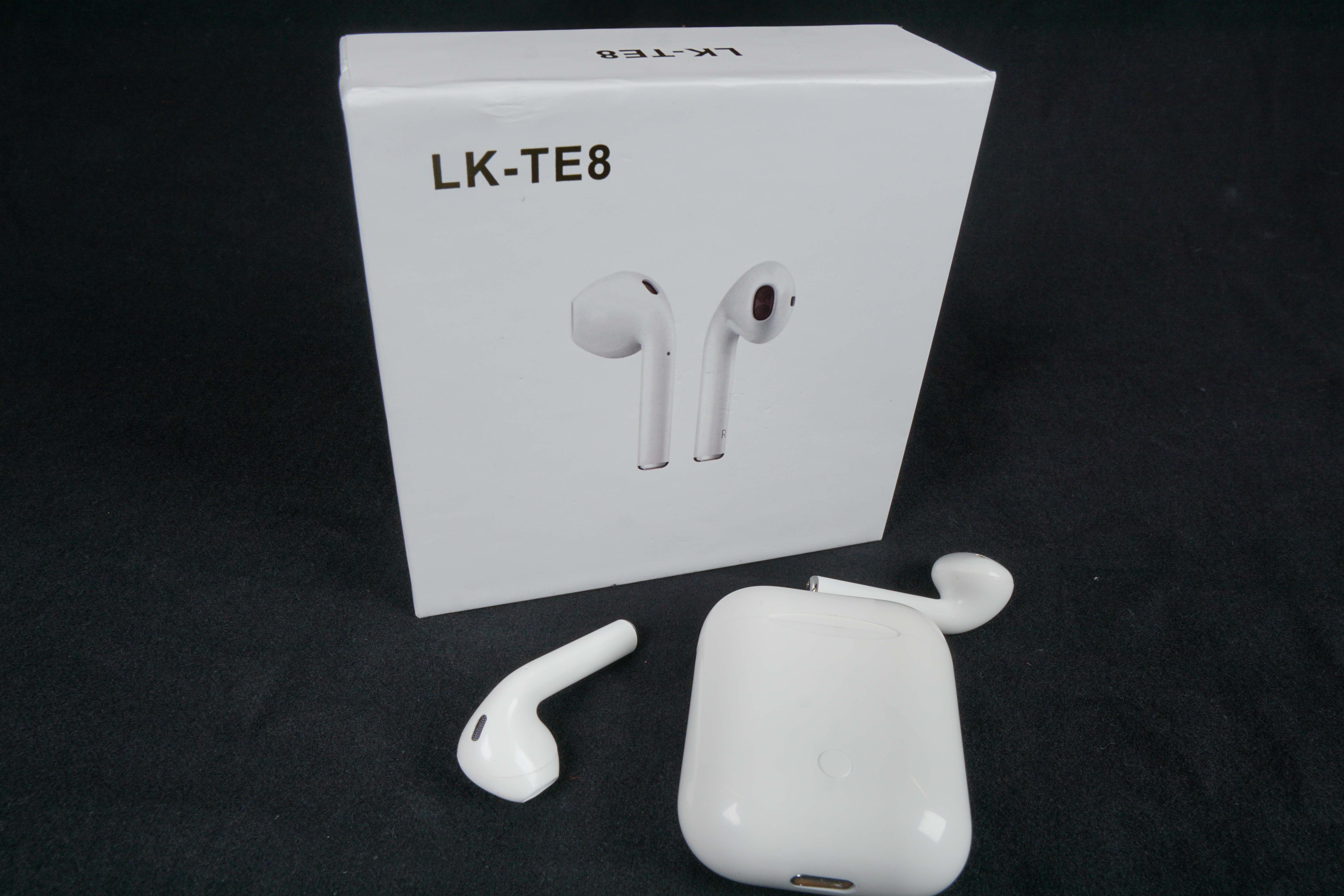
LK-TE8 fake AirPods.
Image: LK-TE8 fake AirPods and their charging case. It uses a USB-C charger.

But of course, they don’t work the same as regular AirPods. The charging cases on all three fake AirPods look extraordinarily similar, and in fact, two out of the three fake AirPods have Lightning charging ports, just like on a regular AirPods case. The LK-TE8 is the only exception and uses a USB-C charger.

There’s also some small differences. For instance, on a normal pair of AirPods, there’s a small LED light between the AirPods when you open the case that glows green, orange, or red depending on how charged it is. But with the fake AirPods, the LED light is located on the front of the charging case. All three cases glow either red or blue, but never green or orange.

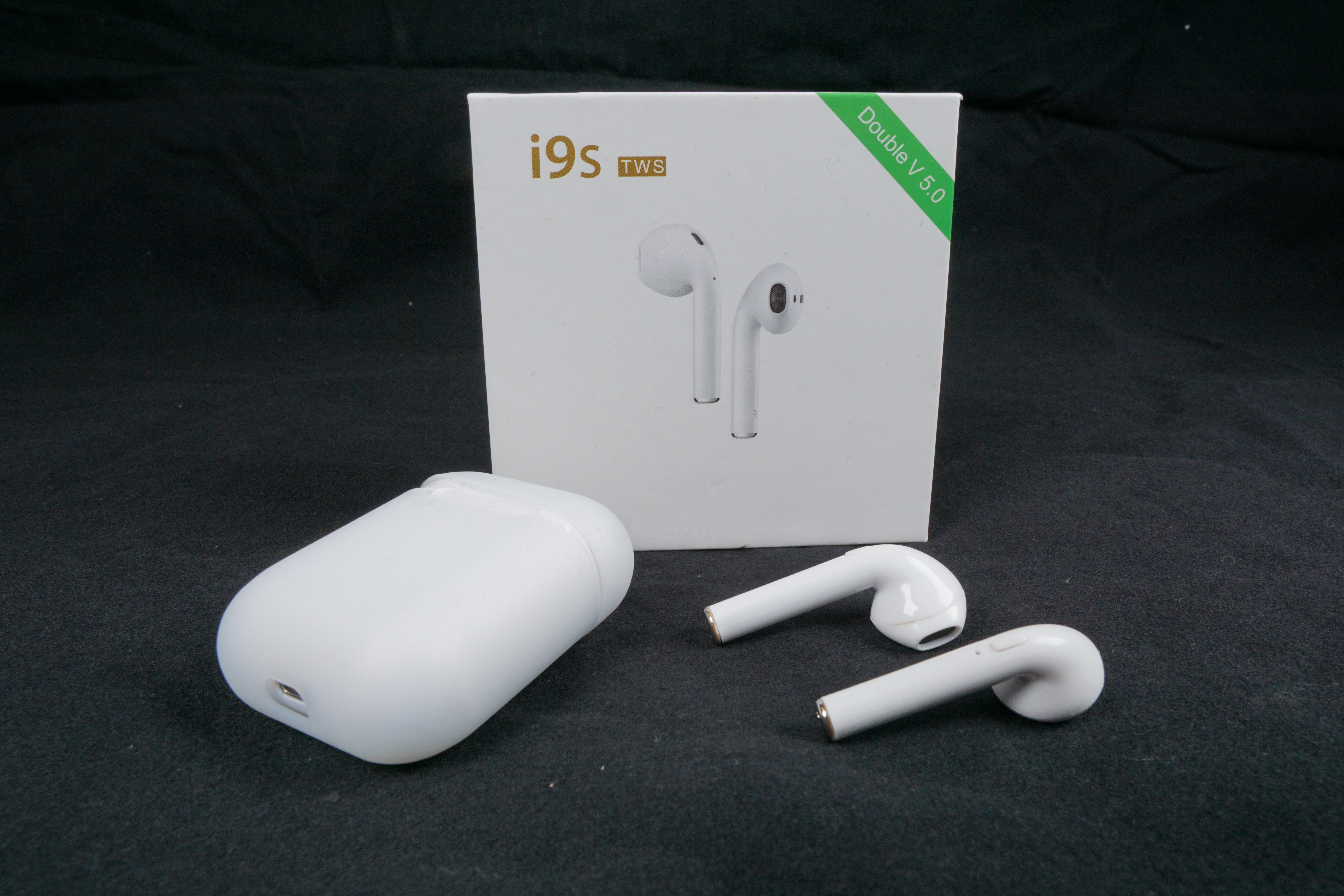
There’s also some tiny differences on the actual AirPod earbuds. The i9S TWS, for example, has tiny power on/off buttons on the stem of the pods. It also has lights that alternatingly blink red and blue, like a police siren, right after you turn on each pod.

On the bottom of each stem, a normal AirPod has a tiny metal seal over a metal microphone grille. People can use these microphones to talk to Siri or take calls. But the i9WS and LK-TE8 don’t have microphones. Instead, they have a silver seal with two gold dots. Each gold dot is a magnet that holds each pod to the bottom of their cases. (There’s corresponding gold magnets in the earpod-crevices of both the i9WS and LK-TE8 cases.)

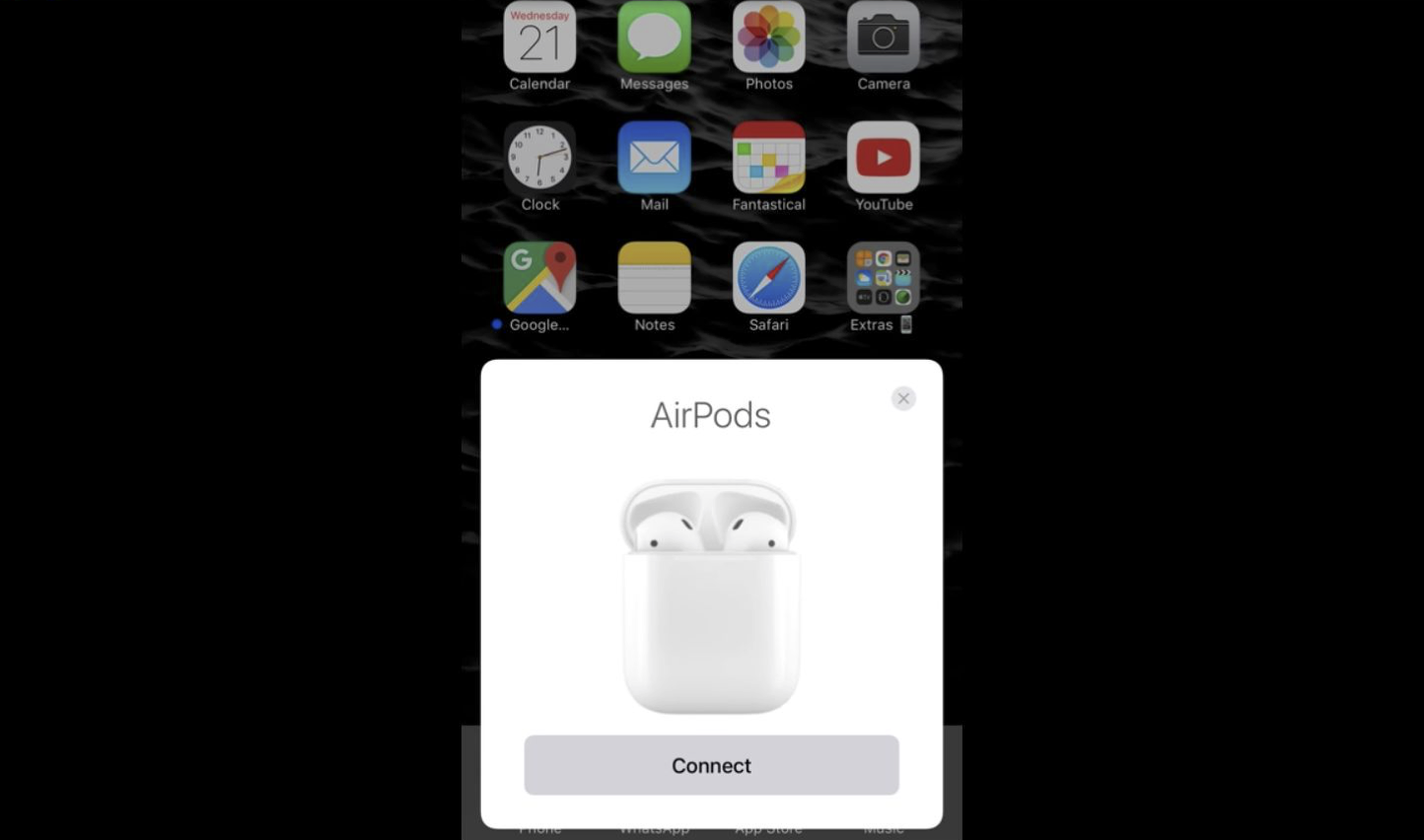
Normal AirPods pair with Apple devices very easily. A big pop-up appears on the bottom-half of a device screen showing an image of AirPods and a giant “Connect” button. The pop-up is meant to jump out to the user and signal that this device is Apple-approved.

Meanwhile, all of the fake AirPods require the user to go into Settings, go to the Bluetooth tab, and select the model names from a list of “Other Devices.” After connecting to them once, each pair of Fake AirPods will appear under “My Devices.” There’s an otherness that’s projected each time users choose to use fake AirPods. Users should know, from the get-go, that they’re not from Apple.

Admittedly, though, some of this “otherness” has nothing to do with the iOS interface. When all three fake AirPods connect to a phone, a female robot voice says "pairing" or "connected." (This voice is very loud and startling on the RW AirPlus.) Regular AirPods, by comparison, make a charming “bloop bloop” noise when they connect to a device. OneZero wrote that this sound exemplifies the feeling of connection. This is intentional: Apple wants AirPods to convey harmony and agreement with the paired device, and with the user.

Screenshot from YouTube/SG Apple Times.
Image: Screenshot from YouTube/SG Apple Times.

Apple has an incentive to make it as easy as possible to connect AirPods to devices. AirPods debuted in 2016, the same year that the iPhone 7 and 7 Plus eliminated the headphone jack from the iPhone ecosystem.

By removing the headphone jack, Apple didn’t just make its devices less user-friendly. It created a problem that, by design, only Apple could solve. AirPods seamlessly link to Apple products. They can easily switch from being connected to an iPhone, MacBook, or Apple Watch, depending on which device you’re using. But this is only feels “convenient” because it’s easier than using a dongle to link wired headphones to an iPhone.

Listening Through Fake AirPods

I’m no sound-expert, but the fake AirPods don’t sound like real AirPods. They sound slightly fuzzy, like the sound-equivalent of having blurry vision. They sound cheap. There’s definitely a reason for this (something like “there’s a limited treble and base range”), but that’s arguably irrelevant. Fake AirPods are supposed to look like AirPods, not necessarily sound like them.

i9S TWS fake AirPods.
Image: i9S TWS fake AirPods. These fake AirPods came with a gummy case around the charger.

Apple knows that the appearance of AirPods is more central to marketing the product than its sound quality. In Apple’s promotional video for AirPods, the sound quality isn’t mentioned until the second-to-last sentence. (“And of course, the new wireless AirPods deliver incredible sound.”) AirPods have a sound quality that can generally be described as “fine” but not “great.” But that doesn’t matter; the core of Apple’s AirPods marketing is the fact that they’re wireless.

AirPods are infamously strange-looking, and early AirPod reviews even called the product “dorky” and “controversial” in appearance. But each of the fake AirPods meticulously reconstructs the appearance of real AirPods.

AirPods aren’t the most expensive earbuds on the market, and the memes about AirPod owners being “wealthy” aren’t serious. However, AirPods do still symbolize wealth.

Like nearly every electronic product, AirPods are built using labor from mines, refinery facilities, and assembly facilities—usually performed by underpaid workers from several dozen non-Western countries. Thousands of low-wage workers, distributed around the world, are subject to the impulses of what capitalists call the “invisible hand of the market.” In other words, when there’s demand for a product or service, these people have work. When there isn’t demand, they don’t.

Apple does not prominently talk about labor practices in facilities that help make its products because it would undermine Apple’s “magic.” Products are supposed to appear out of pristine white packaging and “just work.” But all products, including Apple products, rely on labor and sweat from human beings.These products could not exist without low-wage labor being exploited.

That is why AirPods are able to project “coolness” and wealth. They derive their worth from labor that Apple wants to be invisible.

The Social Life of Fake AirPods

Fake AirPods are built from a completely different culture than regular AirPods. If AirPods are fundamentally Apple products, then the fake AirPods are fundamentally Shenzhen products, born from the city’s Shanzhai community of counterfeit electronic-makers.

As described by Sarah Emerson in a 2018 feature story for Motherboard, Shenzhen’s thriving counterfeit scene, in many ways, is only possible because of its “maker” scene.

“Makers, in the broadest sense, are technology tinkerers: people obsessed with hardware, tools, and communal knowledge, and who pride themselves on their DIY ethos,” she wrote.

But while fake AirPods may be designed by the Shanzhai community, they are not built one-by-one by DIY technologists working in Shenzhen’s federally-funded “maker spaces.” They’re built in assembly buildings not unlike the ones Apple would use. According to facility profiles for the products—which are searchable on Alibaba, a Chinese wholesale shopping website—they’re all based in Shenzhen. The facilities are lit by green-tinged fluorescent lighting. Workers cut, solder, wind, inspect, test, and package these products. It’s skill-based but typically under-paid labor.

So what are these fake AirPods, then?

Fake AirPods seemed destined to the same fate as regular AirPods. According to markings on the case and boxes of these products, you can’t recycle these products or throw them away safely. This means they most likely use the same dangerous, highly flammable lithium-ion battery that AirPods use, which regularly start fires in electronic recycling facilities. Since the fake AirPods are glued together, just like regular AirPods, there’s no safe way for recyclers to separate the internal battery from its plastic shell.

These fake AirPods will probably work for a couple of months with regular use. Then, they’ll probably start holding less of a charge, and eventually stop working entirely. Just like regular AirPods, they’ll make pretty, symmetric fossils. Fake AirPods will never biodegrade, and they’ll never decompose.

These knock-off AirPods are the unavoidable outcome of Apple making culturally important products that are out of most people’s price range. The same capitalist forces that make AirPods possible also make fake AirPods possible.

There will be demand for fake AirPods for as long as there’s demand for regular AirPods. Apple is reportedly planning on debuting a version of AirPods next year that are water-resistant and have noise-cancelling capabilities. In other words, the demand for tiny, wireless pods won’t subside any time soon. -Caroline Haskins


from VICE https://ift.tt/34mAyLF
via cheap web hosting

A Guy Sued An Alabama Clinic Over His Girlfriend’s Alleged Abortion. A Judge Just Threw the Case Out.

A lawsuit once thought to be the first to give an aborted fetus legal rights has been tossed.

Madison County Circuit Judge Chris Comer dismissed a case Friday originally brought by Ryan Magers against the Alabama Women’s Clinic, over an abortion that Magers’ girlfriend had allegedly received there in 2017.

Comer concluded that Magers can’t ask for monetary damages for wrongful death under Alabama law because, as an attorney for the clinic pointed out in July arguments, abortion remains legal in the state.

Still, the case remains a landmark for anti-abortion activists. Magers had petitioned to sue the clinic on behalf of the estate of an aborted fetus, dubbed “Baby Roe.” In March, an Alabama probate judge granted his petition.

"This is the first estate that I'm aware of that has ever been opened for an aborted baby," Magers’ lawyer, Brent Helms, told local reporters at the time.

READ: 6 states are now rejecting federal money because of Trump's abortion 'gag rule'

In July, Comer told both sides that he expected his decision to be appealed — regardless of which side he supported.

Magers’ lawsuit is also among the first to take advantage of a 2018 Alabama ballot measure that made Alabama the first state in the nation to add a “fetal personhood clause” to its constitution. Under that measure, Alabama’s constitution now that recognizes “the rights of unborn children, including the right to life.”

In June, Marshae Jones also dealt with the effects of that amendment. The Alabama woman was indicted for manslaughter over allegations that she had beat up a coworker who ultimately shot her, resulting in the loss of her five-month-old pregnancy. That indictment was ultimately dropped — but not before abortion rights advocates made it clear just how dangerous they believe the indictment to be.

READ: 7 days inside an anti-abortion summer camp training the next generation of activists

“Marshae Jones is being charged with manslaughter for being pregnant and getting shot while engaging in an altercation with a person who had a gun,” Amanda Reyes, executive director of the abortion fund Yellowhammer Fund, told AL.com in a statement. “Tomorrow, it will be another black woman, maybe for having a drink while pregnant. And after that, another, for not obtaining adequate prenatal care.”

Mary Zielger, a professor at Florida State University College of Law, told VICE News in May that “fetal personhood” language threatens to rewrite vast swathes of U.S. law.

“Fetal personhood is kind of an infinitely complicated topic with potentially infinite unintended consequences, because once you recognize a fetus as a person, they could have rights in all kinds of contexts,” Ziegler said. “So you would have to work out what it meant for everything from inheritance law to tax law to civil liabilities rules to criminal law.”

Cover: Protesters for women's rights hold a rally on the Alabama Capitol steps to protest a law passed last week making abortion a felony in nearly all cases with no exceptions for cases of rape or incest, Sunday, May 19, 2019, in Montgomery, Ala. (AP Photo/Butch Dill)


from VICE https://ift.tt/2NMih4v
via cheap web hosting