Wednesday, April 1, 2020

We’re Running Out of Face Masks, But You Can Make One Yourself

Interest in DIY medical equipment has exploded in recent weeks, as the COVID-19 pandemic continues to cause severe shortages of masks, gloves, and other medical supplies.

On YouTube, popular DIY and Maker channels feature video tutorials on making surgical masks from everyday household materials, often set to cute graphics and unsettlingly saccharine music. Hospitals are driving the demand, with some providers publicly calling for people to donate masks made at home to healthcare workers in the field.

Over the past week, hundreds of amateur makers have formed decentralized production lines to get as many masks as possible into the sterilized hands of those who need them most. Even fashion designer and Project Runway star Christian Siriano jumped in, offering the help of his entire sewing team to New York Governor Andrew Cuomo via tweet.

“It hit me that I really need to do something,” Nellie Rose, a textile artist and clothing maker based in West Virginia, told Motherboard. “If we are in such a crisis where we are being asked as seamstresses and home sewists to make these, then we have to.”

After closing down her shop amidst the pandemic, Rose and a collaborator started Holler Mask Force, a group of over 50 home crafters dedicated to making masks. She assembled the group by contacting members of the sewing and maker communities over Facebook and Instagram, forming a decentralized effort to distribute hundreds of homemade masks to hospitals, urgent care facilities, and families in need.

After doing some research, I found that making a mask using household items is fairly simple, and producing them in bulk doesn’t require a team of professionals. So I sought out to make one myself.
1585688822459-IMG_3654
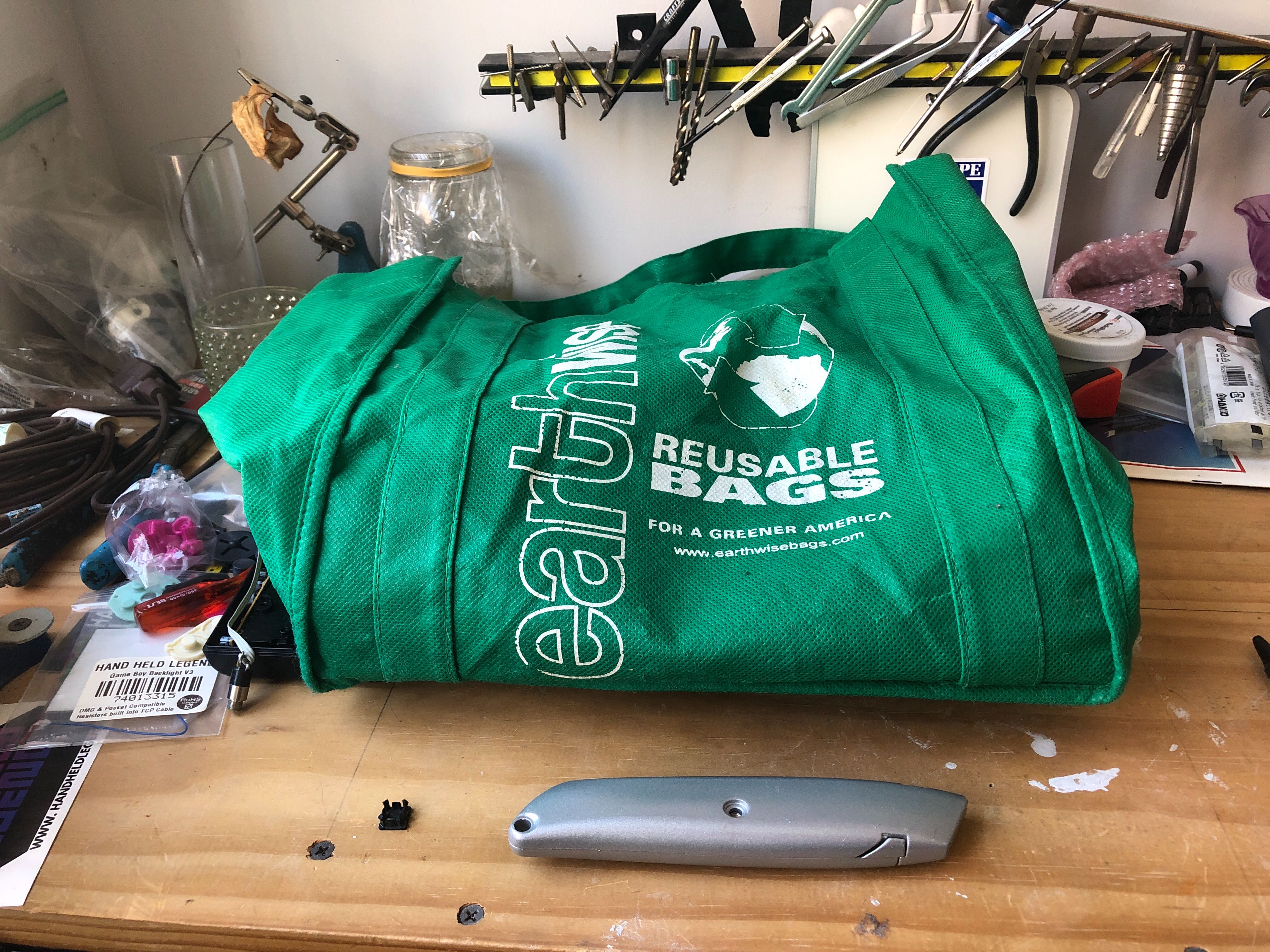
Some reusable grocery bags use non-woven polypropylene, which can act as a filter for DIY masks

For the past several weeks of COVID-19 lock-down, I’ve been delivering food and supplies to people via electric scooter as part of ongoing mutual aid efforts in my Brooklyn neighborhood. Since this sometimes means going into crowded grocery stores and pharmacies, I’ve been trying to limit exposure by wearing sterilized nitrile gloves and an N95 respirator (given to me months ago by a friend) whenever I run errands.

I’m not currently feeling sick, but it’s a known fact that the virus can spread even if a person doesn’t show symptoms. The N95 is considered the gold standard for medical-grade personal protective equipment (PPE), but it’s not designed to be reused indefinitely. And since the limited supplies should be reserved for healthcare workers on the frontlines and not scooter delivery girls, I needed to find an alternative.

Last week, the New York Sewing Center hosted an online mask-making workshop, as part of an effort to encourage local crafters to make PPE for shorthanded hospitals. Once I had found the right materials—and a friend with a sewing machine—I had a completed mask in about 20 minutes.

“For someone who has sewn before it’s pretty doable,” said Julia Morrow, a self-taught clothing maker based in Brooklyn who has been making masks during the crisis. For the sake of time (and to avoid needing to borrow her sewing machine), I asked Morrow to quickly stitch together a mask for me. But she said that even for beginners, it’s a challenging but achievable project.

“Watch a couple videos and allow yourself to mess up a couple times, and don’t rush it,” she said.

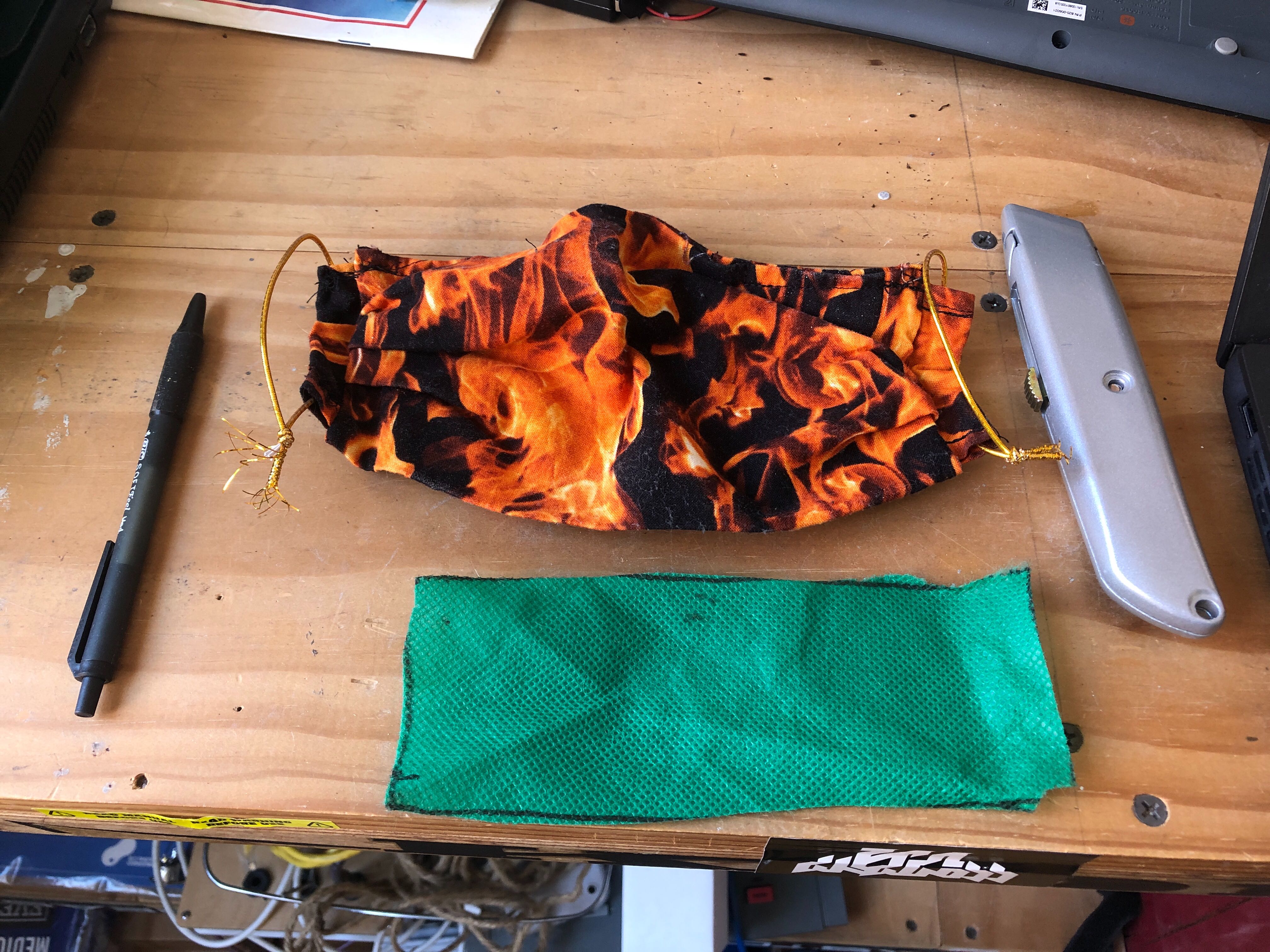
As experts have noted, masks aren’t a magic bullet for preventing the virus’ spread. While the N95 is designed to block 95 percent of particles, an improvised mask will be much less effective, depending on the materials used. Most commercially available masks use a material called non-woven polypropylene (NWPP), which acts as a filter. A cheaper and more porous variety of NWPP can be sourced from reusable grocery bags like the kind you get at Whole Foods. So I measured and cut out a strip of the material from a bag I found at home, then inserted it into the mask’s filter pocket to form an extra layer of protection.
1585689015071-IMG_3652
Inserting a layer of polypropylene into the mask's filter pocket

Dr. Marybeth Sexton, an assistant professor at Emory University School of Medicine, said that while these makeshift masks won’t be as effective as an N95, they are still better than nothing. For example, she said that healthcare workers in the field can wear them over an N95 to prevent the medical mask from getting soiled, thus extending its lifespan.

“It’s not like they block nothing. They just don’t block quite as much as the medical-grade equipment,” Sexton told Motherboard. She also warned that wearing a mask improperly or without thoroughly sterilizing after extended use can further reduce its effectiveness.

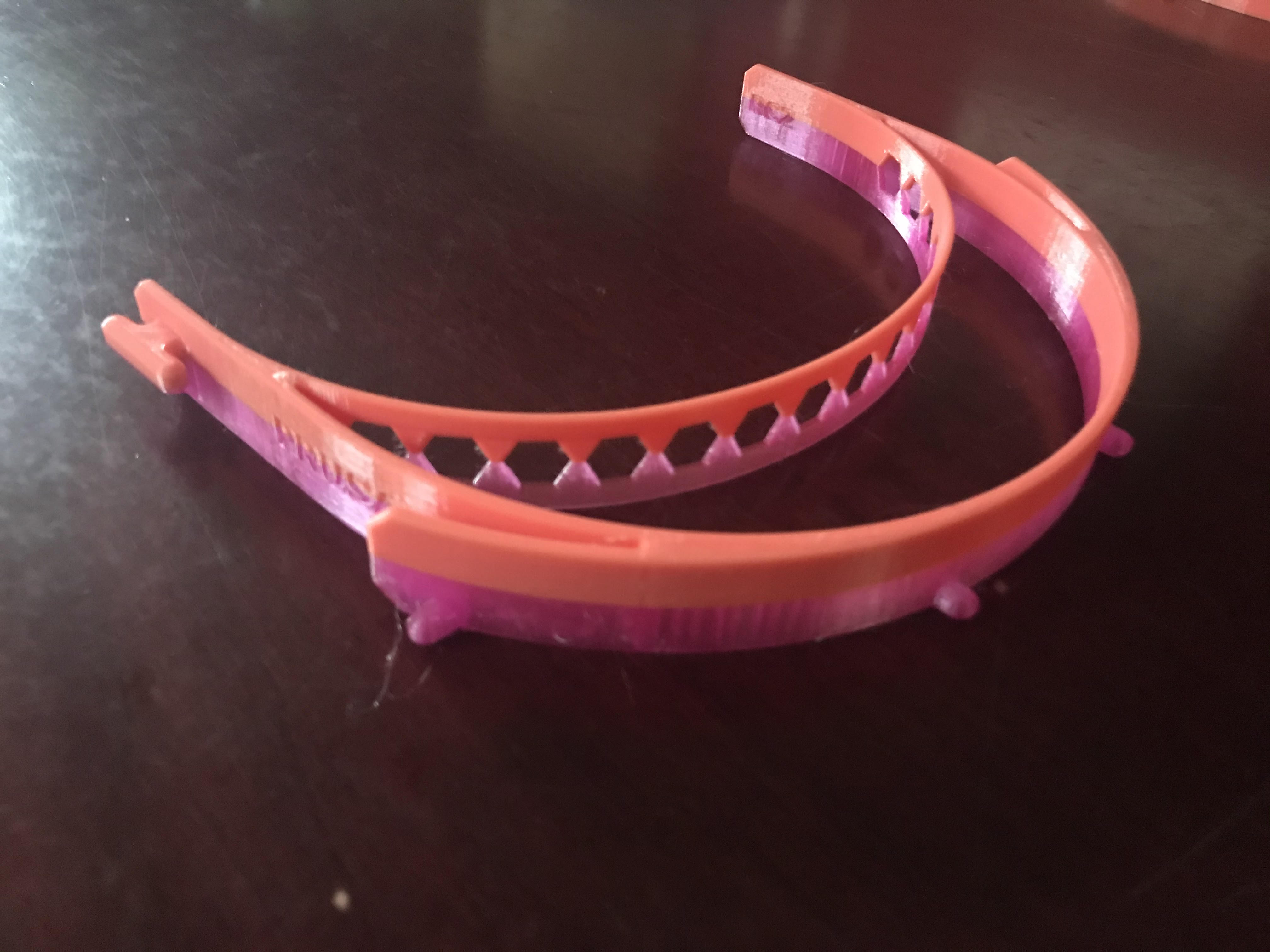
Amateur makers have been exploring other ways to address the limited supply of medical-grade masks. Cristina Peterson, a neuroscientist and postdoctoral associate at the University of Minnesota, said she started using her home 3D printer to produce plastic frames for face shields after finding a design online.

“It's been difficult to get definitive information about if the face masks would be helpful in preventing the transmission of coronavirus or not, so I started searching for other things I could print that were known to be safe and effective,” Peterson told Motherboard. Face shields are used by frontline medical workers to protect their masks from contact with a patient’s fluids (CDC guidelines require that a mask soiled by fluids be discarded).

After posting about the 3D printed designs on Facebook, Peterson says people started reaching out to her, forming a makeshift assembly line from a small network of home fabricators.

“I am planning on collecting all of the printed pieces from all of these different people and dropping them off with an acquaintance who has the materials to add the clear plastic front piece and the elastic headband, and can then hand them over to hospitals,” she said.
3D printed face shield frame
A 3D-printed frame for a face shield. Photo by Cristina Peterson

Meanwhile, public officials have been sending confusing and contradictory messages about whether the general public should be wearing masks. While stocks of medical-grade equipment should be reserved for healthcare workers, improvised and homemade masks could provide some benefit to vulnerable groups, like immunocompromised people and those with chronic respiratory conditions. Some public health experts further argue that when combined with other practices like social distancing, having everyone wear masks can help slow the spread of diseases like COVID-19. According to the Washington Post, the CDC is now considering changing its advice on masks to reflect that criticism.

Sexton said that there is no hard evidence that masks are effective at protecting members of the general public. But they could at very least offer peace of mind to people whose critical jobs force them to constantly interact with the public, like grocery store clerks—as long as they are worn properly.

“People are scared because this is something new, and that can be really frightening,” said Sexton. “If [wearing a mask] is something that allows people to feel comfortable and doing their jobs … I don’t think there’s anything wrong with that as long as you’re careful with how you use it.”

Nellie Rose from Holler Mask Forces worries that her masks might give people a false sense of security, and started including written disclaimers reminding people that they are not medical-grade equipment and must be cleaned and worn properly. Still, she says, in the midst of a global pandemic, some protection is better than none.

“We are essentially sending our soldiers into battle with CDC guidelines saying they can wear a bandanna, and that is fucked up,” said Rose. “If I can create something that’s better than a bandanna, then I will.”


from VICE https://ift.tt/2R2Flg0
via cheap web hosting

De Blasio Could Save Lives by Closing New York City’s Streets. Why Won’t He?

I was walking down the sidewalk in my neighborhood in central Brooklyn when two older women turned the corner in front of me. They both wore masks and latex gloves. They were in conversation, but walked about six feet apart. They had been walking along an avenue with wide sidewalks, but turned onto the sidewalk I was walking along, which was just a few feet wide. As we walked towards each other, it became clear we could not all walk along the sidewalk while maintaining social distancing. I had two options: walk as equidistant between them as possible, perhaps two feet or so from each, or walk into the road.

I repeat this calculus every trip outside dozens of times. I want to be a good pandemic samaritan, but I also don’t want to get hit by a car. And every time this happens, I wonder to myself why roads haven’t been blocked off for pedestrian use.

In 2017, after Mayor Bill de Blasio was re-elected for his third and final term, he decided to make the theme of his lame duck term “the Tale of Two Cities.” It was fresh, original, and not at all a lame throwback cliché, just like de Blasio himself. He explained that there is the rich New York and the poor New York. Little did he expect that an entirely new and unprecedented type of Tale of Two Cities would take place during his term.

Thanks to coronavirus, there is now an empty New York City and a crowded one. The empty city consists of the office buildings, bars, restaurants, libraries, tourist attractions, and streets. It is an object of great fascination for those of us grappling with the blood draining from a metropolis that used to be debatably worth paying exorbitant rents to access. We hope the empty city is merely falling asleep like a limb awkwardly tucked under a torso and the blood will come rushing back to it once it shifts position. But with each passing day we become ever so slightly less sure of this, partly because of a lack of confidence in de Blasio himself to roll the city over.

That lack of confidence stems from what’s happening in the other New York City, the crowded one: grocery stores, hospitals, the living room in our cramped apartment shared with two roommates all of whom are now working from home until further notice or unemployed with nowhere to go, the park where everyone goes to get fresh air and exercise, the playground where kids expend a fraction of their pent-up energy, and the sidewalk which is less than six feet wide, making social distancing a physical impossibility.

In the face of the coronavirus pandemic, for which New York City has become the national epicenter, this tale of two cities is, to a large extent, inevitable and necessary. But there is one thing, one very obvious thing, the city could do to ease some of the crowding in parks, sidewalks, and playgrounds.

The city could close a portion of its more than 6,000 miles of streets to through traffic and open it to people.

The benefits of closing off many streets to traffic are obvious to anyone who visited the Prospect Park loop during the last week. It has been packed with joggers and families to such an extent that it’s not possible to maintain six feet of distance from anyone else. Many neighborhood playgrounds and parks around the city have a similar problem.

While parks are too crowded, streets are virtually empty. In the days immediately following a state executive order limiting business activity, traffic plummeted some 35 percent and it has further declined after the state issued a shelter-in-place order days later. According to urban mobility app Citymapper, only about five percent of trips normally taken in New York City are being made today.

Thanks to this lack of traffic, I now jaywalk across major thoroughfares like Flatbush and Atlantic Avenues without breaking stride—a death sentence during normal times—because there are so few cars. Residential streets are even more desolate. The one I live on would regularly experience traffic jams a block long during rush hour. This hasn’t happened in weeks. On Monday afternoon, a car passed my window every three to four minutes on average. Closing off some streets would have zero impact on traffic because there isn’t any.

Instead of taking this painfully common sense solution at face value—one public place is very crowded, another very empty; let us redirect some of the people from the crowded space to the empty one—and executing it, the city has spat in common sense’s face and shoved it to the ground for good measure. Here, I’m referencing de Blasio’s threat to close not the streets, but parks and playgrounds if they continue to be too crowded, which of course they will, because people have nowhere else to go for fresh air and exercise since the city won’t close off streets. (On Tuesday, the city announced the closure of 10 playgrounds "where we have consistently found a lack of regard for social distancing." Closing playgrounds may in fact be good policy because of all the shared surfaces; parks less so.) It’s a vicious cycle that feels aggressively hostile towards those of us cooped up in something smaller than a mansion on 88th Street.

But it’s not too late to do the right and obvious thing. The good news about closing off streets to most vehicle traffic is it takes little more than a few road cones.

The half-baked idea I thought of a week ago and haven’t immediately thought of a reason why it wouldn’t work—which I guess makes it pretty well-baked by now— is to close off every fifth residential block to traffic. This can be done by placing two orange traffic cones at each end of the block, far enough apart that emergency vehicles and local traffic can still get through but close enough together to force drivers to slow down and see that people may be using the street.

New York already does this, to varying degrees, with two different summer programs: Summer Streets and block parties. Summer Streets is a Department of Transportation program that closes off seven miles of main roads from the pitifully narrow window of 7 a.m. to 1 p.m. on three Saturdays in August. Block parties, which are more in line with what I’m talking about here, merely require a permit in order to close off the street and are limited to one day. The day of the event, the police put a barricade at either end of the block or someone from the block association parks their car across the crosswalk. Fun ensues.

Safe streets advocates have been calling for expanded Summer Streets and block party programs for years, because, as DOT’s own website puts it, “Summer Streets is an annual celebration of New York City’s most valuable public space—our streets.” It seems that if it is truly our most valuable public space, we ought to enjoy it a bit more, especially now.

To be far fairer to de Blasio than he deserves, I will mention the city did recently close off a few blocks per borough—a grand total of 1.5 miles of road—for four days precisely this reason. It is astounding, though, that the city thought this would aid in social distancing one iota. How did they figure closing off four blocks in Bushwick would make the slightest difference in a borough of 2.5 million people?

It’s not at all clear what the Mayor is afraid of, as there has never been a better time to do this, both practically and politically. During these “normal times” to which I keep referring but am increasingly unable to clearly recall, every effort to close streets to cars is typically opposed by a cadre of conservatives: local businesses who think it will hurt their bottom line, crotchety residents who are worried about their parking, and occasionally local politicians who are worried about getting the votes of the people who are worried about their parking.

But these are not normal times. Most of the crotchety people who are worried about their parking have long since gotten in their cars, left their parking spots, and driven far away. Or, they have realized there is nowhere worth driving to and, with alternate side parking suspended, don’t plan on moving the car any time soon. The business owners who normally worry about their bottom lines have much bigger worries about their bottom lines at the moment. All of the usual opposition is either nowhere to be found or no longer opposed.

When I asked the Department of Transportation about all this, it directed me to City Hall, which did not respond to a request for comment. It’s a shame, because closing off hundreds of streets could go a long way towards closing the gap between the new tale of two cities. You’d think de Blasio, of all people, could understand that.


from VICE https://ift.tt/2JHH3zD
via cheap web hosting

OK, WTF is NASA’s Humanity-Saving Ion Engine?

Humans are currently grappling with numerous emerging threats on our planet, ranging from an ongoing pandemic to the long-term risks of climate change. But we are also vulnerable to forces beyond Earth, such as potential collisions with asteroids.

While these impacts rank relatively low in the scheme of likely apocalyptic scenarios, it is still vital to have a contingency plan in case a hazardous object does end up on a crash course with Earth. NASA’s Double Asteroid Redirection Test (DART), which is due for launch in July 2021, is the latest mission to establish a game plan for this particular variety of doomsday. DART is tasked with slamming into a small asteroid to see whether it can be knocked off course—a strategy that could potentially be replicated for asteroids on a warpath with Earth.

The mission will be accelerated toward its target, the Didymos binary asteroid system, by a next-generation ion engine called the Evolutionary Xenon Thruster–Commercial (NEXT–C), which has never flown in space before.

What is an ion engine?

Developed jointly by NASA and the company Aerojet Rocketdyne, this thruster will use solar power and ion propulsion to place DART on a ballistic trajectory to the Didymos system. While it is not the first ion thruster to be incorporated into a space mission, NEXT-C is about twice as large and three times as powerful as its predecessor on NASA’s Dawn mission.

“It’s got more thrust available,” said Terry O'Malley, project manager for NEXT-C at NASA’s Glenn Research Center, in a call. “It’s really good for in-space propulsion.”

Ion engines offer a very different type of space propulsion compared to traditional rocket engines that rely on volatile fuels. The thruster runs on electricity powered by DART’s solar panels, which is then used to heat up xenon propellant until it becomes an ionized plasma. In other words, xenon atoms become ions, which are particles that have an electrical charge due to the loss or gain of electrons. In this case, the xenon loses its electrons, transforming it into positively charged ions.

1585685434372-grc-2019-c-10067
NEXT-C ion thruster undergoing tests. Image: NASA, Rami Daud, Alcyon Technical Services

These ions are drawn toward two gridded screens riddled with thousands of tiny holes. After they pass through the first screen, which has a positive charge, they get a sudden speed boost from the second negatively charged screen.

“What we have is basically two screens that are pretty close to each other and we establish a high voltage of 1,000 volts to 2,000 volts, depending on what thrust you want,” O’Malley explained. “Once you establish that voltage potential, it essentially shoots the ions out the front of the thruster. That’s what creates the thrust.”

Xenon is a particularly good propellant because it is relatively inert, unlike more volatile fuel sources such as hydrazine. Its unreactive nature lowers the risk of explosions and catastrophic damage to a spacecraft. For this reason, ion thrusters are especially useful for long-lived missions tasked with visiting multiple celestial bodies.

“Ion engines are very efficient in regards to use of fuel and xenon,” O’Malley said. “The Dawn mission was able to visit a couple of different asteroids.”

How could the ion engine one day save humanity?

While future missions may take advantage of NEXT-C’s longevity and stability, DART will be a relatively quick trip that will demonstrate the new thruster’s capabilities for the first time in space.

Once DART is launched off Earth by SpaceX’s Falcon 9 rocket, NEXT-C will take over and accelerate it toward the Didymos system over a period of about 15 months.

Didymos is composed of an 800-meter-wide asteroid, known as Didymos A, which is orbited by a moon one fifth its size, called Didymos B or “Didymoon.” Though this system is not hazardous to Earth, its orbit around the Sun occasionally brings it within a few million miles of our planet.

This proximity, and the unique binary nature of Didymos, make it an ideal destination for an impactor. If all goes to plan, DART will crash into Didymos B in October 2022 at a speed of about 6.6 km/s (3.7 mi/s).

Following the crash, scientists will monitor the predicted shift in the moon’s orbit, which is expected to be fairly small. But even the slightest nudge will help scientists understand the efficacy of the plan to redirect hazardous asteroids to protect Earth.

NEXT-C is already being considered as a propulsion source for future sample-return missions to asteroids and comets, and it could be adapted to steer commercial satellites that need to move to different trajectories in low-Earth orbit. So while DART may be the thruster’s first journey in space, it is unlikely to be the last.


from VICE https://ift.tt/347KjNV
via cheap web hosting

India Is Converting 20,000 Railway Cars Into Coronavirus Isolation Wards

India has begun converting 20,000 railway carriages into isolation wards to deal with an expected surge in coronavirus cases.

Each of the carriages will be converted into medical facilities containing 16 beds each, meaning a total of 320,000 people can be cared for. The state-run Indian Railways said that work on modifying an initial 5,000 carriages has already begun.

India is one week into a massive nationwide lockdown with 1.3 billion people told to stay at home as the country attempts to stifle the spread of the coronavirus. But there has been a spike in new cases this week, with the country confirming 1,590 infections and 45 deaths, according to data gathered by Johns Hopkins University.

Critics say India is simply not conducting enough tests and the threat of community transmission is growing, especially as millions of migrant workers are making long and often deadly journeys back to their home towns and villages.

Also of concern is the patchwork Indian healthcare system, which lacks enough trained staff and medical equipment such as ventilators to handle a large outbreak of coronavirus. India has just eight doctors per 10,000 people, compared to 26 in the U.S., 41 in Italy and 71 in South Korea.

As well as converting railway carriages, India has begun converting sports stadiums into temporary hospitals, mirroring efforts by governments around the world as existing hospitals are overwhelmed with patients.

READ: India is spraying migrant workers with bleach disinfectant during coronavirus lockdown

In China, temporary hospitals were built in record time, London has converted a conference center into a temporary field hospital to treat 4,000 patients, and in Spain, an ice rink has been turned into a mortuary.

Following India’s lead, Pakistan Railways has also converted all its business class and air-conditioned sleeper coaches into isolation wards to accommodate around 2,000 beds for coronavirus patients.

Cover: An Indian railway employee works to convert a train coach into an isolation ward for the fight against the new coronavirus in Gauhati, India, Sunday, March 29, 2020. (AP Photo/Anupam Nath)


from VICE https://ift.tt/2xJ6PQU
via cheap web hosting

Laid-Off Restaurant Workers Are Helping Each Other When No One Else Will

It’s a sunny afternoon in Brooklyn and staff at the L.A.-style pastel-hued restaurant Gertie is getting busy for a rush, preparing to hand out free meals and supplies to restaurant workers like themselves who recently lost their jobs as their industry all but disintegrated.

Jovanni Luna, an artist and laid-off Gertie server, has come back to work to give out donated beer and toilet paper to laid-off food service workers in the WIlliamsburg neighborhood, while other staff organize bags of beef goulash, cookies, and salad on long tables to hand out throughout the evening. The normally crowded brunch spot now resembles a food bank that serves those left without incomes after New York City ordered all bars and restaurants closed, excepting takeout service, two weeks ago. Thousands of workers who specialize in feeding others now need to be fed, and here that’s being done with gloves and face masks across tables placed six feet apart to minimize crowds and hopefully prevent the spread of COVID-19.

“You do have to think about yourself and your health, but at the same time you’re not the only person suffering," Luna said. "This whole restaurant is one big family, one big community, we really have to look out for each other.”

I’ve been a server for almost 10 years in three countries and everywhere I've worked, the restaurant staff has come together as a family—a mixed-up bunch of creatives, oddballs, and hard workers who weave their restaurant into the fabric of their communities. When we were all laid off at my restaurant two weeks ago, we poured shots of tequila, shed tears, drank the wine and made it damn clear we all had to stay in touch and support each other through this. Because in a lot of cases, especially in New York, your restaurant colleagues really are your only reliable bonds in a city. And this crisis has shown how strong those bonds are, with various Google Docs, Facebook groups, and GoFundMe pages springing up to help, especially in cases where government programs can't provide relief.

These forms of charity are more ad hoc and informal than government aid or even normal nonprofit channels. In some cases, they amount to individuals sending each other a few bucks on Venmo. But restaurant workers, who often live paycheck to paycheck and have to pay rent on April 1, need money now however they can get it.

Gertie is one of 14 restaurants across the country being supported by the Lee Initiative and Makers Mark to feed out-of-work food service staff through the Restaurant Relief program. The grant, which covers getting four staff back on payroll, will allow them to cook 150 meals per day for 10 days for laid-off food service workers who just need to turn up—no ID needed or questions asked. After the 10 days, Gertie will need community funding to keep going.

Helping their own

Working as a server at Brooklyn farm-to-table restaurant Marlow & Sons, Kelly Sullivan saw how the coronavirus was affecting the industry weeks ago and got nervous, not just for her own financial situation, but for the people she’s worked with who don’t have any safety net. “By nature the industry draws a lot of extroverted people, and also a lot of people in precarious social situations, whether that’s because of immigration status, health status or alienation from family or community,” she said.

Sullivan, along with her fellow hospitality workers Anna Dunn and Seamus Branch, started the mutual aid fund Service Workers Coalition, and have continued to run it while navigating applying for unemployment themselves.

Do you have a coronavirus story you want to tell? Fill out this form or reach out on Signal at (310) 614-3752 and VICE will be in touch.

Initially, the fund was intended to come from friends and be a small amount that was passed around depending on who needed it. Since restaurants closed, the group has raised more than $45,000 and is giving out weekly stipends to hundreds of former service workers in need, a kind of informal unemployment relief. Instead of having to navigate the government bureaucracy—which has been overwhelmed in many states by the suddenly jobless who need money—they could get what they needed from their fellow employees. “It’s an industry where you learn very quickly how little the systems in this country function,” Sullivan said.

There’s no vetting process for the fund. “If you email us and tell us you worked in a restaurant in New York, we will give you the money, and we don’t care how you spend it,” Sullivan said.

Working through personal accounts in Venmo and Cash App, the group has been flagged for fraud and shut down repeatedly, something many other mutual aid groups experience. The group says it's filing to incorporate as a nonprofit to get a business account to avoid that.

To keep the fund going Sullivan encouraged people to think how much they’d normally spend on tips in a week and donate that, or find their favorite bartender or server on Venmo and send them $50. “What we’re hoping is that the inherent cruelty of the economy is being laid so bare that hopefully even as people panic they’ll still reach out,” she said.

Helping the undocumented

Undocumented immigrants are the backbone of many restaurants in the country and for them, mutual aid groups that don’t ask for formal identification or paperwork are the only places to access help.

New Yorkers Audrey Pan and Sahra Nguyen foresaw how undocumented workers would suffer through the pandemic and started the Undocumented Workers Fund to raise money and quickly distribute it to undocumented food service workers who have been laid off. Pan said what keeps coming up in conversations is how scared undocumented workers are feeling under the current anti-immigrant administration. They also worry that they won't be able to pay rent and buy food, and what they would do if they got sick—many of undocumented workers lack health insurance, and after the “public charge rule” went into effect in February, allowing the government to deny green cards and visas to immigrants who use public benefits, many undocumented workers are too scared to go to public health centers.

And unlike documented workers, they can't rely on unemployment or the stimulus bill recently signed into law by Donald Trump.

“Even though I’m not a health expert I’ve had people coming to me with those questions because they’ve had no one else to turn to," Pan said. "Attorneys are backlogged right now and on top of the financial stress something that is really infuriating is ICE agents are continuing to make arrests in regions hardest hit by the virus like New York and California.”

Pan, the community organizer for RAISE (Revolutionizing Asian American Immigrant Stories on the East Coast) and Nyugen, owner of Nyugen Coffee Supply, raised more than $20,000 last week for the Undocumented Workers Fund through social media and word of mouth. Pan said because it’s a grassroots fund the money can be distributed quickly, and any undocumented service worker who needs one of the $200 grants can email them—all that’s required is a sentence on how the fund would help right now.

Pan wants the movement to create a chain reaction, and she said she’s had people from Los Angeles to Philadelphia reach out asking how to start their own funds. “The community has really been stepping up and helping each other in ways I’ve never seen before,” she said.

More traditional funding efforts run through larger organizations requiring more documentation are also available to laid-off food service workers, including the United States Bartenders Guild Emergency Fund, Restaurant Workers Community Foundation Crisis Relief Fund and others. The national Restaurant Opportunities Centers United, an established nonprofit, is trying to raise $500,000 in relief for documented and undocumented workers alike.

But relief comes from all sorts of sources. My partner, a server who is newly out of work, has been painfully waiting on unemployment for more than a week, after not knowing whether he’d get it as someone going through an immigration process. He put his name on a Google doc for laid-off hospitality workers over a week ago, and while checking his account a few days ago, noticed someone had Venmo’d him $5.

I looked and this person had Venmo’d at least 20 other seemingly random people messages of support and $5. At times like this, solidarity can give people something resembling hope, so do tip your bartender if you can, even if the bar is closed.


from VICE https://ift.tt/2WZqE1e
via cheap web hosting

Getting Surgery? Your Doctor Is Probably Making a Playlist for the OR

The day before performing a fairly major operation on my neck, my surgeon emailed me the list of songs that he would be playing during the three-to-four hour procedure. This wasn't out of the blue: After one of his colleagues mentioned what great taste Dr. Cord Sturgeon (his real name!) had in operating-room music, I asked for a preview. Somehow, if our musical tastes were similar, I imagined that the removal of my cancer-flecked thyroid would go more smoothly.

Some songs on his playlist I took as positive cosmic signs, like The Charlatans' "Weirdo"—a favorite of mine from high school—and the Billy Bragg/Wilco collaboration "California Stars," a sweetly comforting ballad that reminds me of the late 90s. And The National! One of my favorite bands, though the choice of the delirious head-trip "Don't Swallow the Cap" felt a little odd. There were a smattering of classic-rock ditties, plus a few unexpected choices—White Denim? Nice. Though I was concerned I might wake up while Phish was playing "Backwards Down the Number Line" and worry I'd been sent to the Bad Place, it was comforting to know that I'd unconsciously be hearing a number of songs that I liked. I hoped they'd guide the doctor's hand.

It's probably worth backing up, first, to give some brain space to the notion that surgeons are rocking playlists while cutting open your flesh and making crucial, life-or-death decisions on your behalf. It might bring to mind Atlanta's "dancing doctor" from a couple of years ago, who mugged and mimed along to O.T. Genasis' "Cut It" and Migos' "Bad and Boujee" while performing cosmetic surgeries—and broadcast the results on YouTube. Following a string of malpractice lawsuits, her license was temporarily suspended, suggesting that her unbridled enthusiasm was the exception, not the rule. But there's one thing she has in common with many of her fellow surgeons: She operates with a soundtrack.

There's no definitive study on what percentage of surgeons use music while in the OR, but of the dozen or so I've found, none puts the number at less than half. In a survey of 700 surgeons from over 50 countries conducted by Spotify and the medical app Figure 1, 90 percent of respondents said they operate to a playlist. Rock and pop, unsurprisingly, were the most popular genres in the surgical theater, appearing on the playlists of 49 and 48 percent of doctors surveyed respectively. Other genres that fared well included classical, at 43 percent; jazz, at 24 percent; and R&B, at 21 percent. (I reached out to Spotify to see if they'd done any further investigating, but they didn't have any information beyond the original 2017 survey.)

Dustin Newell, an interventional radiologist who specializes in minimally invasive guided procedures (when we spoke, he was en route "to save a leg"), told me that music in the OR has been a constant since he was in medical school. "It elevates the mood in the room, it puts the patient at ease, and it helps the staff and the doctor get into a good rhythm," he told me. "It's a net positive."

John LoGiudice, a plastic surgeon at Froedtert Hospital in Milwaukee, told me that music in the operating room is so prevalent now that he sees Bluetooth being incorporated into their design. He says that the days of burned-CD mixes at his hospital are long gone, and that the doctors and nurses now share a Pandora account that's wired into the same system that shows him CT scans and MRIs during procedures. It's standard equipment now.

David Bosanquet is a consultant vascular surgeon at Royal Gwent Hospital in Wales who says he prefers "indie-ish rock-y kind of stuff" like Coldplay and Radiohead while he works. Though he says the 90 percent figure sounds a bit higher than anecdotal experience would suggest (some surgeons, at the end of the stay, still prefer a quieter OR), many of his colleagues craft playlists as part of their pre-work routines.

In 2014, Bonsanquet co-authored a funny yet scholarly article in the British Medical Journal called "Making Music in the Operating Theatre," which collated studies about the benefits of music before, during, and after surgery. In short, existing research suggests that music can have a calming effect on patients and surgeons alike. It may also help boost performance; according to a report from the Journal of the American Medical Association about how music changes "cardiovascular reactivity" for surgeons, "music is related to improved autonomic responses and performance during stressful tasks."

When I discovered that my doctor played music in the OR, I have to admit it crossed my mind that he might get distracted by his killer playlist, using valuable brainpower trying to remember the lyrics to Hall & Oates' "Maneater" when he should be thinking about my thyroid. ("The woman is wild / a she-cat tamed by the purr of a jag-u-ar.") But the surgeons I spoke to said that music helps them in a variety of ways, from relieving boredom and stress to creating a sense of camaraderie. Dr. Callisia Clark, a surgical oncologist who prefers "mellow stuff like Bob Marley" while performing critical tumor resections, said that choosing and listening to music gets her teams on the same page. It also can help ease the anxiety that comes with navigating life-and-death situations.

On the flipside, LoGiudice says music can help him stay alert—especially when he is called on to perform emergency surgeries at off-hours: "This tradition started 20, 25 years ago: Anytime we knew we were not getting any sleep on a particular night, one of my more senior colleagues would start the procedure with the Pulp Fiction soundtrack. You need something to amp you up. And there's folks who will play nothing but Metallica when they're working in the middle of the night. You kind of have to! You're not going to be listening to the Commodores, you know?"

Bosanquet says there have been times—particularly during high-stress operations—when he's said no to music in the OR. "There are certain operations where the adrenaline is flowing so much that, even after five hours, you're still on the wire," he says. Still, most of the time, you're in a state of "slightly heightened awareness," he says. "You're thinking carefully throughout it, but there's still the possibility of getting tired. And I think having the music helps."

And it's not like everybody has the music at Dancing Doctor volume. "You have it at a low level and you make sure you're able to hear everyone clearly," says Newell. "You're not blasting it. Occasionally, there are patients who will ask for quiet, and that's okay. I'll go quiet for them."

Music in the OR isn't just helpful for the doctors, either. Under general anesthesia, the patient is fully out; sadly, I didn't have the chance to be delighted by my doctor playing R.E.M. or horrified at him playing 4 Non-Blondes' "What's Up." But many patients are either mildly sedated or even fully awake during surgery—and in those situations, the doctors I spoke to will ask for input.

Newell has had patients ask for mariachi music, and others—"younger guys, usually"—who want to hear hip-hop. "The only thing I'll veto is if somebody requests country music. I just can't—it messes with my flow."

Bosanquet also encourages requests, though he has an ever-growing, 32-hour playlist of his own to fall back on. The Beatles are a popular choice, which he puts down to the fact that many of his patients are older and that hearing something familiar can be calming. "Some studies say that listening to music is just as effective as giving the patient actual [pain] medication," he told me. "So if a patient is awake, I always ask them what their preference is."

For Newell, there's another benefit: "If your patients are awake, they're not hearing what you're doing. Otherwise, they might hear me make an incision with an instrument or even drop something. They could maybe hear tissue being dissected or cut! If you have a little ambient noise that drowns that out, it helps them focus on being calm and relaxed."

Spotify's list of the ten most popular OR songs favorites heavily favors classic rock—with "Rock You Like a Hurricane" and "Sweet Child O' Mine" at the top of the pile—but any ranking of this kind ignores the fact that every listener is different. The surgeons I spoke to had a wide range of taste, from reggae to ambient to pop; asking doctors about their favorite music, it turns out, is just like asking anyone else. To wit: Search Spotify or Apple Music playlists for "surgery" or "operating room," and you'll find dozens and dozens of results, ranging from mellow to fully rocking.

Musically speaking, as it turns out, my surgeon and I were musically simpatico in many ways—even if was admittedly frightened by the prospect of a Barenaked Ladies live track. But as somebody who's spent a lifetime judging other people by their taste in music (it's wrong, I realize), I mostly just found comfort in the fact that the man who would hold my life in his hands cared enough about music to make a playlist at all.

And who knows? The operation was a success. When I think back on it, I like to imagine that "What's Up" came on at just the right moment and breathed new life into the room, with the doctors, nurses, and support staff boldly singing along with 4 Non Blondes' Linda Perry as she sings, "I said hey / what's goin' on?"


from VICE https://ift.tt/2JyQkJS
via cheap web hosting

Homemade Crunchwrap Supreme Recipe

Servings: 4
Prep time: 20 minutes
Total time: 1 hour

Ingredients

for the ground beef:
1 pound|450 grams ground beef
1 ½ teaspoons garlic salt
1 ½ teaspoons ground cumin
1 ½ teaspoons onion powder
1 ½ teaspoons paprika
1 teaspoon cayenne pepper
1 teaspoon ground coriander
2 tablespoons vegetable oil
1 tablespoon cornstarch
kosher salt and freshly ground black pepper, to taste

for the queso:
8 ounces|227 grams shredded Oaxacan cheese
8 ounces|227 grams Velveeta cheese, cubed
⅓ cup- ½ cup whole milk
1 pickled jalapeño, finely chopped
kosher salt and freshly ground black pepper, to taste

for assembling:
3 ounces|85 grams shredded cheddar cheese
3 ounces|90 grams shredded Monterey Jack cheese
1 cup|90 grams shredded iceberg lettuce (about ¼ head)
2 medium tomatoes, cored and diced
½ cup|120 grams sour cream
8 (10-inch) flour tortillas
4 (5-inch) tostada shells
8 tablespoons|125 ml vegetable oil

Directions

1. Make the beef: In a medium bowl, combine the beef, garlic salt, cumin, onion powder, paprika, cayenne, and coriander. Cover and refrigerate for 30 minutes.

2. Heat the oil in a large skillet over medium-high. Add the ground beef and cook, breaking up the pieces with the back of a wooden spoon, until browned, 5 to 7 minutes. Mix the cornstarch with ½ cup water and add to the beef; bring to a boil. Cook, uncovered and stirring occasionally, until thick, about 4 minutes. Season with salt and pepper and keep warm.

2. Make the queso: Heat 1 cup|250 ml water in a small saucepan over medium heat. Set a heatproof bowl over the saucepan to form a double boiler. Put the cheeses and milk in the heatproof bowl and allow to melt, stirring often. If the mixture seems too thick, add a bit more milk. Once the cheese has melted, stir in the jalapeños and season with salt and pepper. Keep warm.

3. To assemble, stack 4 large flour tortillas and place a tostada shell in the center. Using a paring knife, trace around edges of shell to cut 4 smaller flour tortilla rounds.

4. Add a scoop (½ cup) of ground beef to the center of remaining 4 large flour tortillas, leaving a generous border for folding. Drizzle ¼ cup cheese sauce over each, then place a tostada shell on top. Spread 2 tablespoons sour cream over each shell, then top with ¼ of the lettuce, tomato, and cheeses. Place smaller flour tortilla cutouts on top and tightly fold edges of large tortilla toward the center, creating pleats. Quickly invert Crunchwraps so pleats are on the bottom and they stay together.

5. Heat 2 tablespoons oil in a medium skillet over medium-high. Add Crunchwrap, seam-side down, and cook, flipping once, until tortilla is golden, about 2 minutes per side. Repeat with remaining Crunchwraps and oil.

Get recipes like this and more in the Munchies Recipes newsletter. Sign up here .


from VICE https://ift.tt/2JuqEOD
via cheap web hosting