Friday, November 30, 2018

George R.R. Martin Wants to Make ANOTHER New 'Game of Thrones' Show

Despite the fact that he’s supposed to be holed up in a cabin finishing his next A Song of Ice and Fire book, George R.R. Martin somehow found time to talk about the new Syfy series based on his 1984 novella, Nightflyers, in the New York Times Friday morning. It looks pretty cool, and Martin let some pretty interesting tidbits about the thing fly—but the real story here is that, apparently, he wants to make yet another Game of Thrones spinoff series.

At the tail end of the interview, the 70-year-old author dishes on an idea for a whole new Game of Thrones series inspired by Tom Stoppard's play Rosencrantz and Guildenstern Are Dead, which follows a couple of minor Hamlet characters as the Shakespearean epic rages around them.

“I wanted to do a show called Spear Carriers, which would actually be set during the events of Game of Thrones, but it wouldn’t be following Dany, Tyrion and Jaime. They would all be there in the background like Hamlet, and it would be more like, 'Here’s a story about a guy in the City Watch; here’s a story about a prostitute at one of Littlefinger’s brothels; here’s a story about a mummer who’s in town to do juggling and tricks.' And they all get caught up in the events,” Martin told the Times. “I think that kind of show would be a lot of fun to do. Maybe I’ll be able to convince them to do it!”

The best thing about Westeros is its depth. No matter how many characters Martin kills off, it seems like he has an endless supply lined up to take their places. It makes sense that he would want to showcase a few that didn’t belong to the rich, famous, important ruling and warring classes. Case in point: One of the best scenes in the whole show is Arya and the Hound’s encounter with a dying peasant in season three. A whole episode about that layman-philosopher’s life, or the theater troupe in Braavos, or Ray the Septon before he met the Hound, could be great.

While Martin admits that he hasn’t been able to sell HBO on the idea yet, it’s beyond us how he can even think about piling yet another project onto his docket, which already includes a superhero series at Hulu, five Game of Thrones spinoffs in the works at HBO, and finally finishing the damn books—plus, who knows, maybe a Rick and Morty crossover?

Sign up for our newsletter to get the best of VICE delivered to your inbox daily.

Follow Beckett Mufson on Twitter and Instagram.


from VICE https://ift.tt/2FQOx49
via cheap web hosting

This Is a Dark Day for Press Freedom

This article originally appeared on VICE Canada.

We thought about starting this editorial with a defiant "journalism is under attack" statement. And that's true. But what we're also feeling today is a profound sense of disappointment—that our society has failed to recognize the importance of a free and independent press.

This morning the Supreme Court of Canada ruled against VICE Canada and VICE national security reporter Ben Makuch, siding with the Royal Canadian Mounted Police’s demand to access Makuch’s notes relating to a series of interviews he conducted with an alleged ISIS member in 2014. Prosecutors for Canada’s national police force argued they needed the notes to build a case against Farah Shirdon, a Calgary man who allegedly joined ISIS in Iraq and Syria in 2014. The US military says he was killed in an airstrike in 2015.

Lawyers for VICE Canada argued unsuccessfully through three levels of court that the RCMP is fishing for information and is effectively forcing a journalist to be an agent of the state. With this court decision hanging in the balance for years, Makuch has continued to produce fearless and important journalism on sensitive and often dangerous topics. Today’s decision will no doubt have a chilling effect on both sources, who may be reluctant to talk to reporters, and on journalists themselves, who could be less inclined to report on sensitive issues.

While our lawyers lost, we strongly believe that journalism—which is already under attack across the globe—needs to be free from state intervention.

The last few years have been difficult ones for journalism, with both state and non-state actors using insidious methods to undermine independent journalism. From US President Donald Trump calling journalists “the enemy of the people” to Russian trolls creating fake news on Facebook to the state-sponsored killings of journalists, the current environment is both physically dangerous for journalists and existentially troubling for a healthy democracy.

Even in Canada, where Liberal Prime Minister Justin Trudeau has spoken about the right of the media to do its job and his government recently announced $600 million [$451 million USD] in funding for media organizations, we have seen other disturbing incursions into this work. Justin Brake, a reporter with the Aboriginal People’s Television Network, is facing criminal charges over a story he covered, and Quebec police were found to have spied on several journalists in that province.

It should go without saying: We are all better off when journalism operates freely, without interference from the state. Otherwise, leaders remain unchecked, massive corporations undermine elections, and the stories of the most vulnerable members of society remain untold. This might seem like hyperbole, but a quick glance at the recent headlines in any major publication should serve as proof that these things are happening.

Fair and critical reporting on governments, institutions, and police is a central tenet of our journalism at VICE. Today’s ruling won’t change that. We won’t be stopped from reporting on power brokers globally, and covering the stories that matter.


Sign up for our newsletter
to get the best of VICE delivered to your inbox daily.


from VICE https://ift.tt/2E52Xff
via cheap web hosting

Thursday, November 29, 2018

‘Bad Santa’ Is a Heartwarming Holiday Film About Overcoming Male Impotence

When screenwriters John Requa and Glenn Ficarra first approached the Coen Brothers with the script for Bad Santa, they hoped it would appeal to the brothers enough that they’d want to direct it. The Coens didn’t. Instead, they rewrote the film, removing some tasteless jokes (like ones about Down Syndrome that Requa and Ficarra had put in) and tweaking the dialogue so lines like, “No, thank god,” became gems like, “No, thank the fuck Christ.”

The Coens wanted the movie to be similar to The Bad News Bears, where Walter Matthau played a hard-drinking grump that coaches a gang of little league misfits. They envisioned James Gandolfini in the lead role (other actors who were considered include Bill Murray, Jack Nicholson, Robert De Niro, Sean Penn, and Nicolas Cage) and recommended director Terry Zwigoff (Ghost World, Crumb) take the helm after their extensive edits. They also injected this story, about a drunk misanthropic con artist who poses as Santa to rob department stores on Christmas Eve, with some serious daddy issues.

The Coens are known for incorporating deep-seated themes into their works, from the balance of feminism and masculinity (in The Big Lebowski) to consequentialism and recidivism (Raising Arizona, Fargo) to questioning the importance of art in the world (Inside Llewyn Davis, Hail, Caesar!). For Bad Santa? This Christmas classic received the gift of overcoming fears of impotence and emasculation. And 15 years since its debut, Bad Santa is still as big as ever.

Whether Willie Soke (Billy Bob Thornton) is engrossed by scantily-clad women playing volleyball as he clutches a half-eaten corn dog or interpreting a comment made about his “performing” as Santa Claus to imply that he has poor sexual prowess, it's all about fears of male inadequacy in this 2003 comedy. Bad Santa’s unrated extended cut begins with Willie drinking and admitting in an opening monologue that, as a kid, his father routinely beat and humiliated him. Fast forward a few decades and he’s become a sex-addicted alcoholic who spends his time going to strip clubs and using his skills as a professional safecracker to rob people’s homes. Willie’s only “friends” are Marcus Skidmore (Tony Cox), a dwarf who organizes their annual score, and Marcus’ wife Lois (Lauren Tom), who serves as getaway driver. Despite his many hookups in Bad Santa, Willie is afraid of creating lasting relationships (“Got a name?” “Yeah.”), having a family of his own (“I’m not your fucking ‘da-da’”), and becoming the same kind of father that his own dad was.

Although by having to play a mall Santa for his holiday heist, Willie ironically comes to represent every child’s collective father figure. Especially for Thurman (Brett Kelly), an eight-year-old who idolizes Santa and lets Willie stay with him and his senile grandmother for the holidays. Thurman rescues Willie after he’s accosted by a man outside a bar attempting to assault him (“Turn around, elf fucker! Who’s the bitch now, Sandy Claus?”), which leads to a tenuous friendship between Santa and the kid. While Thurman is able to fend off the guy making a grab at Santa, he’s unable to confront the bullies in his own life. Willie steps in and beats up the leader of the skateboarding kids that give Thurman a black eye, and then attempts to teach him how to fight back. But the only defense that Thurman takes away from an impromptu boxing lesson is how to kick people in the groin.

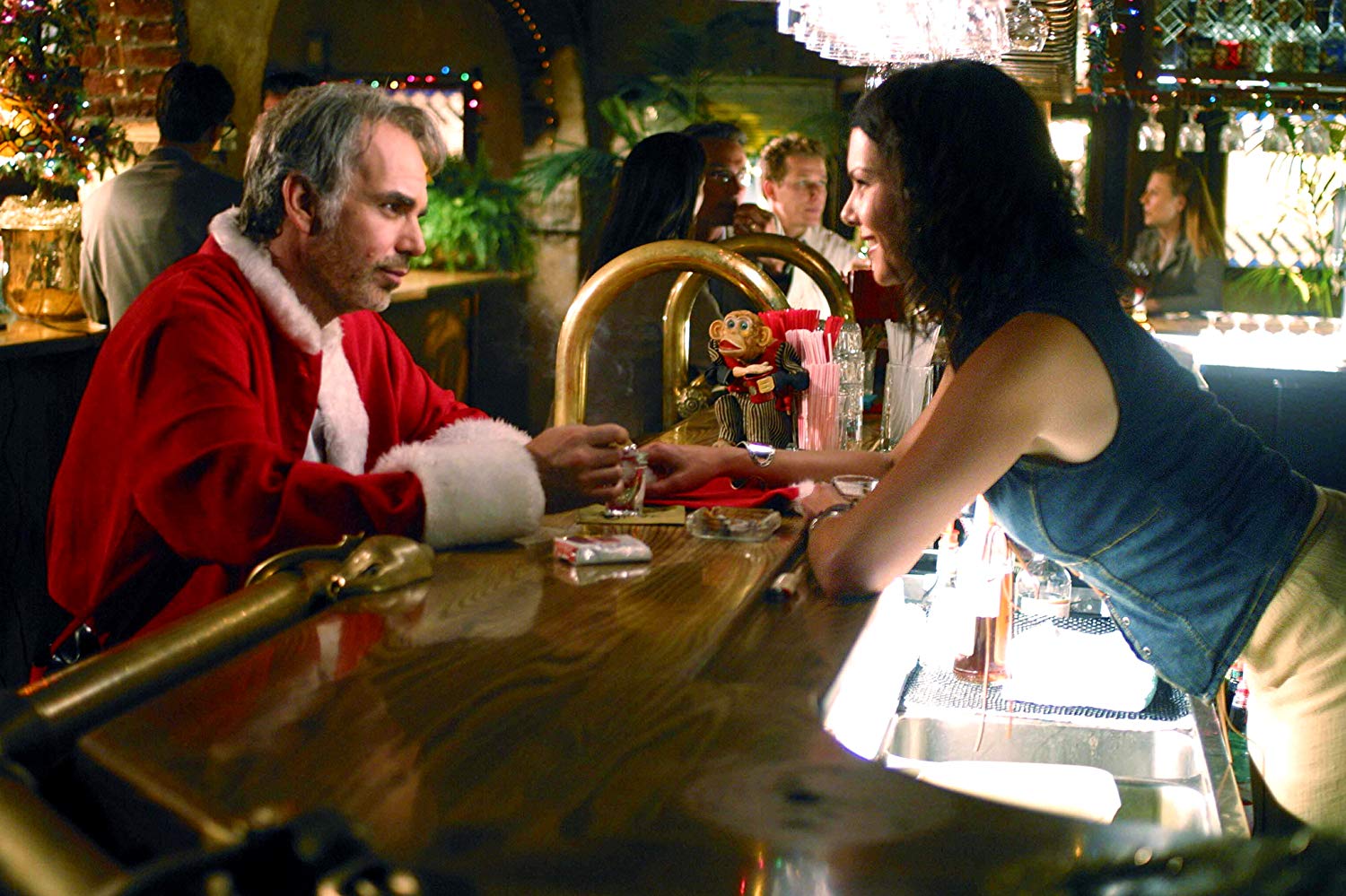
Billy Bob Thornton and Lauren Graham
Lauren Graham and Billy Bob Thornton in 'Bad Santa' (2003) © Dimension Films

Sure, part of the reason there are so many dick jokes in Bad Santa is because it’s the sort of humor that appeals to the dark comedy’s R-rated audience. But on a deeper level, Bad Santa is also the story of a broken man triumphing over his fears of failing as a father and being generally impotent. (“Don’t take no shit from nobody, least of all yourself.” Willie later writes, in a letter to Thurman.) At the end of the movie, Willie is fighting to deliver the one thing he’s been undermining for years: Christmas itself, in the form of a gift for Thurman. The little stuffed pink elephant he steals for the kid may be covered in blood, but it’s also got a small and twisted—yet proudly erect—little trunk.

Sign up for our newsletter to get the best of VICE delivered to your inbox daily.

Follow James Charisma on Instagram.


from VICE https://ift.tt/2E1FPOA
via cheap web hosting

Is Chidi in the Bad Place Because of a Diagnosable Mental Illness?

Welcome aboard the Ethics Express! At least, that’s the idea behind the NBC comedy The Good Place, which follows the trials and tribulations of four recently-deceased weirdos in the Good Place (a sort of heaven, with a surprise twist), the Bad Place (a sort of hell), and some spaces in-between. The Ethics Express is also the name of the trolley used by now-reformed Bad Place architect and literal demon Michael (Ted Danson) to bring a philosophical thought experiment to life. In the episode titled “The Trolley Experiment,” Michael gets a kick out of torturing Chidi (William Jackson Harper) by forcing him to decide between killing five people or veering right to kill just one person. A former professor of ethics and moral philosophy, Chidi is basically living out his worst nightmare, but decision-making isn’t only difficult for him in matters of life and death.

Chidi, in fact, was cast into the Bad Place because of his rigidity and inability to make any decisions. Throughout the show, flashbacks to his time on Earth reveal that Chidi has always dealt with severe anxiety around making choices. Michael tells Chidi that his indecisiveness hurt everyone in his life during his time on Earth, and so he's doomed to suffer for all eternity. But is Chidi in the Bad Place for the wrong reasons? And what is the intended message about mental health issues if he's in the Bad Place because of his anxiety?

While the first two seasons of the show focus primarily on Chidi’s time in the afterlife, his behavior remains much the same as it was on Earth, despite the fact that he believes, at least for a while, that he is in heaven. Whenever he’s faced with a decision of any kind—whether it’s choosing whether or not to help Eleanor (Kristen Bell) become a good person, or if he should use pen and paper or markers and a whiteboard to make a pro-con list—he exclaims that he has a stomachache. For anyone who suffers from anxiety, this seems pretty symptomatic, especially when Chidi explains that his brain often feels like a fork stuck in a garbage disposal.

Licensed clinical social worker Cara Maksimow, who specializes in clinical therapy and counseling for life and work transitions, depression, and anxiety, explained that Chidi exhibits key signs of generalized anxiety disorder: constant worry and difficulty controlling that worry, a need for external validation that causes him to define himself by his academic accomplishments, a propensity to think of the negative possibilities, and general restlessness.

Psychotherapist Robyn Gold, a specialist in anxiety, depression, and acute stress disorder, echoed Maksimow’s thoughts, adding that that this type of maladaptive way of thinking can develop in childhood or as a result of a genetic predisposition to an anxiety-related condition. One consideration in the diagnosis of a mental health disorder is whether symptoms have gotten in the way of a person living their life—whether that's at work, socially, or in another area.

“As his indecisiveness has had negative impacts on others in his life as well as his relationships, we can infer that his social functioning is impaired, or at the very least that he experiences significant distress,” explains Dr. Kathleen Payne, a clinical psychologist who works regularly with PTSD patients.

It’s not just mental health experts who feel for Chidi. Fans of the show have taken to Reddit and other online forums to express their disappointment and confusion as it relates to Chidi’s fate. Many say that Chidi captures their own feelings perfectly with his fork-in-the-garbage-disposal metaphor, and that rather than burning in hellfire, Chidi might instead benefit from the right combination of medication and therapy. Or at the very least a more understanding God. They are not wrong.

The show makes a lax attempt to address concerns about Chidi’s mental health at the beginning of season three. After a near-death experience, Chidi goes to see a neuroscience professor. Apart from a “flurry of activity” that lights up when she asks him to choose between red and blue, she tells him that, at first glance, his brain is very healthy. Chidi is relieved to finally have some answers, but Maksimow explained that diagnosing anxiety disorders is usually based on symptoms, not neuroimaging. Although an MRI might reveal some abnormalities in the part of the brain that processes emotions like fear and anxiety, imaging like that is rarely if ever entirely conclusive.

Fans, too, note that it’s odd Chidi goes to a neuroscientist in the first place and not a therapist. They suspect, hopefully, that this is the first of many stops along the path to self-discovery and self-help for Chidi, although they don’t necessarily agree with his starting point.


One Redditor wrote, “I was a bit thrown by the MRI testing in general. At first I thought Chidi was going to be asking for help from a psychologist or a therapist, but for some reason he goes to a neurologist, and he thinks there's something physically wrong with his brain? Rather than, say, an anxiety disorder that's been exacerbated by the nature of his chosen academic field?” Like many other Redditors, they go on to share their personal story, diagnosis, and treatment for comparison. “This storyline has a strange implication that psychology/therapy isn't real and anxiety is only ‘real’ if there's a literal, physical issue with how the brain functions,” they added.

Neuroimaging aside, the issue is that anxiety, a mental health disorder, is treated as a reason to be damned to the Bad Place, ignoring that it's rarely something an individual can control on their own. In terms of that, introspection does seem to help Chidi at times, but only temporarily, which is to be expected given that you can't typically think your way out of a mental health problem. Still, his intentions are always pure and good, as he always seeks to help and be kind to others. That has to count for something, right? Chidi is the only person in the show’s central four—Chidi, Eleanor, Tahani (Jameela Jamil), and Jason (Manny Jacinto)—who has never done something that appears to be objectively wrong.

Of course, The Good Place isn’t exactly meant to replace, or even call into question, traditional schools of thought on ethics and morality. Creator Mike Schur admitted to VICE recently that, although he’s read a lot of books on ethics and moral philosophy, he understands it all on a “Wikipedia-entry level.” If nothing else, The Good Place is a thought experiment of its own, and Schur concurs. What if the afterlife really does work like this and not in accordance with any major organized religion? What if you could hitch a train from eternal damnation to a Medium Place because you weren’t a total ashhole? What if it wasn’t until you got there that you met a thoughtful, albeit anxious soul who taught you the true meaning of life?

The world of the TV show is flawed, and not just because there’s no Medium Place for medium people. The Good Place, the Bad Place, and the powers-that-be lack compassion and subjectivity. It’s not all that different from life on Earth, where mental illness remains stigmatized, if not outright punishable, and it forking sucks. Having anxiety, depression, or OCD doesn’t make you a bad person, and it certainly doesn’t warrant a one-way ticket to the Bad Place—fictional or otherwise.

Sign up for our newsletter to get the best of VICE delivered to your inbox daily.

Follow Sydnee Lyons on Twitter.


from VICE https://ift.tt/2P9gFP3
via cheap web hosting

Democrats Still Don't Seem to Know What Winning Looks Like

Democrats may still be feeling some residual glow of their historic midterm victory in the House, where their party won a whopping 40 seats. Those gains mean they'll be able to provide a meaningful check on Donald Trump; they also prove there's at least some path for them to win the White House in 2020. Without the presidency, Democrats remain the opposition party, but now they're clearly an opposition party with plenty of steam behind them. The question that needs to be asked, though—before the 2020 campaign descends on us like a horrid cable news fog—is how will Democrats behave if and when they actually run things again?

If recent history is any indication, the answer is something between "passive" and "actively bending backward."

Democrats may well retain the House and drive Trump out of office two years from now, and they have a chance to win the Senate back as well, though that will be a much tougher task. But even if they run the table, they almost certainly won't get the 60 Senate seats required to pass nearly any law thanks to archaic and nonsensical filibuster rules. You may remember the filibuster—or at least the threat of one—as the thing that wrecked the prospects of "cap and trade" climate change legislation passed by the House back in 2010, or the excuse some right-leaning Democrats used to scuttle the progressive "public option" for healthcare the year before.

Nearly a decade later, the Democrats' base has similar issues on its collective mind. Should their party control both chambers of Congress and the presidency, there will be pressure for them to push for a version of Medicare for all along with some form of climate change legislation, perhaps the "green new deal" popular among left-wingers like Alexandria Ocasio-Cortez. Those sorts of bills might get out of the House, but a Republican minority in the Senate would surely veto them if they retained the power to do so.

The way forward is simple and clear: With a bare (50- or 51-vote) majority, Democrats could change the Senate's rules to wipe away the 60-vote threshold, giving them the ability to actually govern the country.

Republicans would complain, of course, but after years of obstructing Barack Obama, these complaints would be transparently self-serving. It's true that the GOP hasn't used the "nuclear option," as removing the filibuster is called, when it comes to passing laws. Maybe that's because they were worried about what Democrats would do when they got back into power, or maybe that's because Republicans didn't need to break that particular norm. They used a technique called "reconciliation" when it came to priorities like the tax cut package and the Affordable Care Act repeal, allowing them to pass bills with a simple majority. (The ACA repeal failed because key GOP defections meant it only had 49 yes votes.) The architect of all these tactics, Senate Majority Leader Mitch McConnell, wrote an op-ed praising bipartisanship after the Republicans lost the House, but that's not the sort of politics he has practiced—Republicans have utterly failed to compromise with the Democrats on key issues, and there's no reason Democrats should compromise in turn if they win big in 2020.


The catch here is that Democratic leaders have shown little appetite for this sort of hardball. Nancy Pelosi, who is preparing to re-assume the mantle of Speaker of the House, is apparently in favor of "pay-go," a rule mandating new government expenditures not increase the deficit—a principle Republicans didn't give a shit about when they jacked up the deficit with tax cuts last year. Pelosi is also reportedly weighing a rule requiring a House supermajority for bills increasing taxes on the bottom 80 percent of earners, which would effectively hamstring proposals like Medicare for all, since that would likely require non-super-rich people to pay more taxes in the name of reducing their overall health insurance spending.

But the person who would be in charge of the filibuster in a world where Democrats possess real power is likely current Senate Minority Leader Chuck Schumer. He's come under fire from the left lately for his willingness to compromise with Republicans on everything from judgeships to border security. Most concerning: Schumer reportedly promised Republicans that the filibuster would remain in place if Democrats retook the Senate.

Maybe Schumer's calculus would change if Democrats had a chance to actually make laws, which they don't with Donald Trump in the White House. But both he and Pelosi have lately demonstrated a commitment to bipartisanship and compromise that, maybe ironically, will prevent anything from being done and in the absolute worst case lead to the end of the world.

The stakes here are revealed when you imagine what will happen if Democrats don't tear down the filibuster if and when they control the government. Republicans would obstruct any actually ambitious legislation, Democrats would therefore fail to deliver on their campaign promises, and Americans would continue to think of Congress as a dysfunctional, do-nothing body—which it is, of course.

Meanwhile, climate change is continuing to get worse, and it's increasingly obvious that large-scale, drastic action needs to be taken. If Democrats let a rare opportunity to do something about it pass them by because of Senate norms or the august traditions of the blah blah blah, they shouldn't be surprised if their base abandons them in 2022. They—if not normal Americans—will deserve what happens after that.

Follow Harry Cheadle on Twitter.


from VICE https://ift.tt/2U0dYmy
via cheap web hosting

Jameela Jamil's New Game Show Sounds Delightfully Awkward

Breakout actress Jameela Jamil, who plays Tahani Al-Jamil on The Good Place, has been wooing fans with her larger-than-life personality on social media, where she finds funny, offbeat ways to discuss serious social issues. Most recently, she dragged Cardi B and other influencers who peddle harmful diet products, practically turning the whole twitter-sphere into eyeball emojis. In her next venture, she’ll apparently be using her skills as a provocateur to ask a bunch of "cringeworthy questions" as the host of a new game show, Deadline reports.

On TBS’s The Misery Index, two teams will rank a series of funny yet terrible real-life experiences on a scale of how miserable they are, based off of the card game Shit Happens. Each team will be made up of one contestant and two people from Impractical Jokers, a hidden-camera show on TruTV.

We couldn’t think of a better person than Jamil to cut through contestants’ BS and shatter the facade that life in 2018 is a-okay, which, you know, it definitely isn't. The show will reportedly rely a lot on her keen ability to find the funny side of life’s absurdities. For her part, Jamil told Vulture she’s excited to get a chance to focus on other people’s problems for a change.

“As someone whose life is just a series of mortifying incidents strung together, it’s going to be brilliant to take a break from my own mishaps, and feast in the disasters of others,” she said. “I cannot wait for the misery to commence. This show is brilliantly ridiculous.”

Hopefully, we’ll be getting a few personal stories from Jamil, too—a lot of her biting jokes are punctuated by her spilling her own tea about why she developed whatever gripe she might be riffing on, with this latest tirade against diet products being a prime example.

The Misery Index has the potential to be pretty funny, maybe even a little cathartic. And with Jamil heading the ship, it’ll probably also go a good bit deeper than just your average game show.

Sign up for our newsletter to get the best of VICE delivered to your inbox daily.

Follow Taylor Hosking on Twitter.


from VICE https://ift.tt/2SmD1in
via cheap web hosting

Artists Like Damon Davis Are Transforming the Image of Blackness

You’ve heard the statement before: Blackness is not a monolith. It stands as true in life as it should in art, but isn’t always acknowledged in that same space.

Throughout history, art has been the silent tool in addressing racial, class, and socio-political strifes. It’s additionally been used to combat hierarchies enforced by those in power by giving the marginalized a place to be seen and heard. In the act of all of this, the idea of blackness being more than the “oppression” has often been overlooked. Artists like St. Louis-born Damon Davis, a documentary film-maker best known for his short film around the Ferguson Protests, Whose Streets?, has long since been attempting to change that.

“We shouldn't just have our feet to the ground, always chronicling and transcribing the world around us. We need to be able to imagine the world as we want to see it,” he tells me in a joint conversation with Black Lives Matter co-founder Patrisse Cullors-Bignac—an artist herself. “It can’t solely be based on anger because you’ll burn out.”

For three years now, Davis has been using western anxieties and obsessions with blackness to create worlds where gods of color can reclaim an identity through the supernatural. And in response, cultural initiatives like Black Lives Matter have been teaming up in joint efforts with artists like Davis to steer greater conversations in the ways that blackness can be symbolized in art; not just through pain and trauma, but through strength.

In advance of his afro-surrealism exhibition, Darker Gods in The Garden of The Low Hanging Heavens, making its debut at the Art Basel next week. We took the time to talk Davis and Cullors about art, and the roles they often play as disruptions and forms of therapy.

Damon, you’re obviously multitalented, from music to film. But when did your more surrealist-based art become this outlet for you?
Damon Davis: I’ve always been into the surrealist art scene, especially in the world of film like in the case of Guillermo del Toro, or even before when it was Terry Gilliam’s work and his 80s outlandish style. The thing for me though, is that I just never saw anyone that looked like me in those spaces. So as I got older and acquired some skills, it became a natural thing. The last few years for me has been an alignment with black people and the pain around what we’ve been going through. But prior to that, it was already surrealist and far more out there. It was the nature of the climate we were living in, especially in the specific place where I lived in being St. Louis, Missouri, where we needed a more aggressive political form of artwork that could be used as a weapon. Now, what we also need is some joy-based work with a larger basis in the imaginative. I think that’s why the surrealist scene has been really moving, and I’ve been pushing back into that.

1543520391533-art10

In saying all that, what do you hope audience take away from your art, Darker Gods, Damon?
Davis: I hope that when people of color see it, they can imagine themselves in a greater light. I hope it brings joy to people, and that it makes others uncomfortable. I’d like them to deal with their own internal shit, and how they view black people when they’re presented with a blackness on a larger-than-life level. I hope they think and deal with it. I want people who don’t feel welcome in these spaces to feel welcome in this one, and I’m primarily talking about my people.

Follow Noel Ransome on Twitter.

Sign up for our newsletter to get the best of VICE delivered to your inbox daily.

This article originally appeared on VICE Canada.


from VICE https://ift.tt/2Q4HJUY
via cheap web hosting