Tuesday, September 29, 2020

The Pure Hell of Quarantining in Student Halls During a Coronavirus Outbreak

In a large, yellow brick building in north west Glasgow, just over 1,000 students are experiencing their first week at university. Under normal circumstances, this would involve getting drunk on WKDs, going on mildly offensive pub crawls and pretending you know how to smoke cigs. But freshers week in 2020 is anything but normal for the residents of Murano Street Student Village.

Last week, students at the University of Glasgow’s largest halls experienced a mass coronavirus outbreak, something universities across the country had feared. When 124 students tested positive for the virus (a number that has likely risen), the university imposed an accommodation-wide lockdown, forcing over 1,000 first-year students to self-isolate in their first weeks living away from home.

The reality of the situation for these students is dystopian. The Facebook page for Murano publicises events including, “Find a Mate Whilst You Isolate: Online student mixer” and “Glasgow Uni Irish & Northern Irish Society quarantine pub crawl”. Students stick Post-It notes to their windows, messaging the outside world for more beer. This is what their university fees are paying for: to sit in a room, away from people they know, as they complete their studies entirely online.

Becca Leslie is an 18-year-old student from Aberdeen studying film and TV studies at the University of Glasgow. She tells VICE News about the reality of self-isolating at Murano.

“When I first got here, it was very, very lonely”

Leslie arrived at Murano in early September, and was the first person to move into her 12-bedroom flat. “When I first got here, it was very, very quiet,” she says. “A lot of people were here in 12-person flats but their flatmates hadn't arrived yet, and it was very, very lonely.”

“I had to have the windows open since it was hot, and all I could hear was people outside having fun,” she continues. “It was not a good experience, but I think that it definitely did lay the groundwork for people feeling that need to socialise with other people. If you didn't, you were sat there by yourself and the first time away from your parents and completely alone.”

“You can't really social distance in a small flat”

IMG_6874.jpeg
Toilets in the Murano Street Student Village flat Becca Leslie shares with 11 other students. All Photos: Becca Leslie.

Before the outbreak, some students had small flat parties, which would be shut down by the accommodation security team. Students then started socialising outside in large numbers, mixing between households. Murano has a reputation for being the “party halls”, so Leslie and her flatmates saw some inevitability to the outbreak.

“We did try and avoid it, but you can't really social distance in a small flat with 12 people, and you can't really social distance in a building where you're passing other people in staircases, [and] you can’t really social distance when you're sharing the same laundry, the same facilities,” she says. “I think we all just sort of said: ‘You know what, it's all gonna spread either way, so we might as well have fun with it.’ We're dumb 17 and 18-year-olds. I don't really know what they expected to happen.”

As the socialising increased, so did the police presence at the halls. “Police started patrolling around,” Leslie says. “It really did feel like a prison. It was insane. I do understand they were doing it out of concern for our safety but we really shouldn't have been here in the first place if that's what they were so worried about.”

“We saw that someone had tested positive, and we were like, ‘Oh, it's happening’”

IMG_6847.png
A screenshot from a group chat between residents of the Murano Street Student Village.

In the following days, more people started to test positive. “I would just get messages from friends I’d made from those gathering being like, ‘Oh, our entire flat is self-isolating now,” says Leslie.

“I think I remember, we were all in our flat in our kitchen, and we were looking through the Murano group chat and we saw that someone had tested positive, and we were like, ‘Oh, it's happening way sooner than we expected’.” she says. “Obviously, it only takes one person in a 12-person flat for it to spread to everyone because you're sharing showers, you're sharing a kitchen, you're sharing two toilets between 12 people.”

Leslie’s housemates also started to exhibit symptoms. Two of them tested positive at first, then another three. “Now at this point, it's five people who have tested positive, and seven of us trying to avoid them but also not, because there’s no real point,” she says. “We're all waiting results, which I don't think are going to be negative.”

“I don't really know what to do”

IMG_6879.jpeg
A whiteboard in one of the Murano flats counting down the two-week isolation period.

“When I heard that all of the isolation was coming in, I was like, ‘I don't know how I'm going to survive with this,’” says Leslie. “‘This is actually horrible. These are people that I've barely even spoken to and they're gonna be like my family now.’ It was definitely hard to get used to and I think it hasn't really sunk in for a lot of people.”

The reaction to the quarantine varied between students, but everyone has largely abided by the rules. “Some people are a lot more scared of getting it, and some people are like, ‘Well, fuck it’,” she says. “I'm more in the middle. I have been spending a long time in my room because I have classes and assignments to do, which is another thing that's really difficult to focus on.”

"All the people that do have coronavirus, they've been sitting together, they've been socialising," adds Leslie. “All the people who have tested negative, some of them aren't leaving their rooms at all. I don't really know what to do. It's hard to gauge what's the most important thing. Is it not going insane in my room or is it not suffering from the physical effects of the virus?”

“We're all trying to get food deliveries”

Without friends or family in the area to help, Leslie and her housemates have been relying on food parcels from the company that manages the Murano halls. “We're getting food deliveries,” she says. “You call the [company] and they basically provide you with little bags of dry food. It's nothing nutritious. It's basically beans and Mug Shot pasta, instant noodles and cookies, crisps and juice boxes (because we're children). There was nothing fresh, and there was nothing that you can really have a balanced diet on.”

“We're all trying to get food deliveries from Tesco and Morrisons,” she adds, “and we can't find a booking because there are so many people trying to get a delivery slot. [There’s] no fruit, no veg or nothing. It's already running low, and there have been delays.”

“We didn't need to be here. That's what's causing me anger”

While Leslie is coping in her halls, she is particularly frustrated with the way that Glasgow University has handled the situation. “The thing that frustrates me is the fact that in July, we put our deposit down for the accommodation,” she says. “That was £600 and we can't get that back now. At that point in time, they did not tell us that all of the classes would be online. We thought that at least some of them would be online but we thought, of course, we're going to need to be in Glasgow for university. But it turns out that we didn't actually need to be here because all of our classes are online.”

She continues: “But we're here, we're suffering, we’re not able to see our parents. We're not able to see anyone. We're just able to see people we've known for one week. We could have been doing our online classes, we didn't need to be here. That's what's causing me anger.”

“I think there is a growing group of people who are very much not wanting to pay their rent”

IMG_6837.jpeg
Posters calling for a rent strike near halls.

I ask Leslie what’s next for the students. How does she feel about the rest of her first year at university? “I think I am upset, quite worried,” she says. “I think there is a growing group of people who are very much not wanting to pay their rent.”

“[Socialising in halls] is basically the only reason why we came here,” she continues. “Murano is known as being a very sociable flat. Why open these flats which are very much infamous for being party central? Of course this was gonna happen. It pains me to see that a lot of people are so angry at students. They handed this to us on a silver platter. They can't blame us.”

VICE News approached the University of Glasgow for comment on the quarantined first-year students. A spokesperson told VICE News: “We were clear with our students that much of the first semester would involve a large degree of blended learning, but that we hoped to provide some face-to-face teaching.”

The spokesperson continued: “We very much regret that the pandemic has impacted on students in our residences and we recently announced a package of support to help. This includes a month rent free and £50 for every single one of the 2,800 students in our residences. We have provided hot food and emergency food bags along with additional towels and bedding for those who need. We appreciate that this is a very difficult time for our students, but we are doing all that we can to be supportive.”

@rubyjll


from VICE US https://ift.tt/2SaAI3C
via cheap web hosting

Indonesia Plans ‘Jurassic Park’-Style Attraction for Komodo Dragon Tourism

Indonesia is pressing ahead with controversial plans to build a multi-million dollar Jurassic Park-style attraction for tourists eager to catch a glimpse of its famed Komodo dragons, the world’s largest lizards.

The $6.5 million proposal, which drew fire from wildlife conservation groups, is tied to a government-sponsored tourism and economic redevelopment campaign for when international tourism safely resumes.

Architects behind the idea took to Instagram to share a video of their design, set against composer John Williams’s theme song used in the dinosaur movie franchise.

No official timeline has been confirmed but construction work will be carried out on Rinca island in Komodo National Park and will include a 1.3 hectare geopark as well as tourist information center.

Around 4,000 Komodo dragons live on a cluster of islands in the park, a UNESCO World Heritage site and huge tourism draw. The Indonesian government temporarily cut off public access in April 2019 to allow for the giant reptiles to recuperate after authorities busted a local dragon-smuggling ring.

In normal times, visitors would arrive by boat having been strongly discouraged from getting too close to the strong, giant reptiles - whose toxic bite can prove fatal. They are meant to stick with local guides and not venture off on their own.

Stricter changes to the island were being discussed in 2019, with local authorities planning to restrict the number of visitors through park tickets and higher entry fees.

But as COVID-19 spread rapidly in Indonesia - the national case figures stand at more than 280,000 infections- visits to Komodo were once again curtailed.

How the dragons will feature as part of the new attraction remains unclear. But conservationists and local residents criticised the proposal.

“According to our ancestors, conservation means to live together with the Komodo dragons within their ecosystem,” one islander told ABC news. “Conservation has nothing to do with making financial benefits.”

A representative for the business community on Komodo also told ABC that the plan should be scrapped. “We demand the government to be completely transparent regarding its construction and immediately consult the public beforehand,” Aloysius Suhartim Karya said.

The Indonesian government did not immediately respond to requests for comment from VICE News.

But Shana Fatina, a managing director from the local tourism authority, was quoted as saying that officials from the environment and forestry ministry had been consulted and the development on Rinca island would not interrupt ongoing conservation efforts.


from VICE US https://ift.tt/33ezxH0
via cheap web hosting

7 People Talk About Job Hunting for Months During the Pandemic

In September, unemployment in the U.S. fell below 10 percent for the first time since March 2020. Unfortunately, this still leaves tens of millions of people out of work, looking for jobs, and trying to collect unemployment. The crisis is far from over: 870,000 new claims were filed last week alone.

When the extra pandemic unemployment funds of $600 a week expired at the end of July, people faced even greater financial pressure to find work. The wrenching combination of smaller unemployment checks, fewer available jobs, and no second stimulus check in sight have all left American workers struggling to ensure they can pay for rent, food, and health care. 

VICE spoke to seven people around the country about what it’s like to still be unemployed and job hunting nearly seven months into the pandemic. 

Some names have been changed for professional and privacy reasons. Interviews have been edited for length and clarity.


Ngozi, 25, Brooklyn, NY 

jobs3.JPG
Photo courtesy of Ngozi

I was a receptionist at a global investment firm. I was laid off because everyone was moving to remote roles, which wasn’t possible for me since my job was front-facing. 

From the start, navigating job opportunities has felt pretty hopeless, especially as the death toll and unemployment numbers skyrocketed. I have an autoimmune condition, so becoming an "essential worker" isn't an option for me. I did interviews and waited months to hear back about companies' decisions—some places’ responses were constantly getting pushed back until I just never heard from them again. In one instance, I was in various stages of interviews over the course of three months for a job that I didn’t end up getting. 

My economic situation is not fantastic. I never received a stimulus check, and after having difficulty claiming my unemployment benefits, I haven't been able to collect any funds since July. It was nearly impossible to talk to a human to get some help with figuring out either problem,  and all the sleuthing I did to figure out what's going on at the NYS Department of Labor and IRS was taxing, mental health-wise. My unemployment checks will be held until NYSDOL assigns someone to help get that resolved, so I’m waiting. 

In the meantime, I'm sticking to a tight budget and leaning on my mom for a little bit of financial support for rent. I've been looking to get more creative and maybe become an independent accessibility consultant for companies rather than seek traditional employment.  I hate capitalism and would prefer to do other things I am good at and enjoy for pleasure. 

I was able to schedule a few career coaching sessions through some Black justice movement fam involved with BOLD. The organization also offered to pay for some online therapy sessions. My mental health has improved a bit, so I've had more capacity to apply for more jobs and interview with headhunters. I've been getting really good feedback on my resumé, and friends have been sending openings to positions I might actually enjoy, so I'm feeling more hopeful these days. 

Kaitlin Stevens, 27, Queens, NY

kaitlin.jpeg
Photo courtesy of Kaitlin Stevens

I was a marketing associate at a small publisher and educational materials company. I got laid off in the second week of March since most of the company's business relies on in-person sales at New York City public schools, which had closed due to COVID. I’ve been looking for jobs in the same field, specifically in young adult fiction. I apply whenever I see something relevant, which is typically one or two times a month. I haven't heard back about anything since I started applying for jobs in April. My major frustration is knowing I’m qualified, but feeling like I can never get a foot in the door.

I’m living off of savings for the most part and taking freelance writing gigs as often as I can, often for less pay than I feel is fair. With my unemployment running out, the pressure to find something steadier is weighing on me. I've also been doing odd jobs here and there between writing gigs—I'm working an event for a wine company this week, as I have a background in doing that. It isn't exactly the safest time to be working with people, but it puts money in my bank account. I’m also writing a YA novel and am planning to find an agent by the end of the year and start pitching the book by the top of next year. 

Photo by Lucas Michael

Clare Palo, 26, Brooklyn, NY 

claire.JPG
Photo courtesy of Clare Palo

I was a social media editor at Vulture at New York magazine/Vox Media. I was laid off in mid-July, when my position was eliminated due to COVID-19 cuts and restructuring.

Since then, I've been applying and interviewing for jobs, and I'm getting pretty far in rounds of interviews. I've applied for about 40 jobs and had real interviews for 12. My biggest frustration has been the long interview process. On average, I'm doing four or five rounds, including phone calls, tests, and video calls, all of which takes several weeks, if not months. Interviewers are asking a lot of intense questions about why I was laid off, as if COVID-19 and an economic recession isn't a good enough answer. 

The job market in media is grim. Layoffs have hit almost every single media company I've interviewed with. I'm not sure when the industry will bounce back, especially since ad sales, in-person sponsored events, and other revenue sources that fuel the industry are on hold until further notice. 

My economic situation is not great. Next week will mark two months without ever receiving unemployment benefits, and no one seems to have an answer as to why. The NYS Department of Labor has been completely unresponsive, and I'm out of ideas. I'm not sure how much longer I can go without having money in my bank account. I was laid off a week before I turned 26, making it impossible for me to go back on my family's health insurance. Luckily, I have health insurance until the end of the year (due to New York's union negotiations). If I don't get full-time work before then, I'll join the long list of people applying for Medicaid. I'm continuing to apply and interview for jobs daily. I haven't taken any time off from job-hunting at all. 

Anthony*, 40, San Francisco, CA 

I’m a substitute teacher in the SFUSD. I was laid off from my last full-time position in March. I was given a small amount of money by the district each month until the end of the semester.  

I've had job offers to be a private teacher/tutor, but none of the potential employers made me feel like my safety was a priority. I'd take a 100 percent outdoors private job if it were not a contractor position, with all equipment (educational materials, PPE, etc.) paid for or provided by the employer. I'd want a fair wage with all the benefits I would receive as an employee (breaks throughout the year, life insurance, sick leave, etc.). All these basics are what I have when I work for the SFUSD. I’m not going to compromise that for a dangerous job. 

None of the wealthy families seeking private teachers/tutors have offered me the combination of outdoor teaching space, materials, and employee status, the last of which seems to be the sticking point. If I want to go back to being an independent contractor risking my health and safety, I can just go back to driving a taxi. At least then I don't have to deal with rich people telling me how to do my job. 

We're hanging in there—my wife is working, and I'm collecting unemployment. There's supposed to be an increase in available distance learning substitute teaching jobs, though I have yet to find one. I'm hopeful that in-person education will return by January, which will allow me to work full time again. I'm going to continue to solicit tutoring and teaching jobs that are safe for my family and me. 

Kitty Milford, 39, Syracuse, NY 

kitty.JPG
Photo courtesy of Kitty Milford

Before COVID hit, most of my income came from sex work: generally, full-service sex work, but also porn. I have autoimmune issues, so as soon as I became aware of COVID, I stopped seeing clients because I was at higher risk of getting sick. My fear is that there lots of sex workers will get sick because they were not able to take time off. 

The expectation that sex workers can just go online is extremely frustrating. Like a lot of sex workers, I can't just switch: For starters, my kids are home all day. It's also a completely different business model and market, which has become saturated, and celebrities are making OnlyFans accounts and fucking things up for actual sex workers.

I've fallen back on my most degrading side hustle: writing personal essays (lol). My spouse's job is safe, but that's only one income, and not quite enough to support six people. I was able to get unemployment beginning in May, which was so helpful, because we have four kids. Since the extra pandemic assistance ended, I’m only getting $182 a week. We're running up our credit card debt! If we keep going like this, we’ll eventually max out our cards. 

In about a month, I think I'll start seeing select clients again and make them take COVID tests first. Some won't want to, but many will be happy to. Then I’ll just hope I don't get sick. 

Erin, 24, Chantilly, VA

unnamed (1)d fhjk.jpg
Photo by Allison Greenlea

I was working as a server when COVID hit. On March 15, the team received an email from corporate stating the entire chain of restaurants would be shut down until further notice. 

Job hunting has been the most humbling and frustrating thing. I was gearing up for a career change and moving from food service into my Big Girl Job search. I decided to apply for Foreign Services, and started looking into Department of State jobs. The process for applying to FS is a long one; I probably won’t see an offer for employment for another year. Recently, I dropped my resumé off to some restaurants in the area, as things in Virginia have started to open up again. I had some promising leads with a few, but no offers yet. 

Thankfully, my economic situation hasn’t been too gutting. I moved back home in May after I broke up with my ex and when COVID really started to get bad. Not having to pay for rent or utilities has helped a lot. I’ve been on unemployment since late April. Since my living expenses have decreased significantly, I’ve been putting all that money into savings. I’m super fortunate to have a stable place to rest my head and my family to support me.

For now, my plans for employment are continuing to apply for jobs with the Department of State and networking as much as I can. I’ve had time to reflect and reconnect with my personal creative endeavors, but I’m hesitant to do these things for profit because I’m afraid of tying the things that bring me joy to a paycheck. I don’t want capitalism to completely ruin the things I find solace in.

William Nowak, 30, Chicago, IL 

william.jpeg
Photo courtesy of William Nowak

I was a full-time floor leader (essentially, a manager/supervisor) at Lush Cosmetics. At the end of March, I was furloughed. Come August, I was permanently terminated based on company decisions as businesses remained closed. My health insurance coverage ends after September.

After being terminated, I started applying to as many jobs as I could. I had an in-person interview with World Market for a management position and I was offered the job the same day. I took it. But the requirements of the job were not clearly represented when the offer was made; I was expected to do tasks that were extremely labor-intensive for a very small amount of pay. The store was also staffed with a pretty sizable amount of employees, making it difficult to socially distance. So I quit.

Brick-and-mortar retail is a dying industry, so it’s really hard to see a lasting future post-COVID. The only reason I’m still job hunting within the retail pool is because it’s where I’ve worked for the last 10 years. I graduated last year with a music business degree and was hoping to get into the live entertainment industry this year. But if there’s an industry that looks even bleaker than retail, it’s live entertainment. 

I’m receiving unemployment benefits, but without the additional $600, it’s not a livable amount of money. I’m fortunate enough to have family who help me out with groceries, bills, and rent, but it’s not sustainable to constantly ask for help. 

Unfortunately, my job search has been put on pause, as my laptop broke two weeks ago; it has my resumé and other important documents on it. It’ll cost $300–$400 to fix, which is an unimaginable amount of money right now. I’m not exactly sure when I’ll even be able to actively apply to jobs again. 

 Follow Reina Sultan on Twitter.


from VICE US https://ift.tt/3471jEy
via cheap web hosting

Amnesty International Halting Operations in India Signals Crackdown on Dissent

Global human rights watchdog Amnesty International has described the government clampdown on its India operations as “unprecedented in a democracy” and a “huge escalation in repression.”

On Monday, September 29, Amnesty International India (AII) announced that they’re being forced to suspend their work in the country as their bank accounts have been frozen by the government over “unfounded and motivated” allegations of violating the Foreign Contribution (Regulation) Act, 2010 (FCRA).

The FCRA is a controversial law that regulates foreign donations and ensures it doesn’t affect internal security in India. Activists and NGOs have called it a “death knell” that would silence dissenting voices.

In an interview with VICE News over the phone, Ashfaq Khalfan, Director of Law and Policy at Amnesty International, said that “this is shocking in a democratic country, and calls into question the government's commitment to human rights and freedom of expression.”

“India has a vibrant civil society, although many groups face restrictions and harassment. But to have a crackdown that shuts down a human rights organisation nationally is shocking. How far is the government willing to go?” said Khalfan.

In October 2018, the Indian government’s economic intelligence agency Enforcement Directorate (ED) raided AII’s office in the southern Indian city of Bengaluru. The raid lasted 10 hours and looked into the NGO’s accounts related to FCRA funds.

“They came asking for information which was in the public domain,” said Khalfan.

The same year, the ED had frozen more than a dozen bank accounts of environmental NGO Greenpeace after searching their premises on charges of alleged forex violations. Greenpeace had called it a “part of a larger design to muzzle democratic dissent in the country.” The NGO was working on multiple campaigns related to climate crisis.

“This government has launched a crackdown on civil society. It is targeting each individual and organisation that does not agree with its policies,” Priya Pillai, environmental activist and former Greenpeace member, told VICE News. “What happened to Amnesty International is part of this pattern. This is indiscriminate use of power to curb dissent and thereby tearing apart the democratic fabric of the country.”

A 2019 data by global management consultancy firm Bain & Company revealed that foreign contributions to India’s social sector declined by about 40 percent last year amid a series of government crackdown on NGOs. It also said that over 13,000 NGO licenses have been cancelled under the FCRA between 2016 and 2018.

The crackdown on activists has been raising concerns for a while. In 2014, the Indian government’s Intelligence Bureau reported that several foreign-funded NGOs were “taking down Indian developmental projects” by agitating against them. The report also said this severely impacted India’s Gross Domestic Product by two-three percent per year.

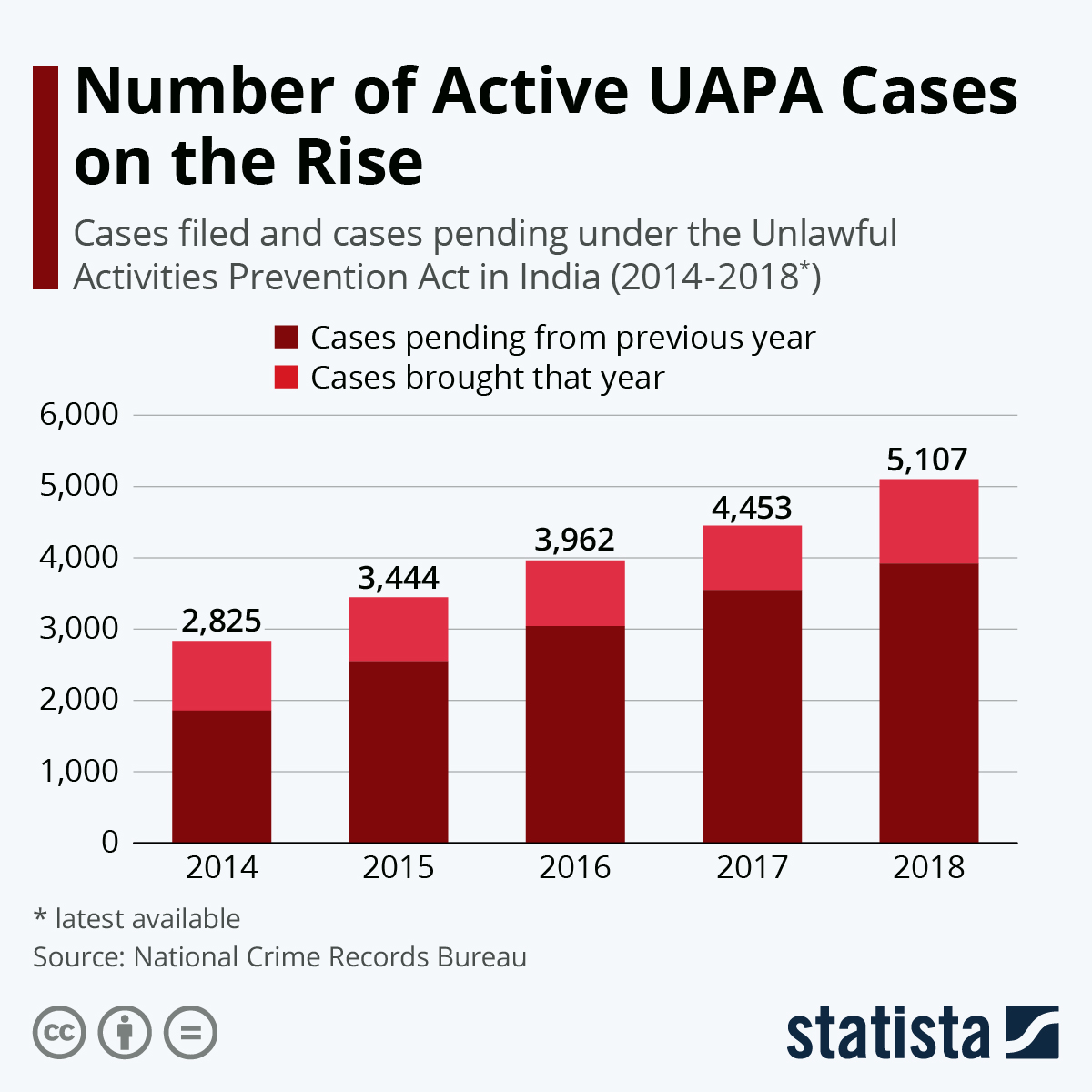
The Indian government has drawn severe criticism for charging protesters under the stringent anti-terrorism law, Unlawful Activities Prevention Act (UAPA). Data from the National Crime Record Bureau shows that 1182 people were arrested under the UAPA in 2018, up from 925 arrests in 2014.

India dissent crackdown activist
Chart Courtesy Statista

The latest round of crackdown on civil society and dissenters is connected to the protests against the controversial Citizenship Amendment Act (CAA). The law seeks to fasten naturalisation process for persecuted minorities, except Muslims, from neighbouring nations. The protests culminated into violence breaking out in the national capital, New Delhi, in February this year.

The Delhi Police have arrested more than a dozen vocal opponents of the proposed citizenship law, naming them in multiple riot cases.

On August 28, AII came out with a detailed report questioning the Delhi Police’s role during the February violence. Early this month, the Delhi Police called the report “lopsided” and “biased against the police.”

On August 5, AII released a human rights report from the newly-formed Union Territory of Jammu and Kashmir—exactly one year after the Indian government took away its special status granted under the Indian Constitution.

Khalfan acknowledged that the government action may be in response to these two reports. “We expected the government to retaliate, but this is more severe than expected,” he said.

The Indian government’s narrative of “Naya Kashmir” or new Kashmir highlights, among other things, the ease for outsiders to attain domicile status in the region and establish businesses. In contrast, the AII report showed detention of political leaders, muzzling of the press, unprecedented restrictions on the internet and lack of access to justice.

Follow Danish Raza and Pallavi Pundir on Twitter.


from VICE US https://ift.tt/3kY3iBW
via cheap web hosting

Japan Airlines to Stop Calling Passengers ‘Ladies and Gentlemen’ in Announcements

Announcements on Japan Airlines flights will start sounding different very soon. The country’s flag carrier has announced that it is changing up its in-flight and airport announcements, foregoing words like “ladies and gentlemen” by Thursday to make way for gender-neutral expressions.

A spokesperson from Japan Airlines told AFP that they “will abolish expressions that [are] based on [two types of] sex and use gender-friendly expressions like ‘good morning’ and ‘good evening’.”

According to CNN, the airline will use phrases like "attention all passengers" and "welcome, everyone.”

The airline has been using gender-neutral terms in Japanese, but will now start to do the same in English and other languages, a first for a major Japanese carrier, Japan Today reported. It recently adopted other changes for more inclusivity, like extending spouse and family allowances to same-sex couples and giving female flight attendants the choice to either wear pants or skirts. In August 2019, the airline also had a special “LGBT Ally Charter” flight for same-sex couples and their families, to celebrate the LGBTQ community.

“By communicating our company’s stance that we are an LGBTQ ally, we’re raising awareness about sexual orientation and gender identity among each and every employee. We’re also assuring our LGBTQ employees that they can continue working at our company,” Japan Airlines Human Resources Strategy Division Director Hiroshi Momota told  Huffington Post Japan in October 2019.

Apart from Japan Airlines, other international carriers have taken similar actions in a bid to promote inclusivity. Australian airline Qantas launched their “Spirit of Inclusion” initiative in March 2018 that encourages staff to refrain from using gender-specific terms. Last year, Air Canada’s flight attendants swapped out “ladies and gentlemen” for “everybody.”

A 2019 survey conducted on 428,000 people aged 20 to 69 found that one in 10 people in Japan identified as LGBTQ or another sexual minority. While many are still steeped in conservative traditions, there has been a growing push for LGBTQ rights in Japan, including a movement to recognize and legalize same-sex marriage. In September, Kyoto followed other Japanese cities in recognizing same-sex partnerships. And in June, Mie became the first prefecture in Japan to ban people from outing other people’s sexual orientation and or gender identity.

Follow Frankie on Twitter and Instagram.


from VICE US https://ift.tt/345cFsI
via cheap web hosting

Duterte Threatens Facebook Shutdown in Philippines After Pro-Gov't Pages Removed

President Rodrigo Duterte has threatened to shut down Facebook in the Philippines as he rebuked the leading social media platform in the country for taking down a network of accounts linked to the Philippine military.

“Facebook, listen to me,” Duterte said in a rambling late night televised speech on Monday. “We allow you to operate here hoping that you could help us also. Now, if [the] government cannot espouse or advocate something which is for the good of the people, then what is your purpose here in my country?”

The president said the government was using Facebook to stop Asia’s longest-running communist insurgency.

The televised dressing down came after Facebook removed a network of 155 accounts, pages and Instagram accounts linked to the Philippine military for its “coordinated inauthentic behavior” that violated the social media platform’s rules.

A sampling of content shared by the tech giant showed the network targeted activists, opposition figures and the Communist Party of the Philippines and its military wing, the National People’s Army.

Included in the dismantled network are accounts that originated in China and supported the potential presidential bid of Duterte’s daughter, Davao City Mayor Sara Duterte, Facebook added.

The Philippine military first denied Facebook’s allegation that they are behind the pages, but it later asked the company to restore the deleted accounts saying they are using it for “advocacy.”

Duterte accused Facebook of siding with the left and communists in the Philippines as he demanded a dialogue with the tech giant’s executives.

“[W]hat would be the point of allowing you to continue if you cannot help us? We are not advocating mass destruction, we are not advocating mass massacre. It’s a fight of ideas,” he said.

The removal of pro-government accounts amounted to censorship, presidential spokesperson Harry Roque said Tuesday, adding that Duterte will probably not order Facebook banned.

Facebook did not immediately respond to requests for comment from VICE News. However, it has stressed before that the take down was not based on content but due to “inauthentic” behavior or when fake accounts mislead people about “who they are and what they are doing.”

An independent investigation done by Washington-based The Atlantic Council’s Digital Forensic Research Lab revealed the names of three Philippine soldiers who operate the network of fake accounts. One of them was the head of the army’s social media operations.

“Although the people behind this activity attempted to conceal their identities, our investigation found links to Philippine military and Philippine police,” said Nathaniel Gleicher, Facebook’s head of security policy, said in a briefing on the take down.

It remains to be seen whether Duterte would take action against a platform that was so key to his election campaign.

The number one website in the Philippines, Facebook was instrumental to Duterte’s landslide presidential victory in 2016, elevating a brash city mayor to the top job.

Duterte’s supporter base thrived on Facebook with mobilization fueled by social media influencers, some of whom were later appointed to government positions.

The Philippine president has also admitted his campaign paid some $200,000 to help rally support on Facebook, as first reported by the Computational Propaganda Project at Oxford University.

“I spent P10 million? Me? Maybe in the elections, in the elections I spent more than that...they were all during the campaign,” Duterte said.

Critics of Facebook say its model undermines democracy and helps autocratic governments across the world, but it remains an enormously popular platform with 2.7 billion monthly active users worldwide.


from VICE US https://ift.tt/34b3Kpk
via cheap web hosting

Half a Million Sharks Could Be Killed to Make a Global COVID Vaccine

Conservationists are worried that the mass production of a COVID-19 vaccine could devastate shark populations around the world, as a number of pharmaceutical companies are found to be using oil from the animals’ livers in the development of their vaccines.

Squalene, a natural organic compound sourced primarily from shark liver oil, is most commonly used by pharmaceutical companies to produce cosmetics and sunscreens. But the substance also plays a valuable part in vaccine development for the way in which it acts as an “adjuvant”—that is, a pharmacological agent that increases the strength of certain medicines by boosting the immune response in recipients.

In short, shark liver oil helps make vaccines stronger. And that, of course, is bad news for sharks—particularly at a time when every major country in the world is scrambling to develop and produce a coronavirus vaccine on a global scale.

Data published by the Regulatory Affairs Professionals Society (RAPS) and the World Health Organisation (WHO) indicates that of the 176 candidate vaccines in clinical and preclinical evaluation, 17 use adjuvants. And according to research by US non-profit organisation Shark Allies, at least five of those adjuvants are shark squalene-based.

One of them is MF59: an adjuvant that typically contains 9.75 milligrams of squalene per dose, and which is currently being used by the University of Queensland, in partnership with biotherapy companies CSL and Seqirus, for the development of a coronavirus vaccine candidate.

If every person on Earth was given a single dose of that vaccine, an estimated 249,351 sharks would have to be killed. If two doses of the vaccine are needed to immunise the global population—a likely outcome, according to some medical experts—the prospective death toll climbs to nearly half a million sharks.

“This is not speculation,” Stefanie Brendl, founder and Executive Director of Shark Allies, told VICE News over email. “However, it's not like 500,000 sharks are going to be hunted down in some particular region just so they can be killed for vaccines. No one is going out to specifically kill sharks right now just to get enough for a vaccine. [But] that is not the point.”

According to Brendl, the point is that the development and production of coronavirus vaccines is likely to keep multiplying over the coming years as the global population attempts to inoculate itself against a range of coronaviruses. And if the harvesting of shark livers continues to be the primary source of a major ingredient in those vaccines, then worldwide immunisation could carry an immense ecological cost.

“It's something we need to get ahead of ASAP, because we are facing many years of vaccine production, for a global population, for many more coronavirus vaccines to come,” said Brendl. “The real danger is in what this can turn into in the future. A reliance on shark oil for a global vaccine—it’s truly insane. A wild animal is not a reliable source and cannot sustain ongoing commercial pressure. [And] the overfishing of sharks globally is already at critical levels.”

Brendl points out that the squalene industry is already taking 2.7 million sharks for cosmetics use—a number that is predicted to double by 2024 and triple by 2027—while millions more are taken for fin harvesting and as a result of overfishing in general. Often the squalene is harvested as a by-product of these activities, but “livering”—where a shark is killed only for its liver, or has its liver taken before being thrown back into the water—is also an issue in some parts of the world.

Great whites, hammerheads and endangered whale sharks are among those most often targeted for their livers. And conservationists like Brendl are worried that a squalene-dependent COVID vaccine could spell further disaster for shark species that are already at critical levels.

That doesn’t mean they want researchers to delay the development of vaccines until they can ensure the absolute preservation of sharks, though.

“That is not what we are asking for,” Brendl said. “We are asking for producers to continue what they are doing. There is no need to halt or slow down anything. We ask that they start testing non-animal based squalene ALONGSIDE animal based squalene for all uses … We ask that the pharmaceutical and the cosmetics industry replace their shark squalene with alternatives as soon as possible without affecting current vaccine development.”

In recent years scientists have started turning to more sustainable, plant-based sources for squalene, including vegetable oils from rice bran, wheat germ and olives. In 2015 a team of researchers in the US produced squalene biosynthetically using genetically engineered bacteria. In 2013, a team of researchers in Poland noted that the oil from amaranth seeds could be used as a promising source of squalene, stressing that “in the interest of protecting biodiversity, raw materials of animal origin must be replaced by alternative sources that respect our environment”.

“The industries stand to profit immensely from having a global vaccine,” said Brendl. “It is reasonable to ask that they start thinking about a reliable and sustainable production.”

Follow Gavin on Twitter


from VICE US https://ift.tt/339iW7f
via cheap web hosting