Thursday, January 31, 2019

Five Questions About This Bizarre Photo of Kanye, Cudi, Pete, and Timothée

In the early hours of Thursday morning, the denizens of the internet awoke to rub the sleep out of their eyes, pick up their phones, and—because they don't know what's good for them—open Twitter, where they came upon a cursed or possibly blessed, perplexing image posted by the incredibly attractive, megawatt smile-having rapper Kid Cudi.

The image is somewhat reminiscent of the Last Supper, only in this case Jesus and his disciples have taken the shape of Kanye West, Timothée Chalamet, Kid Cudi, and Pete Davidson, who have all gathered at what could possibly be a private dining room at the Midtown Manhattan Benihana, or maybe somewhere swankier like Nobu. But why? What has brought these titans of industry, makers of club bangers, dumpees of pop stars, doers of dope shit, and fuckers of peaches together to chat over a plate of what appears to be hard boiled eggs, raw mushrooms, and either taquitos or tightly rolled blunts?

It turns out they all gathered there for Cudi's birthday, which makes sense—but still, I have questions, and I need answers, or there is a definitive possibility I will never sleep again. Unless I get my hands on a white noise machine and one of those taquito blunts. Which reminds me...

Really, what the hell are they eating?

This collection of fine, and in some cases highly questionable (*cough* Kanye *cough*) men have access to the finest cuisine on this planet, and probably other planets us normies will never explore. And yet why does this pile look like shit you'd find in the snack section at Marshall's next to jars of boysenberry jalapeño jam, old ass popcorn, and an abandoned Kat Von D eye shadow palette covered in black shimmer? Maybe I'm not refined enough to recognize high-end cuisine when I see it (I did once add Flaming Hot Cheetos to Caprese salad, which was hella dank FWIW), but this looks terrible. Are those two red piles the result of a can of wet food intended for a rich lady's cat turned over onto bone china? We'll never know.

They're talking about their feelings, right?

If there's one thing that brings this collection of sculpted XY chromosomes together, it's feelings. So. Many. Feelings. Did they manage to break out into these smiles after weathering some serious tears? I love the idea of these men congregating to go in deep. None of that fake shit. "WHO ARE YOU, TIMOTHÉE?? TELL ME SOMETHING REAL, TIMOTHÉE!!" Did they emerge from this minimalist dining room emptied of their traumas and unshackled from their pasts, covered in sweat, and smiling in the expression of pure ecstasy that comes with discovering that ancient Egyptians have blessed them with the ability to escape the bounds of time and space and actually become love? Did they split a Lyft on the way home, and did Cudi pretend he didn't know how to do the split thing in the app so he would't have to pay? Fuckin' Cudi.

Who kissed?

If I was a gambling woman, I'd put good money on Kanye kissing Pete. Mainly because I think they are the ones that need it most. The act of not only giving love, but receiving love, is healing and bonding. And I bet the kiss, if it happened, was nice. Like really nice: delivered at the precise moment its recipient needed it most. Did Kanye's pillowy lips meet Pete's forehead? Then left cheek? Then right cheek? Then, after a long stare into Pete's eyes that silently told him everything was going to be okay, the lips? Perhaps after Yeezy said something like, "Hey, man. You're amazing and talented as fuck, and I just want you to know I see you and love you?" Did I just write Kanye-Pete erotic friend fiction? Am I a sick fuck and like a quick fuck, specifically when the fuck is friendship?

What did Kanye do when the onion volcano erupted?

I have to assume that the chef assigned to their table at what I have alleged is a Benihana dropped the onion volcano on them. They are some of the biggest stars in their respective fields, after all! They probably ordered enough that the manager said, "Go on, give 'em the volcano. We can expense it." So when that onion was chopped and stacked into the unmistakable shape of Mount Vesuvius, and then aromatic steam emerged from within its core, did Kanye at least momentarily break his steely demeanor? Did he say "Ayyye that shits wild!" and then get kind of sad as he thought to himself that sometimes he feels like he is an onion volcano, liable to erupt at any given moment if he's triggered by society (which the chef is a metaphor for)?

What was Cudi's birthday wish?

Was it for love? Was it for health? Was it for a really sick new bike? Who knows. But what we can be sure of is that he got the greatest gift of all: Friendship.

Sign up for our newsletter to get the best of VICE delivered to your inbox daily.

Follow Alex Zaragoza on Twitter .


from VICE http://bit.ly/2B9Ko6s
via cheap web hosting

This 'Sinkhole' in Florida Turned Out to Be a Secret Underground Tunnel to a Bank

Reports of a sinkhole in a suburban area of South Florida this week turned into an all-out FBI investigation after the feds realized that the thing wasn't a sinkhole at all—it was part of an elaborate, man-made tunnel leading right to a bank, the Miami Herald reports.

On Tuesday evening, the Pembroke Pines Public Works Department made a routine stop to follow-up on complaints about a pothole on a local roadway. What they found, though, wasn't some ordinary hole—upon closer inspection, they noticed it looked like part of an underground passageway that had caved in.

Public Works employees called in the FBI, who took a look at the suspicious-ass hole and started digging, eventually uncovering a 50-yard tunnel that led all the way up to the ATMs outside a Chase bank. They found the entrance of the tunnel in a nearby wooded area, stocked with some work boots, a few excavation tools, and an extension cord hooked up to a small gas generator.

According to the crack team at the FBI, the tunnel was likely dug over the course of "months" by a would-be thief (or group of thieves), seeing as how it was headed straight for a bank and all. "They're heading towards the ATM. I don't think they were doing that for any other reason," Miami FBI spokesman Michael Leverock told reporters.

But there were some details about the tunnel that makes this whole story a little stranger—namely, that it was small as fuck. "It's approximately two-foot, maybe three-foot in diameter," Leverock added. "You would have to be really small to get in there and it would be very claustrophobic... There’s no way anybody could sit up in there, that’s how small it was."

"I’ve only seen something like this in the movies—and I’m not even sure I’ve seen this, because it’s so small," he said.

The FBI is currently investigating the tunnel as part of a potential bank heist, but many questions still remain. What, exactly, was this alleged robber's plan? The tunnel didn't lead into up into the bank vault or anything, it just popped up outside—was the idea to rob the place and then make a quick escape by shimmying to safety through a hole in the ground? Would the stolen money even fit through there? Wouldn't a standard getaway car be preferable?

Plus, why is the tunnel so goddamn small? Is this bank heist actually a plot hatched by some sinister children? What size were those work boots, exactly? We need answers, FBI. Get on it.

Sign up for our newsletter to get the best of VICE delivered to your inbox daily.


from VICE http://bit.ly/2UBSuMH
via cheap web hosting

'Dragon Ball Z' Superfans Tell Us Why the Franchise Is Still So Popular

This article originally appeared on VICE UK.

Dragon Ball Z was a revelation to 14-year-old me. Gone was the slapstick silliness of most children's cartoons, in were sprawling sagas full of drama, character development, and overblown fight scenes in which planets were destroyed by colorful heroes; and villains were as dedicated to hurting each other as they were to excruciatingly long pre-fight dialogue.

Although the original Dragon Ball was broadcast in Japan back in 1989, before making its way to western audiences via Cartoon Network and its spin-off channel Toonami in the late-1990s and early-2000s, its popularity has never faded. If anything, the fandom has grown, despite there being a 12-year absence of new episodes between the end of Dragon Ball GT in 1997 and the start of Dragon Ball Z Kai in 2009.

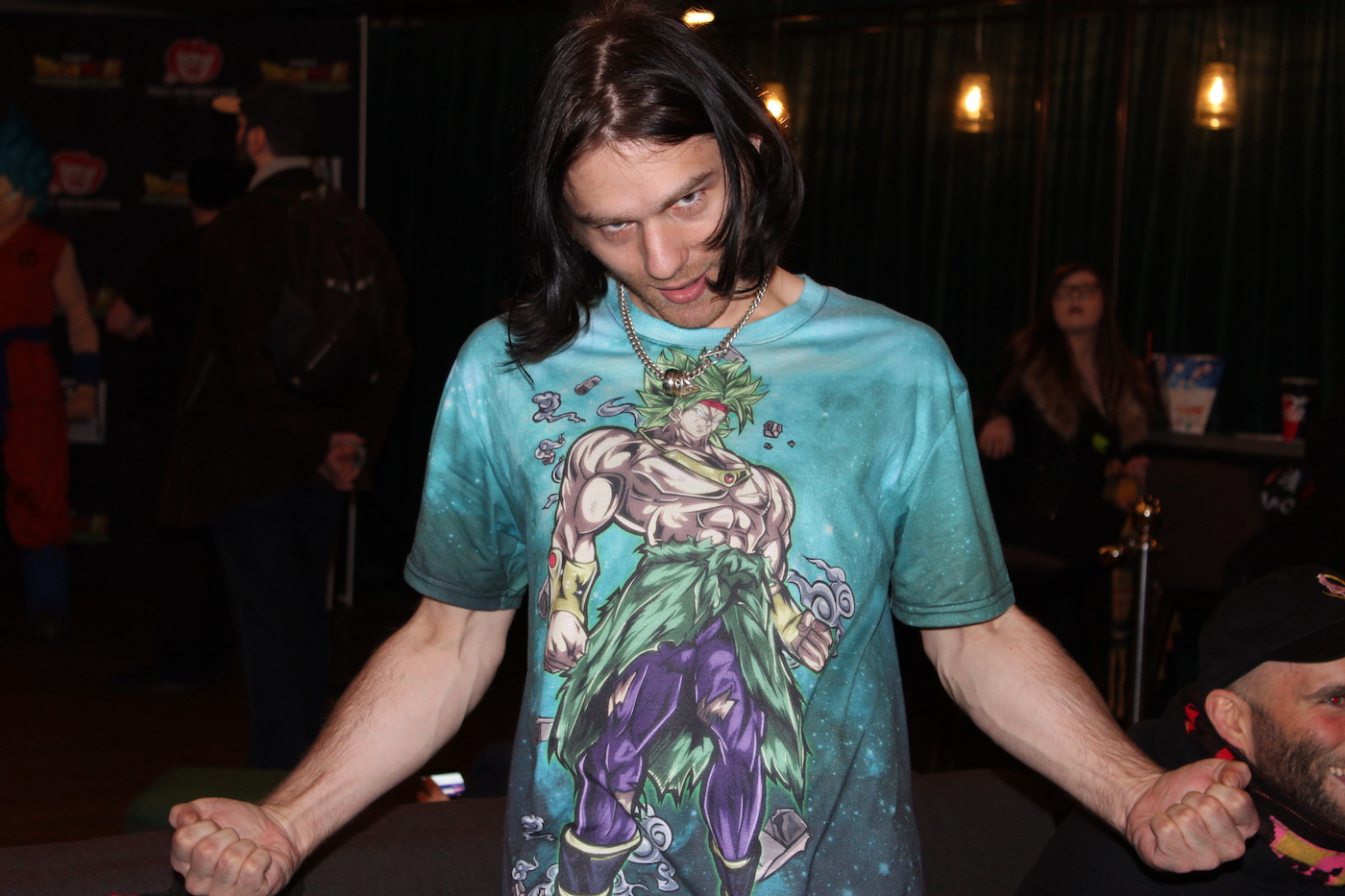
1548870043867-morgan
'Dragon Ball Z' fan Morgan

With the release of the new film Dragon Ball Super: Broly this month, the franchise looks set to attract an ever wider audience. What's strange is that—as we literally just established—a huge fanbase has existed for years, and while there have been 20 animated DBZ movies released since 1986, this is only the second to get a UK showing. So why did the powers-that-be decide to treat British audiences to a theater release of Broly?

"Because a shit-ton of fans demanded it," explains Jerome Mazandarani, COO of anime production giants Manga UK. "We discovered with the previous release, Resurrection F [2015], that the DBZ fanbase in the UK transcends normal anime fandom and is a multigenerational phenomenon. Outside of Studio Ghibli and Your Name, DBZ is the biggest anime movie franchise in the UK."

1548869912907-a-and-c
'Dragon Ball Z' fans Abigail and Chris

At a special screening for fans in London's Leicester Square, that multigenerational audience is clear to see. The fans lining up outside are more diverse in terms of age and ethnicity than I've seen among any other major cult following. Noticeably, though, that diversity doesn't stretch to gender: the fans are very much mostly men.

1548869302784-winston
Winston

"I've been a Dragon Ball Z fan since I was 15, and I'm 33 now, so it's been the most influential thing in my life," says one fan, Winston. "Dragon Ball Z isn't my favorite anime—it's beyond that. It's my life story. It's beyond TV shows, beyond anime—it is what I do with my life. I got my pay rise just so I can buy more Dragon Ball Z stuff. Whenever there's a convention or [a chance to meet the voiceover actors], I just study really hard, put in the work and make sure I can get there. My next plan is to buy a house so I can fill it with Dragon Ball Z memorabilia."

I'd already been exposed to some manga and anime before being turned on to Dragon Ball Z, but for many of the fans here, it seems their dedication stems from the fact that DBZ was their gateway into this world.

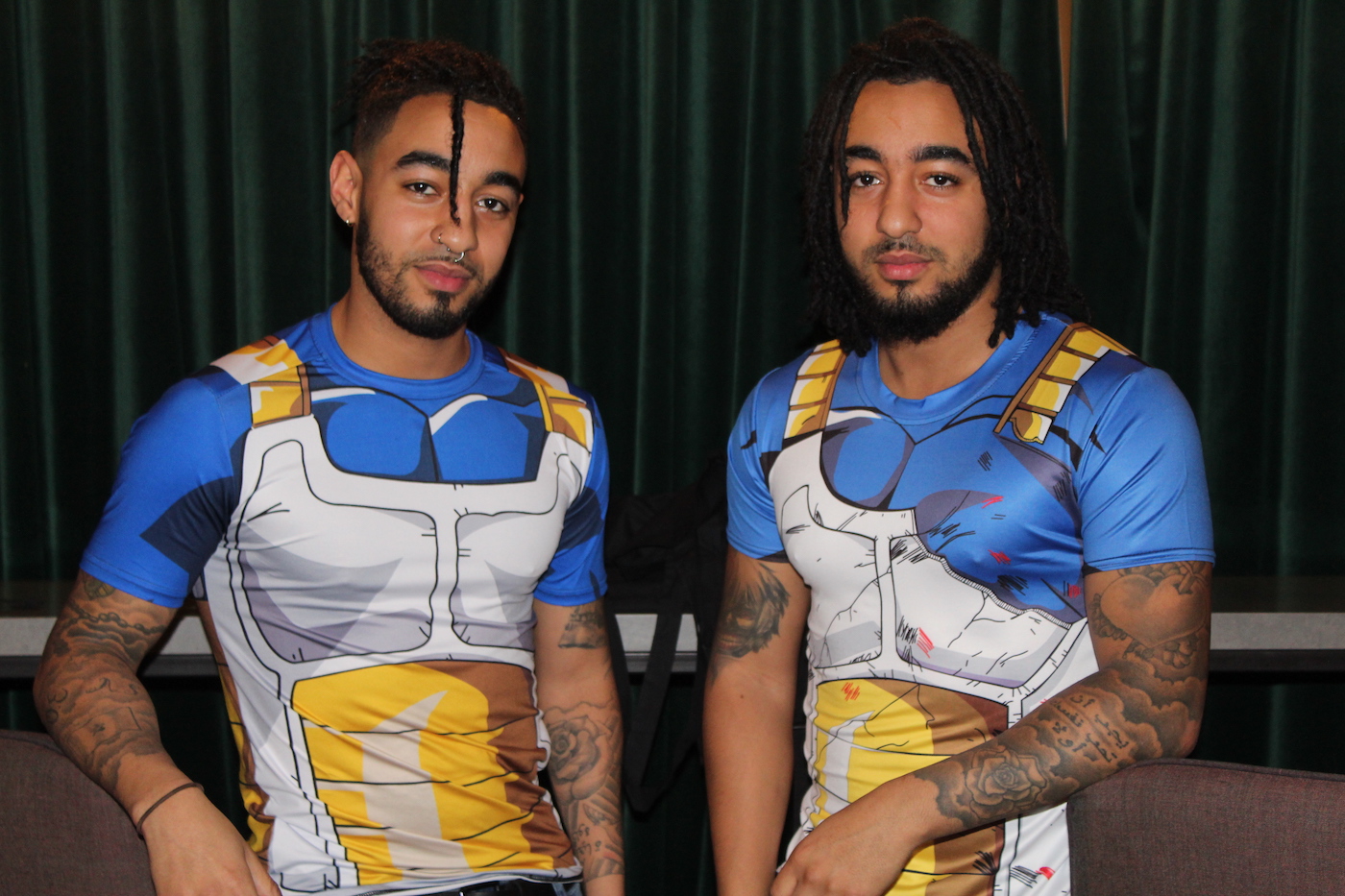
1548869262115-IMG_6088
Shakeel and Kameel

"We were watching it from a young age, [on] Cartoon Network, before Toonami was even a thing," says Shakeel, from London. "We were, like, five or six when we first saw it, and the fight scenes just blew our minds. We'd watch Dragon Ball Z from, like, 12 AM all the way through to 12 PM, all day."

"It was the first anime we ever watched—it was the OG anime," adds his brother Kameel, whose arm is covered in anime tattoos. "If it wasn’t for Dragon Ball Z, I don't think anyone in the western world would even be into anime, at least the way they are now."

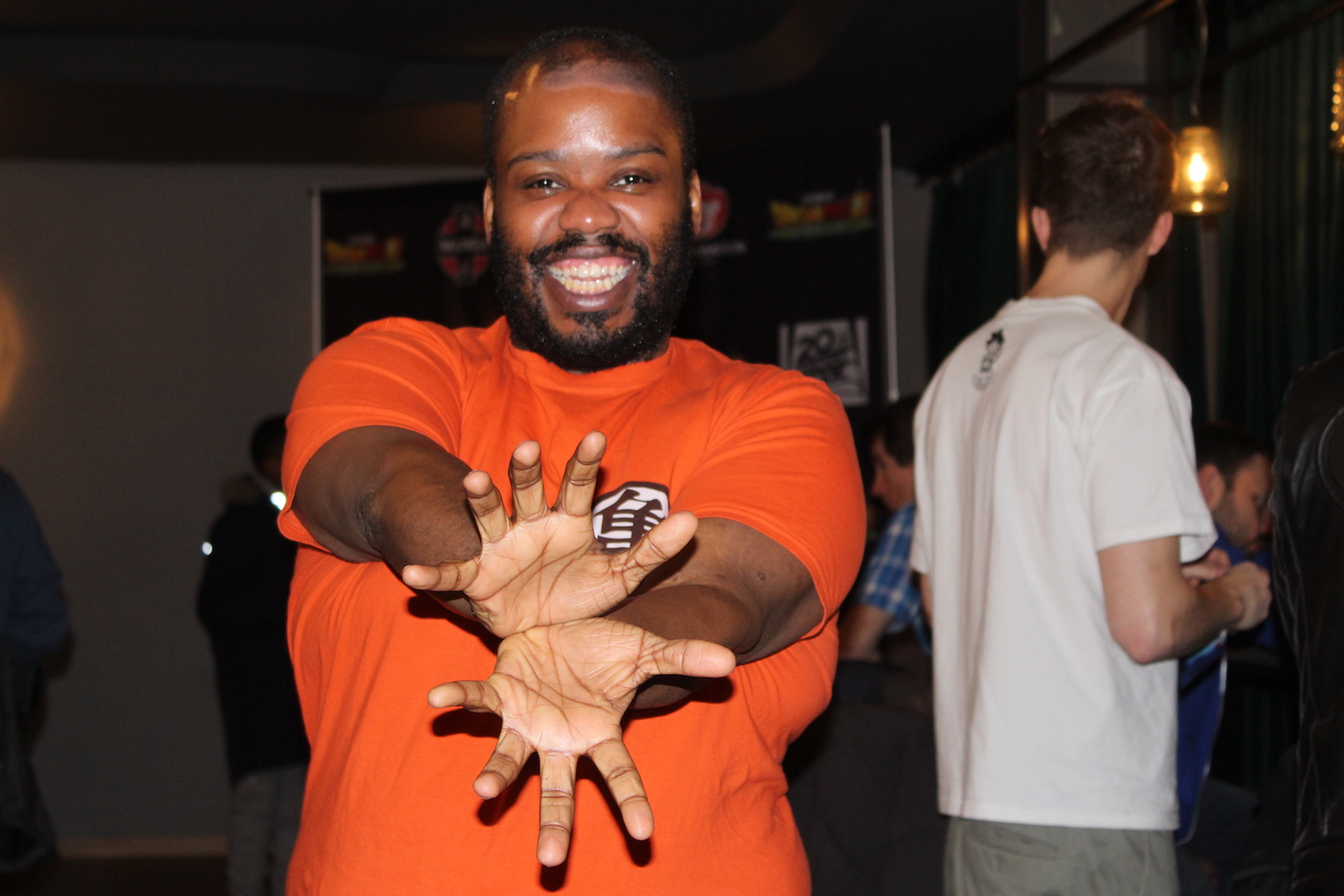
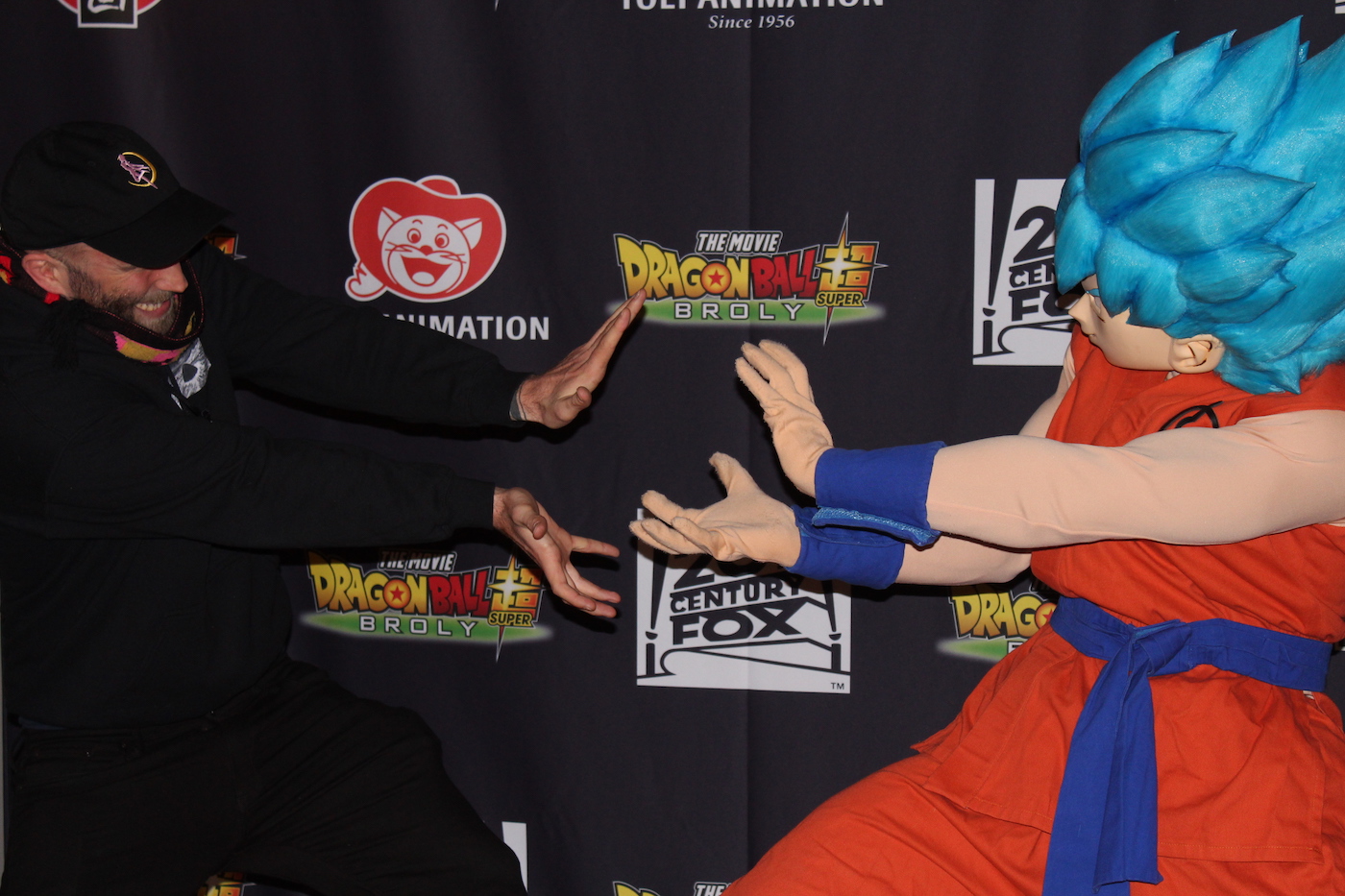
1548870490559-tom2
The author (left) kamehameha-ing

This is a sentiment repeated regularly over the course of the night: "I got into anime after watching Dragon Ball Z on Cartoon Network, and it changed my life." But for the majority of fans, that initial exposure happened a decade ago. Why is the franchise's fandom still as enthusiastic as ever?

"I think illegal streaming, [anime streaming site] Crunchyroll and Netflix have taken anime mainstream, which in turn has turned local television broadcasters back onto the medium in a bid to attract tweens, teens, and millennials to their channels," says Jerome Mazandarani. "Dragon Ball is the Iron Maiden of anime because its fans are multi-generational. You'd have an old gray metal dude in a denim jacket covered in heavy metal badges attending the gig with another, younger middle-aged metal dude in the same attire, and beside them would be a tween metal dude in matching paraphernalia. Dragon Ball is the same to me: We see dads and sons at Comic Cons all the time; it's been passed on organically over time through family and friends."

Sign up for our newsletter to get the best of VICE delivered to your inbox daily.

Follow Tom Usher on Twitter.


from VICE http://bit.ly/2TqWEXm
via cheap web hosting

How to Have a One Night Stand Without Being an Asshole

Casual sex isn’t everyone’s cup of tea, but if you’re going to get it on with someone you’re not in a committed relationship with, it’s best to prepare yourself for what’s about to go down. Securing enthusiastic consent, making sure neither of you are blotto, using protection, and keeping your friends aware of your whereabouts are just some of the ways you can ensure a fun, safe (and hopefully hot) sexual encounter.

We talked to sexologists, therapists, and sex experts about what to keep in mind when having a one-night stand. Here’s what they recommend to get your rocks off without waking up with a ton of regret. Answers have been edited for length and clarity.

Tell a Friend, and Put Down the Booze

If you are having a one night stand and you know nothing about the person you are about to go home with please, for all the love of sex, send your location to a friend. And if you’re real smart, take a playful selfie of the person you’re with and send it to a friend with the location. It might be your saving grace if she or he becomes a crazy person.

If you are planning to drink, don’t drink too much or too fast looking to let down your guard. If you need a ton of alcohol to hook up with someone you might not really want to sleep with them in the first place. If you are out with friends or alone on the prowl and you find you’re in a hot and heavy exchange with someone that it might go down with, slow down. Drunk sex is not sexy or safe sex. If you are stumbling or slurring your words you don’t need sex. No one wants to wake up in the morning like, “WTF, did I do last night?” - Michelle Hope, sexologist

Be Vocal About Your Needs

A one-night stand means you're agreeing to be intimate for one night, not that you're agreeing to be in a relationship, date each other, or even get each other's phone numbers!

Ask for what you want. Give feedback, make specific requests. People in relationships tend to have a harder time asking for what they want in the bedroom because they're worried about the impact their requests might have on their partner or on the relationship. If you know this is just a casual thing, allow yourself to be vulnerable and ask for what you really want! - Vanessa Marin, sex therapist and online sex therapy course creator

Consent Is Essential, Don’t Forget Protection!

Consent is key. Consent isn't the absence of "no," it's an enthusiastic "yes!" So make sure you're communicating and ensuring consent all throughout the night. Check in with what turns the other person on. Don't just assume that they're enjoying it. And, no, you can't always tell if someone is faking it.

Always carry and use protection. Safe sex is good sex. You're looking to make this a one night stand so don't make it a lifelong thing by getting (someone) pregnant or contractingan STI. - Theresa Herring, a licensed marriage and family therapist

Experiment, and Make Sure Your Motives Are Pure

If you're with a person that you feel comfortable with, you're going to find it a lot easier to orgasm and enjoy yourself. One night stands are also a great place to try out new things and build your "repertoire" without worrying much about how it will affect your relationship; it's only one night long, after all.

Do it for the right reasons. One night stands can be so much fun when you're single or in an open relationship and you find the right person. But if you're doing it as an act of revenge or to get a little extra on the side, then you are doing it for the wrong reasons. - Sean Jameson, Founder of the Bad Girls Bible sex advice site and podcast

Sign up for our newsletter to get the best of VICE delivered to your inbox daily.

Follow Anna Goldfarb on Twitter.


from VICE http://bit.ly/2So2lbv
via cheap web hosting

I Pretended to Be a Young Joseph Stalin on Tinder, and It Went Weirdly Well

This article originally appeared on VICE Germany.

As Tinder dates go, things are looking pretty good for Sofia and I. We're drinking beers, we share a love for books, and we both get annoyed by the way Americans take up too much space on dance floors. When she offers me a cigarette, I decide to forgo my plan to quit smoking for the week.

Despite this connection, I have absolutely zero chance with her because our date is the result of an experiment. As far as she knows, my name is Joseph Stalin.

Five Days Earlier

It's amazing what kind of behavior hot people can get away with on dating apps. But does that rule also apply to one of the better-known dictators of the 20th century? I wonder this while examining a matchbox a friend brought back for me from Georgia, birthplace of the former Soviet ruler Joseph Stalin, a man who reputedly said, "A single death is a tragedy; a million deaths is a statistic."

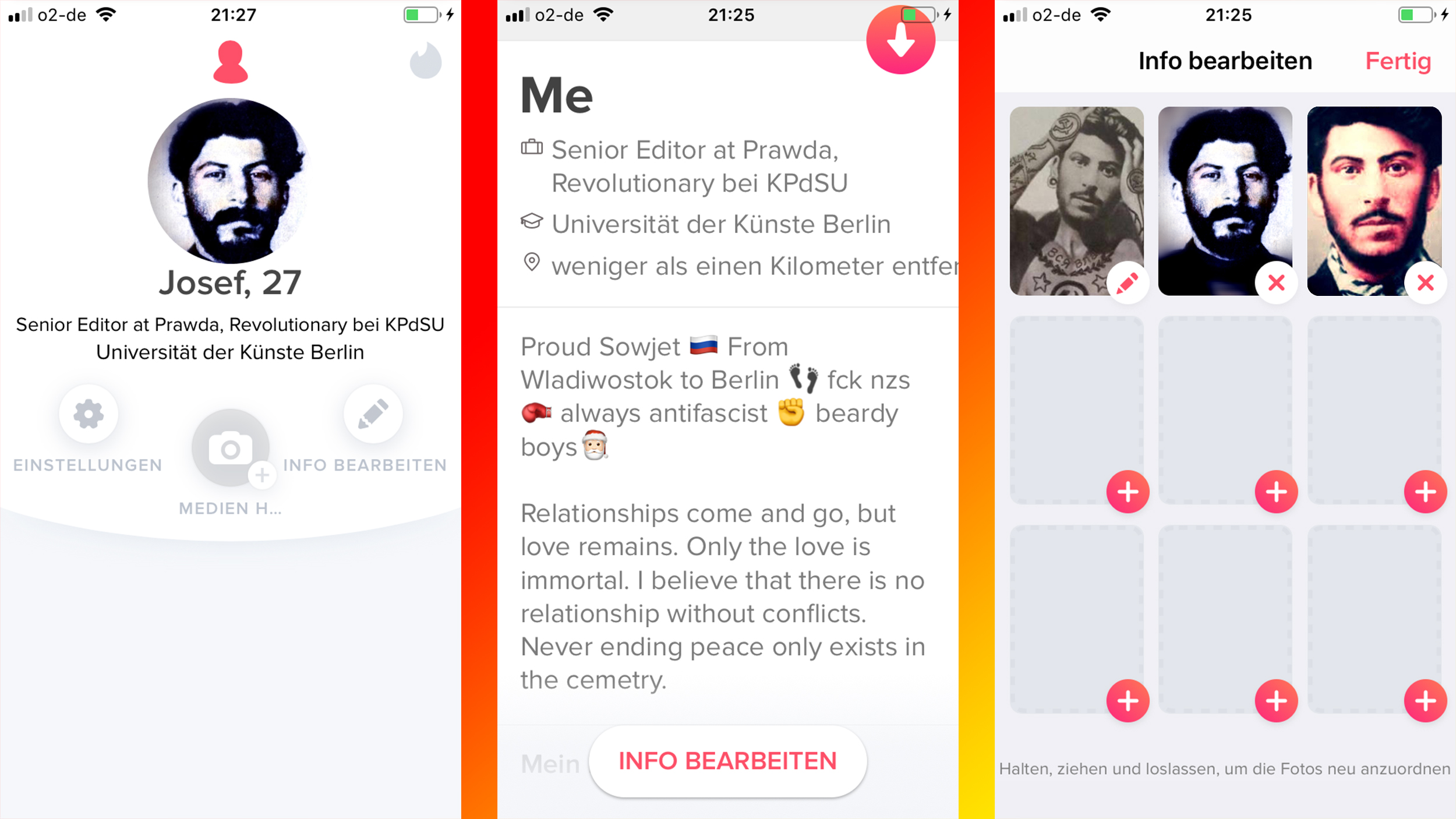
On one side of the packet, Stalin is pictured as he is in history books: round face, Tom of Finland mustache, and slicked-back hair. The other side shows a young, clean-shaven man with jet black hair. He could be the synth player from a mid-2000s landfill indie band, but he's not: He's the totalitarian communist as a young, bafflingly handsome, revolutionary.

To find out just how far your looks can take you on Tinder, I register as Josef, 27, on Tinder.

Unfortunately, I'm unable to find a romantic quote from Stalin to spice up my profile; he was way more into chatting about death than affairs of the heart. Instead, I manipulate an excerpt from one of his speeches, changing "Hitlers come and go, but Germany and the German people remain" to "Relationships come and go, but love remains."

Stalin's profile comes together fairly quickly, but finding a date is a little harder. After 15 minutes, I run out of people to swipe right on, and don't get a single match. Does this mean more people than I realized are familiar with the work of Stalin's twilight years? Are the "FCK NZS" and "always anti-fascist" notes I've added to my bio not enough to compensate?

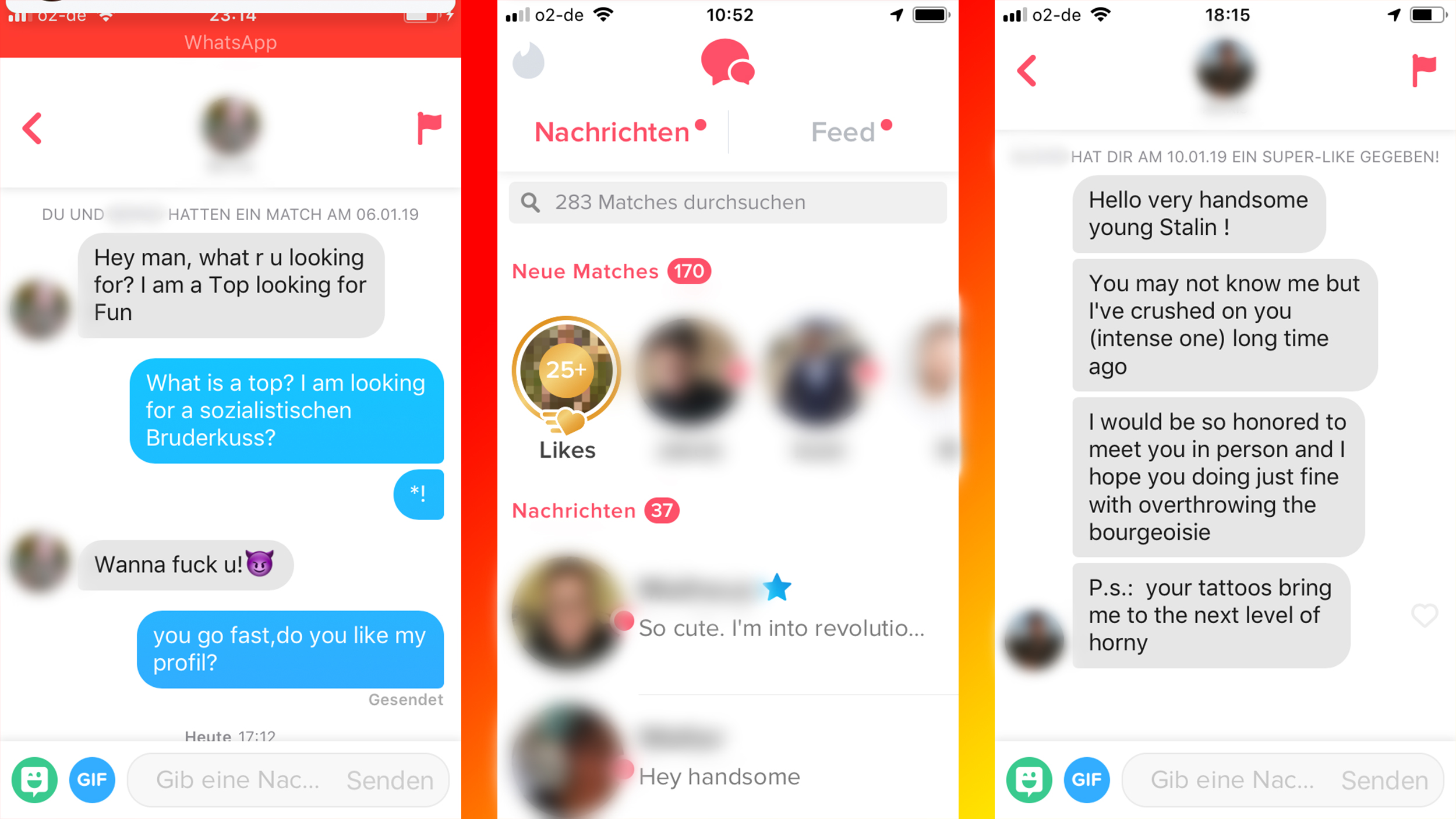
I switch the order of my photos and expand my catchment area, but still have no luck. Next, I grab my card and pay for Tinder Plus. Then I open my profile up to men. With the ability to leave endless "super-likes," and Stalin's newly discovered bisexuality, things are suddenly moving forward. Within the first hour, my phone freezes 15 times. The tiny profile photos begin to dance across the screen and the app proclaims: "It's a match, you and Simon like each other."

I look for the right Karl Marx quote to break the ice. "Hey there, comrade, you've got nothing to lose but your chains!" He responds: "Which chains are you talking about ;)"

I, of course, mean the chains that capitalist forces have used to shackle the working classes, but realize that isn't a great pick-up line, so go for "you can decide where I'll wear them ;)" instead.

Das Stalin-Profil unseres Autoren auf Tinder
My Stalin profile

I now have flood of messages in my inbox. My matches can be sorted into three main groups. First: the clueless—those showering me with compliments. Second: Those who have become increasingly skeptical as we chat; "I didn't realize I was talking to a dictator. I should read people's bios more carefully," says one. Third: a combination of Stalinists and history experts. With these people I can speak freely about Lenin's Testament, using a silence emoji, and chat about the murder of party rival Trotsky, utilizing the ice pick emoji.

Very few seem disturbed by the fact that I've assumed the identity of a tyrant—at least, no one tells me they have a problem with it. Alex says, "I wouldn't mind sharing a Gulag with you ;)." Cute.

Stalins Tinder-Chats mit mehren Usern
Stalin is doing very well on Tinder.

In the mix is Sofia, who I bestowed one of my precious super likes. The 30-year-old wants to "exchange thoughts before bodily fluids," according to her profile. She starts the conversation in Russian, asking, "You're alive?" and follows up by asking if I've returned to bring communism back. I use Google translator and the Russian I learned in school for my response: "Wherever I am, therein lies communism."

The responses keep pouring in—by Monday, I've reached 100 matches and, on Wednesday evening, I hit the 200 mark. Meanwhile, I'm writing back in Russian, English, and German, to lawyers, students, and tattoo artists. I'm completely neglecting my conversation with Sofia by this point; she sends me a message saying that I'm not very talkative.

I'm looking for something to say about how the Soviet Union cannot industrialize on its own. I explain my lack of communication by stating that the highly paranoid Stalin can trust no one and must do everything for himself. Sofia ensures me that she's not a spy and that I can trust her. She's set me up, so I've decided to swing for it: "To judge that accurately, I would have to look you in the eye."

I suggest that we meet in the former Soviet sector of east Berlin. Sofia agrees. I tell her I'll be wearing a vintage East German football jacket, as it's the most suitable thing I can find in my wardrobe.

Before our date, I'm really not sure if she's going to show up. "Are you there yet?" she messages me at 8 PM. I'm sure she's only messaged because she's wondering if I'm standing alone in the rain like an idiot. Maybe she's just looking for revenge—messing around with the person behind a fake account, fronting as a tyrant responsible for the deaths of countless people. This is, after all, a fairly macabre joke.

But then I see her making her way toward me. "Sofia," she introduces herself bluntly. "I'm Joseph," I reply with a businesslike handshake.

"Oh, Joseph is actually your real name?" she asks, taking the last drag from a hand-rolled cigarette and then stomping it out. She is taller than me, with shoulder-length brown hair. Unlike Sofia, I don't look at all like my Tinder profile. And I'm under no illusion that I look anything like the young Stalin. Hidden behind the app, I had the confidence of a dictator, but IRL I'm fairly shy.

Sofia seems glad that I'm not a pushy, retired Stasi officer, and I'm relieved that she's not a member of The Association of Victims of Stalinism, using this date as an excuse to attack me. But the evening is far from over.

There isn't a free table in Prassnik, the dimly lit bar in Berlin-Mitte where we agreed to meet, so we're forced out into the rain. Before we find somewhere to grab a drink, I ask her: "Why did you agree to go on a date with someone who is pretending to be Joseph Stalin?"

It can't be for lack of options. Sofia is good looking, smart and funny. "I thought it would be funny," she says. It's more interesting than guys who flaunt their six-packs, she says.

Once we've finally found a dry place to sit, Sofia tells me that she's a German teacher, and about what it was like growing up near the German-Polish border. She describes how she left home for Moscow on her own directly after college, without being able to speak a word of Russian, which led to her later deciding to study Slavic studies.

Distracted by the pleasant conversation, I start to forget my role. I slip up and accidentally reveal my real name. "Who's Paul?" Sofia asks.

When she goes to the bathroom I check my phone to find over a dozen new notifications. I try, but fail, to resist the urge to go through my matches. Every 30 seconds another man seems to fall in love with Stalin. Emre thinks that he looks "magical." Egon, balding with a gray wizard beard, asks if I want to switch to WhatsApp. He tells me he wants to be the one to set the vibe when we have sex. He's not into my suggestion to start things off with a brotherly socialist kiss.

In the meantime, Sofia has returned from the bathroom. I quickly put my phone away and decide to explain my base motives to her. I confess that I'm a writer, and I plan to do an article about the Young Stalin experiment. Sofia lets it sink in. She's less than enthused and asks, only half joking, "Are you secretly recording our conversations?" For some reason, she stays, and we imagine where our date could take us if this was all for real. We imagine her bedroom filled with Stalin posters and memorabilia hanging over her bed.

Sofia's students are taking an exam tomorrow so she switches to soft drinks. We watch people on the dance floor for a while before we decide to leave. We say goodbye with a hug and plan to go to the theater together soon.

The next morning, I thank her for our "very nice date" and ask how the exam went. The same day, the Tinder app lets me know that I've been reported for posting offensive material on my profile. A Russian number begins incessantly calling me, but when I answer there's only white noise at the other end of the line. I think it's time for me to delete my account, but not before one final message: I send Sofia my real phone number. I haven't heard from her since.

Sign up for our newsletter to get the best of VICE delivered to your inbox daily.


from VICE http://bit.ly/2ScEg7l
via cheap web hosting

Wednesday, January 30, 2019

Guatemala's 'Slow-Motion Coup' Is Causing Migrants to Flee to the US

Defense Department officials announced Tuesday that they’re preparing to send additional troops to the US’s southern border to support Department of Homeland Security efforts to fight what Donald Trump has been calling a national security crisis. But there’s not a whole lot of evidence of the sort of crisis Trump talks about: The number of unauthorized immigrants in the US is at its lowest point in ten years, according to Pew Research, and the number of Mexicans crossing the border without authorization has been declining steadily as well. But it is true that according to recently released statistics from Customs and Border Patrol (CBP), the number of families seeking asylum in the US is increasing, many of them from Central America’s “Northern Triangle”: Guatemala, El Salvador, and Honduras. Nearly 20 percent of migrants who were apprehended at the southwestern border last year claim their reasons for emigration are fear-driven.

There is a crisis related to these migrations, but it’s happening hundreds of miles south of the US-Mexico border, inside the countries these people are fleeing. The appropriate response, experts told VICE, is not military deployments but an effort to stabilize countries in the Northern Triangle. And though the world’s attention is currently on the unrest gripping Venezuela, Guatemala is struggling with unrest of its own, fueled by political chaos and widespread poverty that disproportionately affects the indigenous population.

“No solution to the migration issue is possible while the Central American states remain captured by organized criminal networks,” said Elizabeth Oglesby, an associate professor of Latin American studies at the University of Arizona. “Corruption siphons off resources that could be used for basic services: to fix the roads, health care centers, to improve schools. That affects everybody.”

In 2018, over 22,000 unaccompanied Guatemalan children and 50,000 Guatemalan family members were apprehended at the US border, according to CBP data, more than from any other Central American country. Many Guatemalan migrants are indigenous, including the two children who died last year in US Border Patrol custody.

The country is in the midst of what many observers are referring to as a “slow-motion coup.” This means not soldiers in the street, but rather a president, backed by powerful allies, taking over government institutions like the courts and challenging human rights protections.

“The current situation in Guatemala is already pushing and forcing people to flee,” said Giovanni Batz, a researcher and fellow at the School for Advanced Research in New Mexico and the son of working-class Guatemalan immigrants. “Crime is constantly on the minds of many. In Guatemala City, when you leave your house, you never know if you will be robbed, assaulted, or worse. The police are corrupt, known to take bribes, and have been implicated in working with narco-traffickers and gangs.” It’s led to a general distrust of law enforcement and the justice system.

The country’s president, former comedian Jimmy Morales, is trying to dismantle a UN-backed anti-corruption commission known by its Spanish acronym CICIG, which was investigating Morales himself for illicit campaign financing. (A Guatemalan court blocked Morales’s order to expel members of the commission from the country, but foreign members of the commission have fled, fearing for their safety.) In addition, the Guatemalan congress is drafting an amnesty law that, if passed, would allow dozens of people convicted of grave human rights violations to walk free. And allies of the president have voted to impeach judges on the country’s highest court who have ruled against Morales’s policies.


Guatemala has a long history of violence. More than 200,000 of its people were killed during the country’s brutal 36-year civil war, which lasted from 1960 to 1996. “People were terrified, because if you spoke out you could be killed or disappear,” said Jo-Marie Burt, an associate professor of political science and Latin American studies at George Mason University. Now that fear is returning, she said: “You can see this slow-motion chipping away at the key institutions that have helped sustain the anti-corruption fight, and the belief of Guatemalan civil society that they can’t speak their minds without being killed.”

In 2015, US Vice President Joe Biden went to Guatemala to meet with then President Otto Perez, who was at the time also being investigated for corruption. Biden threatened to withdraw aid to Guatemala if Perez didn’t comply with the investigation. Perez later resigned, was arrested, and went to prison for his role in a customs fraud case. It validated a growing pro-democracy movement, which has now been upended by the current political leadership. This time, the US doesn’t appear to be interested in getting involved, even as it has thrown its support behind the opposition in Venezuela.

“There remains a double standard in the US regarding Latin American countries,” said Batz. “While attention in the US has been placed on the political turmoil in Venezuela, where the US is supporting a coup, countries such as Guatemala and Honduras, two of the largest migrant-sending countries where their presidents are repressing their citizens, are getting ignored.”

“The silence of the Trump administration in the face of what’s going on in Guatemala is shocking,” Oglesby told me. “It is a catastrophic moral and strategic error.” She is quick to point out that this is fundamentally a Guatemalan problem that Guatemalans must resolve, but noted that at various points over the last several decades, the US has inserted itself into Guatemalan affairs and exacerbated already existing conflicts.

“We could look back on this as a watershed in which future policy makers are going to sorely regret the US silence,” said Oglesby. “We’re at one of those juncture moments where the US has a decision to make.”

Last year, Florida Republican Senator Marco Rubio announced he was placing a hold on $6 million of US funding to CICIG, a significant blow to the anti-corruption commission’s efforts. The move came after a Russian family was jailed in Guatemala for using false documents to obtain Guatemalan citizenship. “I am concerned that CICIG, a commission mostly funded by the United States, has been manipulated and used by radical elements and Russia’s campaign against the Bitkov family in Guatemala,” Rubio said in a statement.

“The US policy has been kind of co-opted by a tiny group of people with Marco Rubio at the head, saying that CICIG has been infiltrated by Russia—it’s utterly absurd,” said Burt. “Yet that seems to be what’s guiding our policy. It’s not evidence-based at all. It’s ideological. We have turned a blind eye to everything that’s happening and it is incredibly discouraging for people in Guatemala who have acted in good faith, trying to do the right thing.”

Earlier this month, Arkansas Republican Representative Rick Crawford tweeted his support for “the people of Guatemala and their president” to expel the anti-corruption commission, though recent polling indicates that 71 percent of Guatemalans support the commission.

There's a partisan divide in the US on the issue: Two weeks ago, 47 Democratic members of Congress signed a letter urging President Trump to take action in Guatemala, citing the recent US response in Venezuela and Nicaragua. “We are deeply concerned that, absent a strong U.S. response, the current government’s pattern of anti-democratic behavior will continue to escalate, and that Guatemala will descend into lawlessness,” they wrote.

This follows legislation recently introduced by California Democratic Congresswoman Norma Torres designed to impose sanctions and deny visas to people who have undermined the Guatemalan justice system. “Allowing the rule of law to disintegrate is a recipe for instability and a growing humanitarian crisis at our borders,” Torres said in a statement.

Other countries are watching, Oglesby said. “This is no longer something contained to Guatemala. The effects of the unraveling of the rule of law could spill over into the rest of the region,” she said. “It will impact other Central American countries and their anti-corruption efforts, and it will have an impact on people’s daily lives and their decision to migrate.”


from VICE http://bit.ly/2Utca51
via cheap web hosting

The Dangers of Marketing Addictive Drugs

The pharmaceutical company Purdue Pharma began selling OxyContin in 1996. By 2001, it was already clear that addiction and overdoses related to the painkiller were on the rise. Despite the data, however, the company—and its CEO, Richard Sackler—continued to aggressively push the drug. Now, a barrage of lawsuits have been filed against the company for its role in the opioid crisis.

As reporter and author Maia Szalavitz explained in a recent piece for TONIC, newly released documents shine a light on Purdue's history of recklessly marketing OxyContin—and the effects of that marketing are real and dangerous. On this episode of The VICE Guide To Right Now Podcast, we sat down with Szalavitz to learn more.

You can catch The VICE Guide to Right Now Podcast on Acast, Google Play, Apple Podcasts, Stitcher, or wherever you get your podcasts. And sign up for our newsletter to get the best of VICE delivered to your inbox daily.


from VICE http://bit.ly/2MFELl6
via cheap web hosting